Meeting details
Topic: Water Worker Confined Space Hazards
Goal: This toolbox talk on water worker confined space will review the tragic fatality of Buddy Powell, a 23-year-old City of Longview, Texas Water Distribution and Wastewater Collection crew member who died on March 16, 2026, and prevent similar accidents in 2026.
The incident: what happened?
On Monday, March 16, 2026, Buddy Powell, a dedicated 23-year-old employee with the City of Longview’s Texas Water Distribution and Wastewater Collection crew, suffered a fatal workplace accident classified as an industrial incident. This water worker confined space tragedy underscores the inherent dangers faced by field crews in water and wastewater operations, where entry into manholes, vaults, pipes, or other enclosed areas can lead to sudden and irreversible consequences. The incident occurred in Longview, Texas, prompting an immediate investigation by local officials, though specific details on the exact location, circumstances, or root cause have not yet been released publicly as of the article’s publication on March 27, 2026.
In response, the City of Longview activated counseling services for affected staff and implemented additional safety measures to support the team. City Manager Rolin McPhee issued a heartfelt statement emphasizing Powell’s immense value as both an exemplary employee and a cherished community member, highlighting the profound loss felt across the organization. While the precise sequence of events remains under review, such incidents in water worker confined space environments often involve atmospheric hazards, engulfment risks, or entrapment, reminding us of the critical need for unwavering adherence to established safety protocols in these high-risk operations.
Core safety lesson
The technical failure in water worker confined space incidents typically stems from inadequate pre-entry atmospheric testing, lack of retrieval systems, or bypassing permit-required procedures, allowing invisible killers like toxic gases, oxygen deficiency, or flammable vapors to claim lives without warning. In wastewater collection and distribution work, confined spaces such as manholes and vaults are ubiquitous, and even brief exposures can turn fatal.
The Hazard: Confined space hazards, including atmospheric issues (e.g., low oxygen, hydrogen sulfide buildup), engulfment by water or sludge, and physical entrapment.
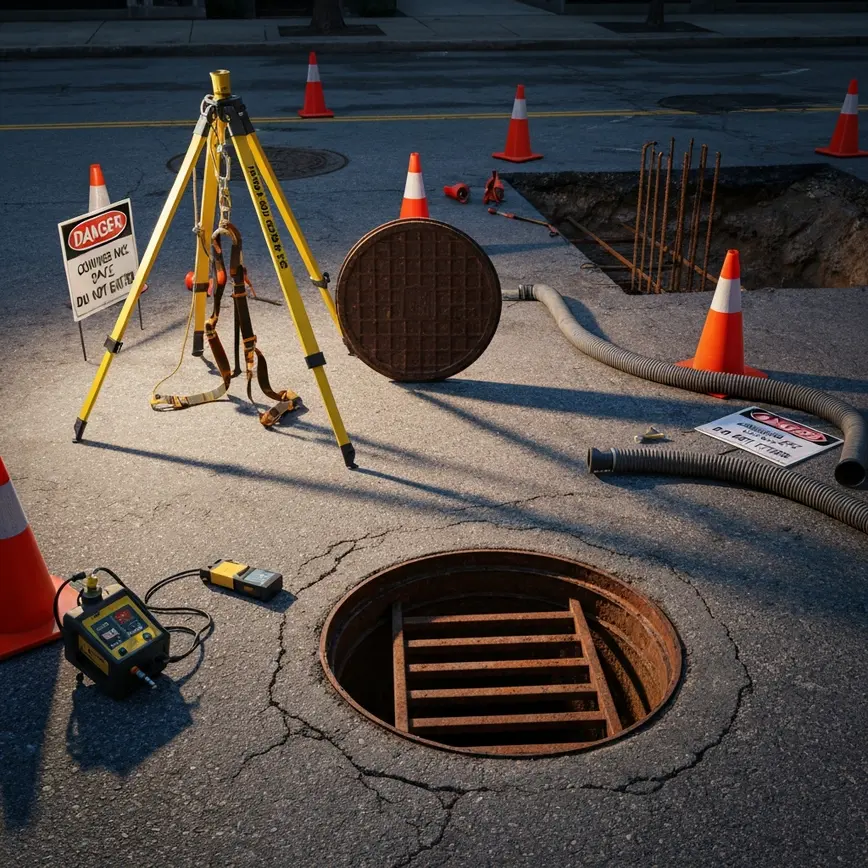
The Control: Implement OSHA 1910.146 permit-required confined space entry procedures: conduct atmospheric testing with calibrated multi-gas monitors prior to entry, deploy retrieval systems like tripods with full-body harnesses and lifelines, ventilate spaces effectively, and designate attendants with non-entry rescue capabilities.
This control is non-negotiable because confined spaces in water worker confined space scenarios offer no easy escape—once compromised, seconds matter, and atmospheric hazards are undetectable by human senses alone. Gas monitors provide real-time data on oxygen levels (19.5-23.5%), flammable vapors (<10% LEL), and toxics (e.g., H2S <10 ppm), preventing blind entries that have caused countless fatalities. Retrieval systems ensure rapid, external extraction without endangering rescuers, as statistics show secondary fatalities often exceed the initial victim. Skipping these steps isn’t a shortcut; it’s a guarantee of preventable tragedy, as evidenced by ongoing investigations into cases like Buddy Powell’s.
Supervisor’s discussion guide
Use these questions to engage the crew in a 10-minute dialogue, fostering ownership of safety in water worker confined space tasks:
- Q1: “Looking at our own equipment today, where is the biggest risk of water worker confined space hazards like atmospheric issues or engulfment?”
- Q2: “What steps have we skipped in past confined space entries, and why do you think permit systems are mandatory?”
- Q3: “How would you respond if a gas monitor alarms during testing—walk us through the shutdown procedure.”
- Q4: “In our wastewater collection routes, which manholes or vaults pose the highest confined space risks, and what retrieval gear do we need on hand?”
Action plan & inspection
Immediately after this toolbox talk, conduct these 5 mandatory checks and implement actions today:
- Inspect all multi-gas monitors for calibration (due date within 30 days) and functionality—test with zero and span gases on-site.
- Inventory retrieval systems: Verify tripods, harnesses, and lifelines are OSHA-compliant, free of damage, and readily accessible at every water worker confined space job site.
- Review and update confined space entry permits for upcoming tasks, ensuring atmospheric testing logs are complete and signed by attendant and entrant.
- Perform a walkthrough of high-risk areas (manholes, vaults) to confirm warning signage, barricades, and ventilation blowers are in place.
- Conduct a crew drill on non-entry rescue using tripod systems—document participation and corrections needed.
Key takeaways
Buddy Powell’s death on March 16, 2026, serves as a stark reminder that water worker confined space operations demand zero tolerance for shortcuts. Atmospheric testing, retrieval systems, and permit procedures per OSHA 1910.146 are not optional—they are the only barriers between routine maintenance and catastrophe. Every crew member must treat confined spaces as non-negotiable permit-required entries, with calibrated gas monitors dictating go/no-go decisions.
Commit today to proactive inspections, thorough JHAs, and a culture where speaking up saves lives. By honoring controls like LOTO for mechanical risks and trenching protections alongside confined space protocols, we eliminate the vulnerabilities that claimed Powell. Safety isn’t reactive; it’s our daily standard to bring everyone home.
Source & Disclaimer: This toolbox talk is for educational purposes based on public report. Read Original Report