Meeting details
Date: March 27, 2026
Topic: Preventing Heavy Equipment Boom Collapse
Goal: This toolbox talk on heavy equipment boom collapse will review the Bingham Canyon Mine worker fatality and prevent similar accidents in 2026.
The incident: what happened?
On March 12, 2026, at approximately 5:20 a.m., a tragic heavy equipment boom collapse occurred inside a maintenance shop at Rio Tinto Kennecott’s Bingham Canyon Mine in Kennecott, Utah. A 37-year-old worker named Brian Cameli was fatally struck when a large boom attached to heavy equipment gave way and fell on him. Colleagues provided immediate aid until first responders from the Utah County Sheriff’s Office, Herriman Police Department, Unified Fire Authority, and Utah Office of the Medical Examiner arrived, but Cameli died at the scene.
The incident led to a suspension of both surface and underground operations at the historic copper mine, which has been operational since 1903 and employs over 2,000 people. Rio Tinto is cooperating fully with authorities in the ongoing investigation, while providing counseling support to affected employees. Rio Tinto CEO Simon Trott expressed devastation and reaffirmed the company’s commitment to safety, and Utah County Sheriff Rosie Rivera described the event as tragic.
Core safety lesson
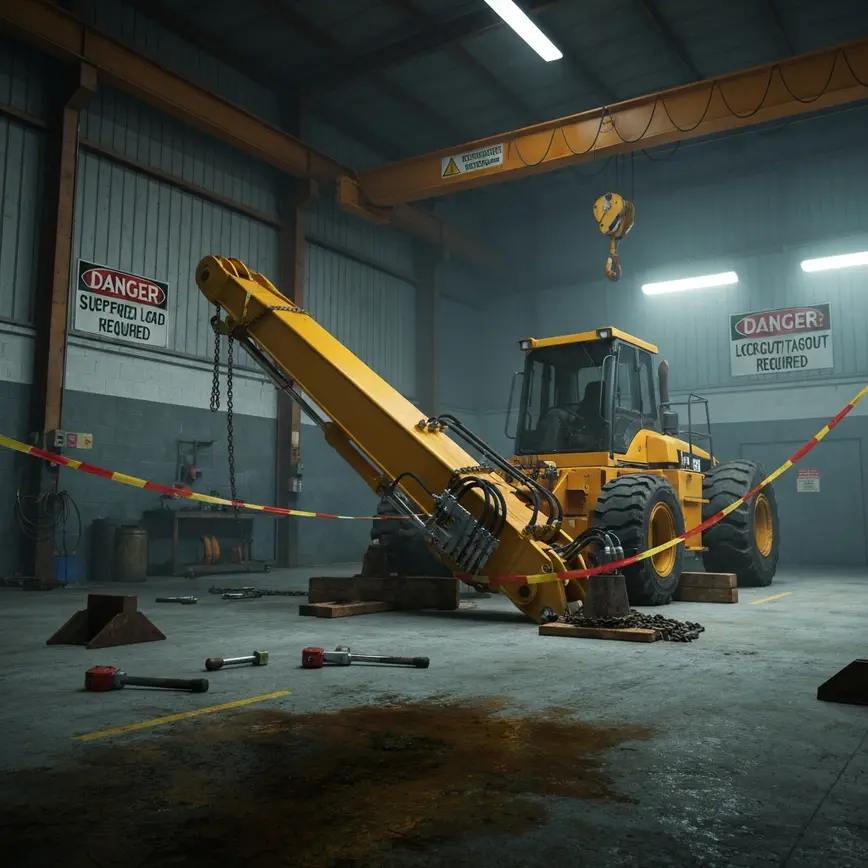
The technical failure in this incident stemmed from an unsecured or failed heavy equipment component, specifically the boom that collapsed during maintenance work. This heavy equipment boom collapse highlights the catastrophic risks when energy sources are not isolated and components are not physically secured.
The Hazard: Unsecured heavy equipment components, such as booms, that can give way unexpectedly, especially when workers are positioned under or near suspended loads in maintenance shops.
The Control: Implement lockout/tagout (LOTO) procedures to isolate all energy sources, physically secure components with cribbing, chains, or stands, conduct pre-task job safety analyses (JSAs), and enforce prohibitions on working beneath unsupported loads. Use engineered supports like overhead cranes with redundant safety catches, mandatory pre-maintenance inspections, hazard recognition training, PPE including hard hats and high-visibility gear, clear signage, and barricades.
These controls are non-negotiable because heavy equipment boom collapse can occur instantaneously without warning, resulting in immediate fatalities as seen in this case. LOTO ensures no unintended movement from hydraulic, pneumatic, or mechanical energy, while physical securing prevents gravitational failures. Skipping JSAs or inspections bypasses critical hazard identification, turning routine maintenance into deadly traps—compliance saves lives and operations.
Supervisor’s discussion guide
Engage your crew with these questions to drive home the lessons:
Q1: “Looking at our own equipment today, where is the biggest risk of heavy equipment boom collapse?”
Q2: “What steps in our LOTO process could prevent someone from working under a suspended load?”
Q3: “How do we ensure pre-maintenance inspections catch potential failures like this boom collapse?”
Q4: “What would you do if you saw a coworker bypassing barricades near heavy equipment?”
Action plan & inspection
Immediately after this meeting, verify and document the following 5 items:
- Inspect all heavy equipment booms for secure pinning, cribbing, or stands before any maintenance.
- Confirm LOTO devices are applied and verified on energy sources for equipment in shops.
- Review and update JSAs for all maintenance tasks involving suspended loads.
- Check maintenance shops for signage, barricades, and PPE availability.
- Audit training records to ensure all crew are current on hazard recognition for heavy equipment.
Key takeaways
Never work under or near unsupported heavy loads— a heavy equipment boom collapse, like the one at Bingham Canyon Mine, demonstrates the lethal consequences of unsecured components during maintenance. Prioritize LOTO, physical securing with cribbing or stands, and rigorous JSAs to isolate hazards before they become tragedies. These protocols, combined with pre-inspections, training, PPE, signage, and barricades, form an unbreakable defense against such failures.
Supervisors must lead by enforcing zero tolerance for shortcuts, fostering a culture where every crew member stops unsafe work. By committing to these controls today, we honor Brian Cameli’s memory and protect our teams from preventable heavy equipment boom collapse incidents in 2026 and beyond.
Source & Disclaimer: This toolbox talk is for educational purposes based on public report. Read Original Report