Meeting details
Topic: Machine Guarding Failures in Industrial Machinery
Goal: This toolbox talk on machine guarding failures will review the August 2024 incidents at Commercial Lines Limited (trading as HLN Supplies) in Leeds, UK, where two workers lost fingers, and prevent similar accidents in 2026.
The incident: what happened?
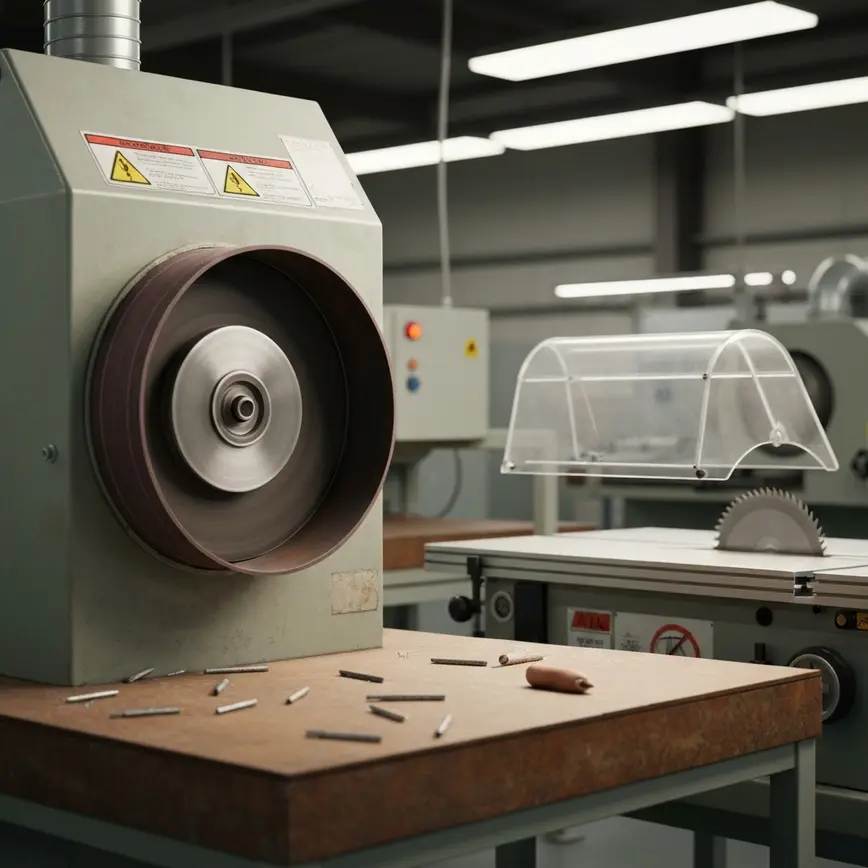
In August 2024, at Commercial Lines Limited (trading as HLN Supplies) in Leeds, UK, machine guarding failures led to two devastating machinery incidents just 10 days apart. On 12 August, 61-year-old worker Angela Morrison, who had been employed for 28 years, suffered the loss of her middle finger and severe damage to another finger on her right hand. This occurred when she reached to clear a blockage on a sanding machine, and her hand made contact with a large metal rotating disk through an unguarded ventilation port.
Ten days later, on 22 August, a 57-year-old worker lost part of his index finger and the top of his middle finger on his left hand while operating a table saw to cut small plastic strips; his hand contacted the exposed blade. The Health and Safety Executive (HSE) investigation pinpointed inadequate machine guarding, insufficient table saw training, lack of safe work systems for cutting small materials, and no suitable risk assessment. On 26 March 2026—today’s date—the company pleaded guilty to breaching health and safety regulations at Leeds Magistrates Court, resulting in a £16,000 fine plus £6,534 in costs.
Core safety lesson
These incidents underscore critical machine guarding failures, where dangerous moving parts on industrial equipment were left exposed, allowing direct contact during routine operations like clearing blockages or cutting materials.
The Hazard: Unguarded dangerous moving parts, such as rotating disks in sanding machine ventilation ports and exposed table saw blades, which can cause severe amputations even to experienced workers.
The Control: Install fixed or interlocked guards compliant with PUWER (Provision and Use of Work Equipment Regulations), manufacturer-approved blade guards, push sticks, and extraction systems on table saws; ensure guards remain in place and develop task-specific safe systems like jigs for small cuts.
This control is non-negotiable because momentary lapses, like reaching into a machine, can lead to irreversible injuries—fingers lost forever in seconds. Proper guarding physically prevents access to hazards, regardless of training or experience, as evidenced by the 28-year veteran still suffering due to the unguarded port. Without it, no amount of procedure can fully mitigate the speed and force of rotating machinery. Regular risk assessments and competency checks must verify guards are effective and in use, turning potential tragedies into preventable near-misses.
Supervisor’s discussion guide
Engage your crew with these questions to drive home the lessons from these machine guarding failures:
Q1: “Looking at our own equipment today, where is the biggest risk of unguarded moving parts?”
Q2: “What would you do if you needed to clear a blockage on a sanding machine or similar equipment?”
Q3: “How can we ensure blade guards and push sticks are always used on table saws for small cuts?”
Q4: “Have you received training on safe systems for handling small materials, and what gaps do we need to address?”
Action plan & inspection
Immediately after this meeting, conduct these 5 checks on site:
- Inspect all sanding machines and similar equipment for unguarded ventilation ports or access points to rotating parts; install or repair fixed/interlocked guards if missing.
- Verify table saws have manufacturer-approved blade guards, push sticks, and extraction systems in place and functional.
- Review risk assessments for all machinery operations involving small materials or blockages; update if no suitable assessment exists.
- Check training records for table saw use and safe systems of work; schedule competency assessments for at-risk tasks.
- Confirm safe operating procedures (e.g., jigs/holders for small cuts) are posted, enforced, and followed; document compliance.
Key takeaways
Machine guarding failures are entirely preventable yet caused two workers at a plastics firm to lose fingers in under two weeks—highlighting that even long-term employees like the 28-year veteran are not immune. The core lesson is clear: unguarded moving parts demand robust physical barriers like PUWER-compliant guards, blade protections, and tools such as push sticks, backed by training, procedures, and assessments.
Act now to eliminate these risks on your site. Prioritize inspections, enforce controls without exception, and foster a culture where bypassing guards for “quick fixes” is unacceptable. By addressing machine guarding failures head-on, we protect hands, prevent fines like the £16,000 penalty, and ensure everyone goes home whole.
Source & Disclaimer: This toolbox talk is for educational purposes based on public report. Read Original Report