Meeting details
Date: March 13, 2026
Topic: Preventing Retaining Wall Collapse
Goal: This toolbox talk on retaining wall collapse will review the fatal incident at the North American Silica industrial sand mine in San Antonio, Texas, and equip supervisors and crews with strategies to prevent similar accidents in 2026.
The incident: what happened?
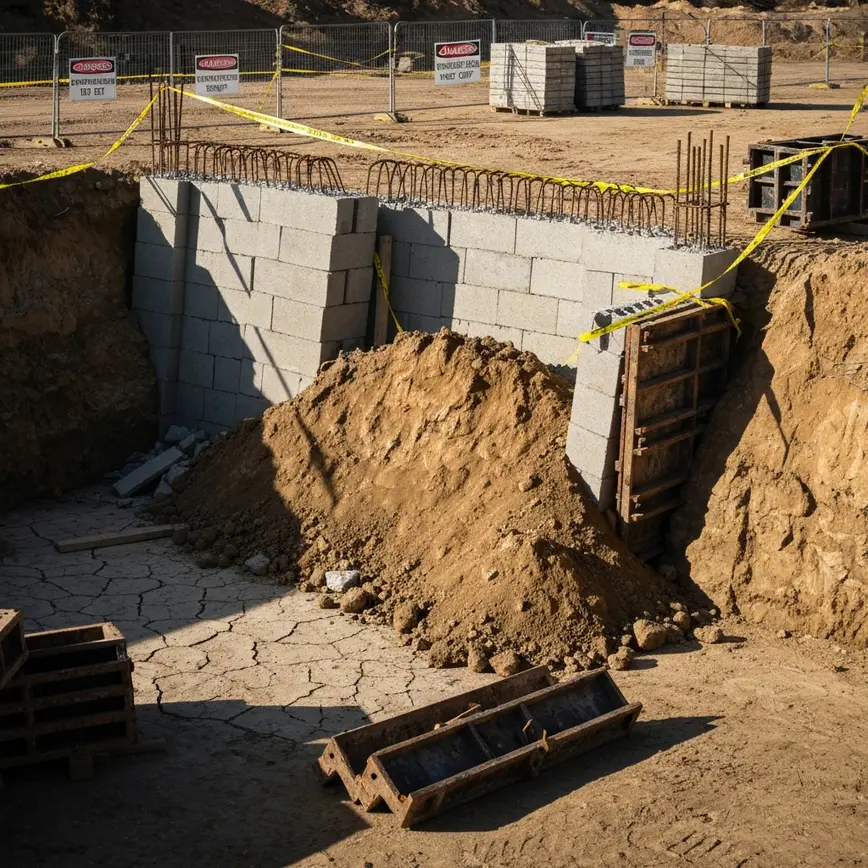
On March 3, a tragic retaining wall collapse occurred at the North American Silica industrial sand mine on the 21400 block of Applewhite Road in San Antonio, Texas’ South Side. A 63-year-old construction worker named Leandro Castro was fatally injured when the retaining wall he and his co-workers were actively building failed catastrophically around 1:44 p.m., as deputies were called to the scene. The collapse buried Castro under a large amount of displaced dirt, causing blunt force and crushing injuries that led to his death. Despite immediate rescue attempts by co-workers, emergency responders pronounced him dead at the site.
Castro had only been at the mine site for two days but brought extensive experience, having worked with contractor Renteria Construction for two years and 26 weeks, and accumulating over 40 years in the industry. The incident was reported to the Mine Safety and Health Administration (MSHA) and categorized under incidents by ISSSource. This retaining wall collapse underscores the dangers of structural failures during construction in mining environments, where soil instability and inadequate safeguards can turn routine tasks deadly.
Core safety lesson
The technical failure in this retaining wall collapse stemmed from likely inadequate design, materials, or construction practices, compounded by risks of cave-in, soil entrapment, and insufficient proximity safeguards. These elements created a perfect storm: an unstable wall during active building led to massive dirt displacement, fully trapping the worker despite his vast experience.
The Hazard: Retaining wall structural failure, cave-in or soil entrapment, and lack of proximity safeguards during construction.
The Control: Conduct engineering assessments and soil stability analysis before and during wall construction, adhering to MSHA standards (e.g., 30 CFR Part 56) for temporary excavations and retaining structures, with third-party review for non-standard designs. Implement sloping, shoring, or shielding systems (e.g., hydraulic shoring or trench boxes) for excavations deeper than 5 feet, with daily inspections by a competent person per OSHA 1926.652 and MSHA equivalents. Establish barricaded exclusion zones, real-time monitoring (e.g., strain gauges), and spotters to maintain safe distances.
These controls are non-negotiable because retaining wall collapses happen rapidly and without warning, as seen in this incident where even seasoned workers couldn’t escape. Engineering assessments prevent overload from poor soil or design flaws, while shoring systems distribute loads to avoid entrapment—critical since dirt weighs over 100 pounds per cubic foot and can crush in seconds. Exclusion zones eliminate the human factor in proximity risks, ensuring no one is in the collapse path. Skipping them gambles lives, as MSHA data shows excavations cause dozens of fatalities yearly; compliance isn’t optional—it’s survival.
Supervisor’s discussion guide
Use these questions to engage the crew and apply lessons from the retaining wall collapse:
- Q1: “Looking at our own equipment and excavations today, where is the biggest risk of cave-in or soil entrapment?”
- Q2: “What signs of instability have you seen in past retaining walls, and how did we address them?”
- Q3: “In a retaining wall collapse scenario like the one at North American Silica, what would your first action be to protect the team?”
- Q4: “How can we improve exclusion zones and monitoring around unstable structures on our site?”
Action plan & inspection
Immediately after this meeting, perform these 5 critical checks and document them:
- Inspect all current excavations and retaining walls for proper sloping, shoring, or shielding, ensuring compliance with OSHA 1926.652 and MSHA 30 CFR Part 56.
- Verify engineering assessments and soil stability analyses for any ongoing or planned retaining structures, including third-party reviews if non-standard.
- Establish and mark barricaded exclusion zones around unstable areas with signage and barriers, confirming minimum safe distances.
- Conduct a competent person inspection of all trenches deeper than 5 feet, checking for water accumulation, vibrations, or material surcharges.
- Test real-time monitoring tools like strain gauges on retaining walls and assign spotters for active construction zones.
Key takeaways
The retaining wall collapse at North American Silica serves as a stark reminder that even experienced workers like Leandro Castro, with over 40 years in the field, are vulnerable to structural failures during construction. Key lessons include mandating engineering oversight, robust shoring systems, and strict exclusion zones to combat cave-ins and proximity risks. These aren’t suggestions—they’re proven barriers against the 100+ pounds per cubic foot crushing force of soil.
Supervisors must lead by enforcing daily inspections, real-time monitoring, and zero-tolerance for working near unstable walls. By integrating these controls, we honor Castro’s memory and ensure 2026 sees zero repeats of this tragedy. Safety first: assess, protect, and verify every time.
Source & Disclaimer: This toolbox talk is for educational purposes based on public report. Read Original Report