Meeting details
Date: March 09, 2026
Topic: Preventing Loading Dock Pinch Points
Goal: This toolbox talk on loading dock pinch points will review the worker fatality at Rivian Automotive Warehouse and prevent similar accidents in 2026.
The incident: what happened?
On March 5, 2026, a tragic incident occurred at the Rivian automotive warehouse in Normal, Illinois, where loading dock pinch points proved deadly. A 61-year-old contractor named Kevin Lancaster was fatally injured when he became pinned between a tractor trailer and a loading dock, suffering blunt traumatic compressional injuries. Emergency response was called at 1:40 p.m., but the victim remained trapped for approximately 20 minutes before firefighters arrived for extrication. He was pronounced dead at 2:33 p.m. at a local medical center.
The incident took place near Rivian’s main factory, and investigations are now underway by the Normal Police Department, McLean County Coroner, and the Occupational Safety and Health Administration (OSHA). Rivian has issued a statement emphasizing their priority on safety and full cooperation with authorities. This event underscores the severe risks associated with vehicle-dock interactions in warehouse environments, where even brief lapses in safeguards can lead to catastrophic outcomes.
Core safety lesson
The technical failure in this incident stemmed from inadequate safeguards against the dynamic interaction between backing tractor trailers and fixed loading docks, creating deadly crush zones. Key issues included unsecured vehicles, undefined exclusion zones, and challenges in rapid emergency response.
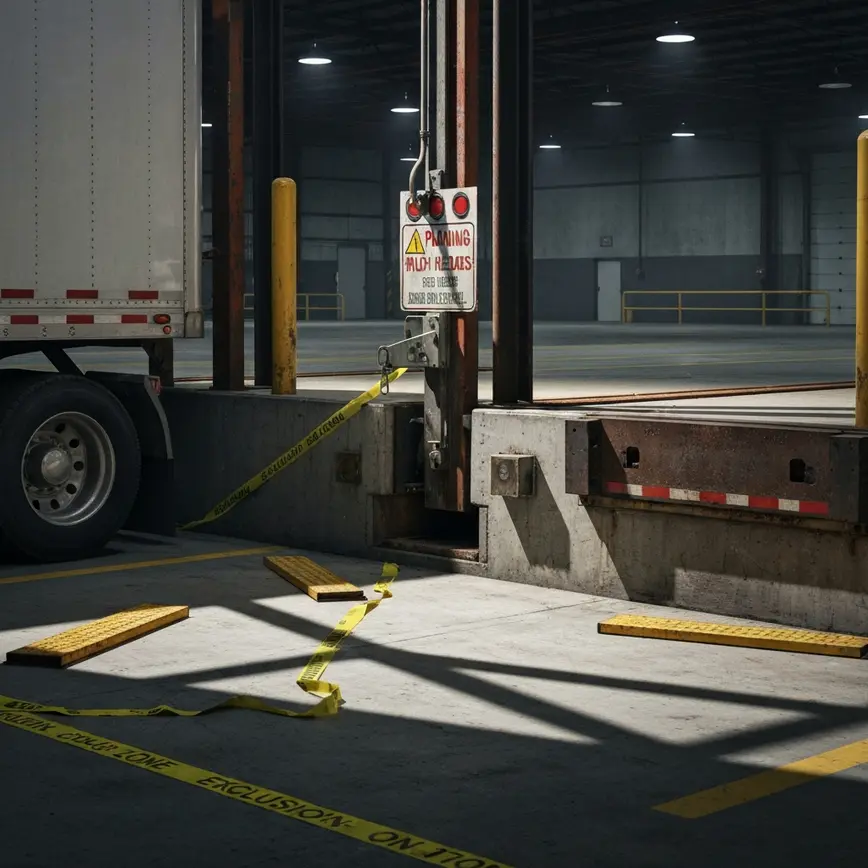
The Hazard: Crush/pinch hazards from vehicle-dock interactions, particularly loading dock pinch points where workers can be trapped between moving trailers and stationary docks; lack of clear exclusion zones around these areas; and delayed emergency access in confined warehouse spaces.
The Control: Install and use dock locks or wheel chocks to secure vehicles; establish marked exclusion zones with barriers, signage, spotters, and lockout/tagout for vehicles; conduct emergency drills and equip sites with rapid-access tools like hydraulic spreaders and panic buttons.
These controls are non-negotiable because loading dock pinch points represent an immediate, high-energy crush risk that can cause fatal compressional injuries in seconds, as seen in this case where 20 minutes of entrapment sealed the tragedy. Without dock locks or chocks, even slight vehicle shifts—due to air brake release, wind, or mechanical failure—can close the gap unpredictably. Exclusion zones enforced with physical barriers and spotters eliminate unauthorized entry, breaking the chain of human error. Emergency preparedness ensures survival windows aren’t wasted, turning potential fatalities into recoverable incidents. Supervisors must treat these as engineering imperatives, not optional practices, to uphold our zero-tolerance stance on preventable deaths.
Supervisor’s discussion guide
Use these questions to engage the crew and identify site-specific risks:
Q1: “Looking at our own equipment today, where is the biggest risk of loading dock pinch points?”
Q2: “What steps do we take to secure trailers at the dock, and have we ever seen a close call with vehicle movement?”
Q3: “How do we ensure exclusion zones are respected during loading/unloading, and what barriers or signage could we improve?”
Q4: “If someone gets pinned tomorrow, what’s our exact emergency response plan, including tools and communication?”
Action plan & inspection
Immediately after this meeting, conduct these 5 checks and document completion:
- Inspect all loading docks for functional dock locks, wheel chocks, and proximity sensors; test and tag any defective units out of service.
- Verify exclusion zones are marked with barriers, reflective signage warning of loading dock pinch points, and floor tape; add spotter requirements if missing.
- Review and update lockout/tagout procedures for vehicles at docks, ensuring keys or blocks are used during pedestrian activity.
- Inventory rapid-access rescue tools like hydraulic spreaders and ensure panic buttons or two-way radios are operational in dock areas.
- Schedule and log a mock emergency drill for crush/pinch incidents at loading docks within the next week.
Key takeaways
Today’s toolbox talk on loading dock pinch points drives home that these invisible crush zones between trailers and docks demand unwavering vigilance. The Rivian incident—where a worker was pinned for 20 minutes leading to fatal blunt traumatic injuries—proves that unsecured vehicles and absent safeguards turn routine operations into kill zones. Commit to dock locks, wheel chocks, exclusion zones, and drilled emergency responses as your unbreakable defense.
Every supervisor and crew member shares responsibility: spot risks, enforce controls, and intervene without hesitation. By prioritizing these measures, we honor victims like Kevin Lancaster and ensure 2026 sees zero repeats. Safety isn’t a discussion—it’s execution.
Source & Disclaimer: This toolbox talk is for educational purposes based on public report. Read Original Report