Meeting details
Topic: Ethanol storage tank fire prevention and emergency response
Goal: This toolbox talk on ethanol storage tank fire will review the BCL Industries incident and prevent similar accidents in 2026.
The incident: what happened?
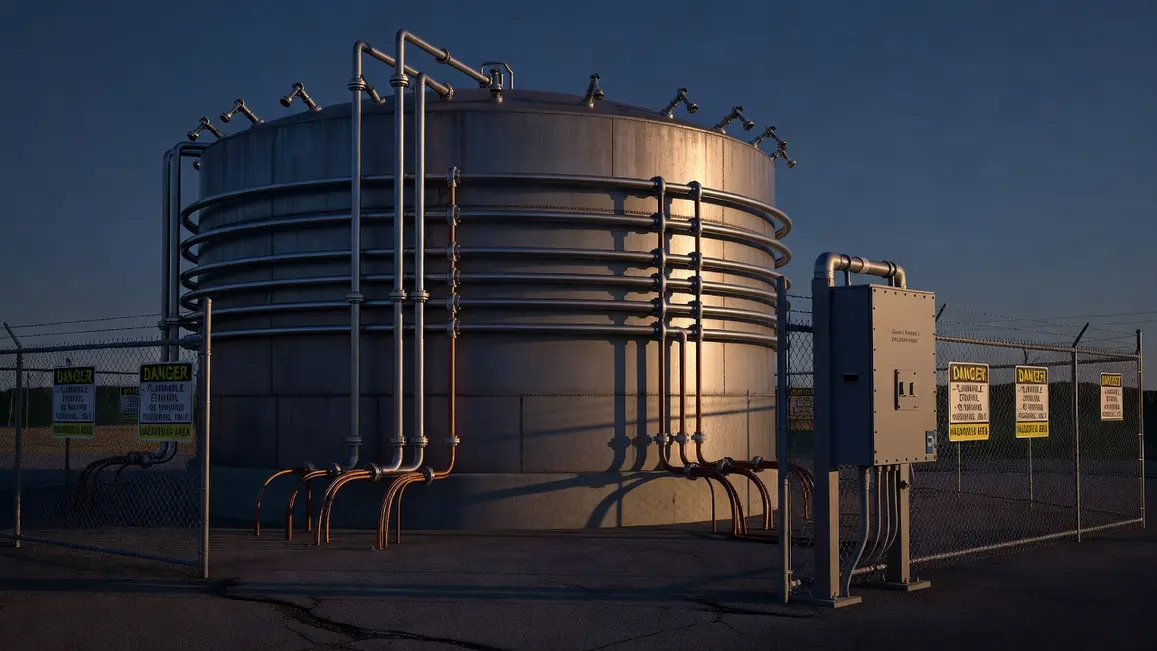
On Friday, June 22, 2026, at approximately 9 a.m., an ethanol storage tank fire erupted at the BCL Industries Limited distillery unit in Machhana village, Bathinda district, India. Residents heard a powerful explosion as flames rapidly engulfed the large-capacity tank. The facility’s in-house firefighting team and two fire tenders could not contain the blaze, requiring support from nearly 18 fire tenders from the Bathinda Municipal Corporation, HMEL refinery, Bhisiana Air Force Station, and nearby industrial units. Coordinated efforts eventually controlled the fire after several hours.
No injuries or fatalities occurred, though significant financial losses are expected. The cause remains under investigation by a specialized technical team. This ethanol storage tank fire highlights the extreme hazards of storing large volumes of flammable liquids and the critical need for robust prevention and response measures at every distillery and industrial site.
Core safety lesson
The Hazard: Ignition of flammable ethanol vapors leading to fire and explosion.
The Control: Implement rigorous ignition-source control measures, including explosion-proof electrical equipment, grounding and bonding of tanks and transfer lines, and strict hot-work permit systems with gas monitoring before any maintenance activities.
Ethanol vapors can ignite from even minor sparks or static discharge, turning a routine operation into a catastrophic ethanol storage tank fire within seconds. The BCL Industries event demonstrates how quickly an initial ignition can overwhelm on-site resources when vapors accumulate in or around large storage tanks. Without systematic controls, any electrical fault, maintenance activity, or transfer operation carries unacceptable risk.
Grounding, bonding, and explosion-proof equipment eliminate common ignition sources at their origin. Gas monitoring combined with a rigorous hot-work permit system ensures that no work proceeds until the atmosphere is verified safe. These layered controls are non-negotiable because ethanol’s low flash point and high vapor pressure leave almost no margin for error once vapors are present.
Supervisor’s discussion guide
Q1: “Looking at our own equipment today, where is the biggest risk of ignition of flammable ethanol vapors leading to fire and explosion?”
Q2: “Are all transfer lines and tanks properly grounded and bonded, and when was the last verification performed?”
Q3: “How would our current hot-work permit process have prevented an ethanol storage tank fire similar to the one in Bathinda?”
Q4: “What additional gas-monitoring equipment or procedures do we need before any maintenance on flammable liquid systems?”
Action plan & inspection
- Verify grounding and bonding integrity on all ethanol storage tanks and transfer piping within 24 hours.
- Confirm explosion-proof rating of all electrical equipment in classified areas around storage tanks.
- Review and update hot-work permits to include pre-task gas monitoring for flammable vapors.
- Inspect and restock foam concentrate supplies to ensure capacity for large-scale flammable liquid incidents.
- Schedule a mutual-aid drill with local fire departments within 30 days to test large-volume response capability.
Key takeaways
An ethanol storage tank fire can escalate rapidly when ignition sources are not strictly controlled and on-site firefighting capacity is insufficient. The June 22, 2026 incident at BCL Industries proves that even facilities with dedicated response teams require layered engineering controls and pre-planned external support to protect people and assets.
Every supervisor must enforce ignition-source controls daily, maintain emergency resources, and conduct realistic drills. Consistent application of these measures prevents recurrence and ensures that any future incident remains a near-miss rather than a major loss.
Source & Disclaimer: This toolbox talk is for educational purposes based on public report. Read Original Report