Meeting details
Topic: Combustible dust fire prevention following the Polymer Processing incident
Goal: This toolbox talk on combustible dust fire will review the June 21, 2026 fire at the Polymer Processing facility and prevent similar accidents in 2026.
Date: June 23, 2026
Duration: 10 minutes
Facilitator: Site Supervisor
The incident: what happened?
On Sunday, June 21, 2026, at approximately 1:00 p.m., a significant combustible dust fire broke out at the Polymer Processing facility located at 1391 Fire Tower Road in Rock Hill, York County, South Carolina. The 100,000 sq ft toll-processing operation, which specializes in grinding, blending, repackaging, and classification of dry materials and polymers, experienced heavy fire conditions that required more than five hours of firefighting operations. Multiple agencies responded, including Lesslie Fire–Rescue, Rock Hill Fire, York County Hazmat, and several volunteer departments, deploying ladder trucks, cooling stations, and EMS support. No injuries were reported, and the cause remains under investigation.
The event underscores how rapidly combustible dust fire conditions can develop in polymer processing environments when fine dust accumulates and ignition sources are present. The prolonged duration of the response highlights the challenges of suppressing fires in large industrial buildings containing high volumes of combustible organic materials.
Core safety lesson
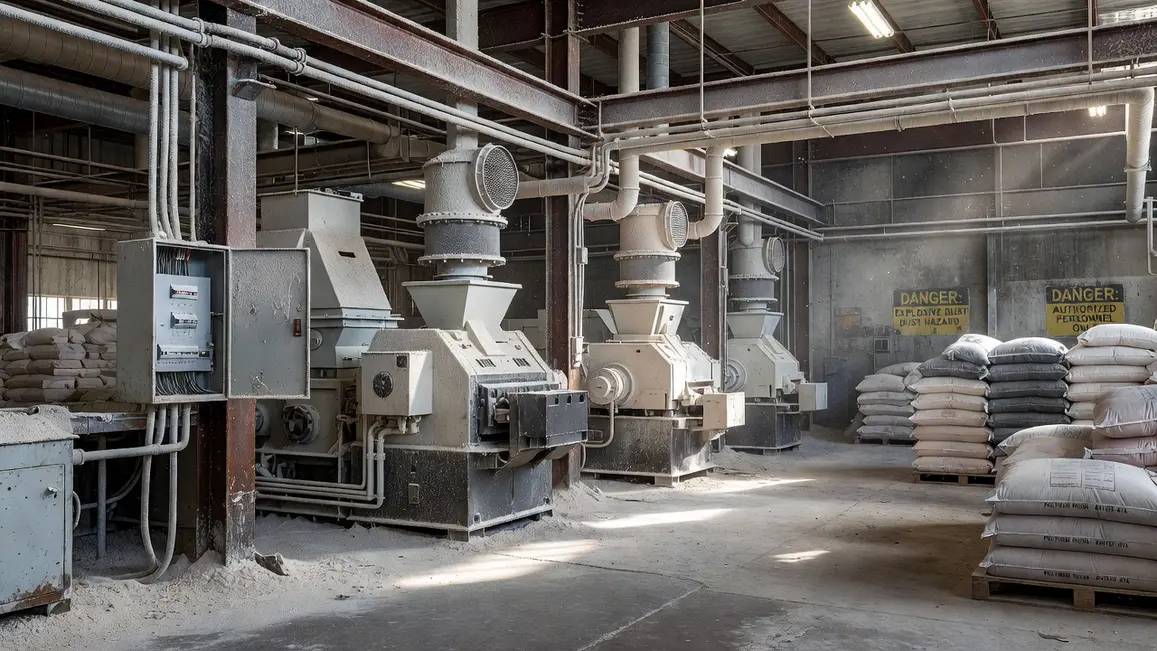
The Hazard: Combustible dust accumulation from polymers and organic materials.
The Control: Implement a rigorous housekeeping and dust-control program, including regular cleaning of overhead structures, use of dust-collection systems with explosion vents, and control of ignition sources in areas where fine polymer dust can accumulate.
This control is non-negotiable because polymer dust can form explosive mixtures when suspended in air, and even small accumulations on overhead beams or equipment can fuel rapid fire spread once ignited. In the Rock Hill incident, the facility’s processing activities inherently generate fine dust, making consistent removal and containment essential to prevent a similar combustible dust fire from occurring.
Electrical and mechanical ignition sources compound the risk in dusty environments. Without proper Class II rated equipment, grounding, and frequent inspections of motors and bearings, a single spark can trigger catastrophic events. Regular impairment testing of detection and suppression systems further ensures early intervention before a small ignition escalates into a multi-hour fire requiring extensive multi-agency resources.
Supervisor’s discussion guide
Q1: “Looking at our own equipment today, where is the biggest risk of combustible dust accumulation?”
Q2: “Are all motors and conveyors in dusty areas properly grounded and rated for Class II locations?”
Q3: “When was the last time we verified the performance of our dust-collection systems and explosion vents?”
Q4: “How would we coordinate with local fire departments if a combustible dust fire occurred in one of our processing buildings?”
Action plan & inspection
- Conduct an immediate overhead dust-cleaning audit in all grinding and blending areas.
- Verify that all electrical equipment in dusty zones carries proper Class II, Division 1 or 2 ratings.
- Inspect and test dust-collection systems and explosion vents for proper function.
- Review and update pre-incident plans with local fire departments for rapid response.
- Confirm that early-warning smoke and heat detection is tied to automatic suppression systems and free of impairments.
Key takeaways
Combustible dust fire events can develop quickly in polymer processing facilities when housekeeping, dust control, and ignition-source management are not maintained at the highest level. The June 21, 2026 incident at Polymer Processing demonstrates that even facilities with no injuries can suffer extended operational disruption when these controls fail.
Supervisors must treat dust accumulation as an active hazard requiring daily attention. Consistent application of housekeeping programs, proper equipment ratings, and coordinated detection systems remains the only reliable defense against future combustible dust fire incidents.
Source & Disclaimer: This toolbox talk is for educational purposes based on public report. Read Original Report