Meeting details
Topic: Chemical Incompatibility Hazards in Manufacturing Environments
Goal: This toolbox talk on chemical incompatibility hazards will review the July 8, 2026 incident at the Liburdi Dimetrics and Turbine Services facility and prevent similar accidents in 2026.
The incident: what happened?
On July 8, 2026, five workers at the Liburdi Dimetrics and Turbine Services manufacturing facility in Mooresville, North Carolina, were injured when hydrochloric acid was mixed with hydrogen peroxide, generating chlorine gas. The event stemmed directly from chemical incompatibility hazards that were not identified before the task began. Firefighters responded to an initial medical call, evacuated the building normally occupied by approximately 60 employees, decontaminated the affected workers by removing contaminated clothing and rinsing their skin, and transported one employee to a local hospital. The spill was described as small and contained on-site with no public threat; firefighters later ventilated the building and handed the site over to a private environmental cleanup contractor.
The root cause was the unplanned combination of two incompatible oxidizers and acids without any pre-task review or engineering safeguards. This single mixing event triggered an immediate release of toxic chlorine gas, overwhelming the workers before they could evacuate or access decontamination resources. The incident underscores how quickly chemical incompatibility hazards can escalate when storage, ventilation, and procedural controls are not enforced.
Core safety lesson
The Hazard: Incompatible chemical mixing (HCl + H₂O₂ → Cl₂ gas)
The Control: Implement strict chemical-compatibility procedures and segregated storage; require pre-task compatibility review and secondary containment for reactive pairs.
Chemical incompatibility hazards arise when reactive substances are brought together without recognition of their potential to generate toxic or explosive byproducts. In this case, hydrochloric acid and hydrogen peroxide produced chlorine gas almost instantly, creating an inhalation hazard that injured five workers and forced a full building evacuation. Without a formal compatibility check, even experienced personnel can overlook these risks during routine or rushed operations.
Engineering and administrative controls are non-negotiable because they interrupt the chain of events before exposure occurs. Segregated storage prevents accidental contact, while mandatory pre-task reviews force workers to identify incompatibilities in writing. Secondary containment further limits the spread of any unintended reaction, buying critical time for evacuation and response. These layered protections directly address the failures observed at the North Carolina facility and must be verified before any mixing or transfer activity begins.
Supervisor’s discussion guide
Q1: “Looking at our own equipment today, where is the biggest risk of incompatible chemical mixing?”
Q2: “Do we have current compatibility charts posted and accessible at every chemical-use station?”
Q3: “How would we handle an unexpected chlorine gas release if local exhaust ventilation failed during a mixing task?”
Q4: “When was the last time we verified that our emergency showers and eyewash stations are fully functional and unobstructed?”
Action plan & inspection
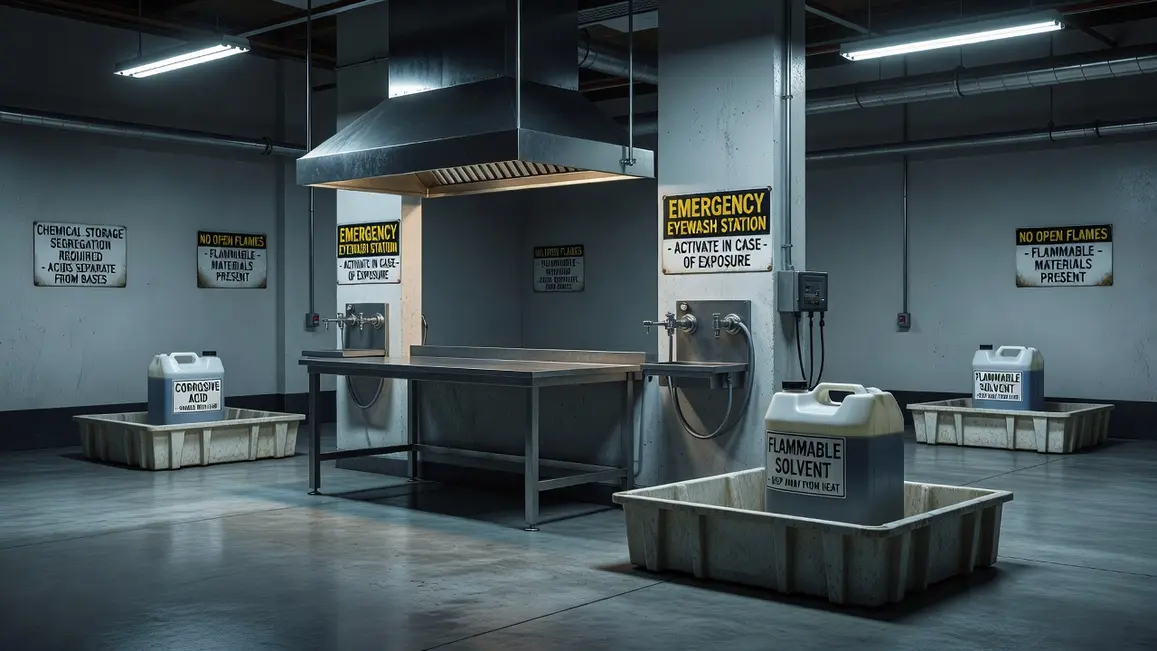
- Verify that all hydrochloric acid and hydrogen peroxide containers are stored in segregated, labeled cabinets with secondary containment trays.
- Confirm local exhaust ventilation or fume hoods over any mixing stations are operational and have been tested within the past 30 days.
- Inspect emergency showers and eyewash stations for immediate access, proper flow rate, and clear signage.
- Review and update chemical compatibility procedures to require documented pre-task reviews before any reactive substances are handled.
- Ensure appropriate chemical-protective PPE and rapid doffing instructions are available at each chemical-use area.
Key takeaways
Chemical incompatibility hazards remain one of the most preventable yet severe risks in manufacturing. The July 8 incident demonstrates that even a small, unintended mixing event can injure multiple workers, trigger evacuations, and require external emergency response when basic controls are missing.
Supervisors must enforce segregated storage, pre-task compatibility reviews, functional ventilation, and accessible decontamination equipment every shift. Consistent application of these controls eliminates the conditions that allow chlorine gas releases and protects the entire workforce from similar exposures in 2026 and beyond.
Source & Disclaimer: This toolbox talk is for educational purposes based on public report. Read Original Report