Meeting details
Topic: Roof work safety briefing following the Academy Trust prosecution
Goal: This toolbox talk on roof work safety will review the fall at St Mary’s Catholic Primary School and prevent similar accidents in 2026.
The incident: what happened?
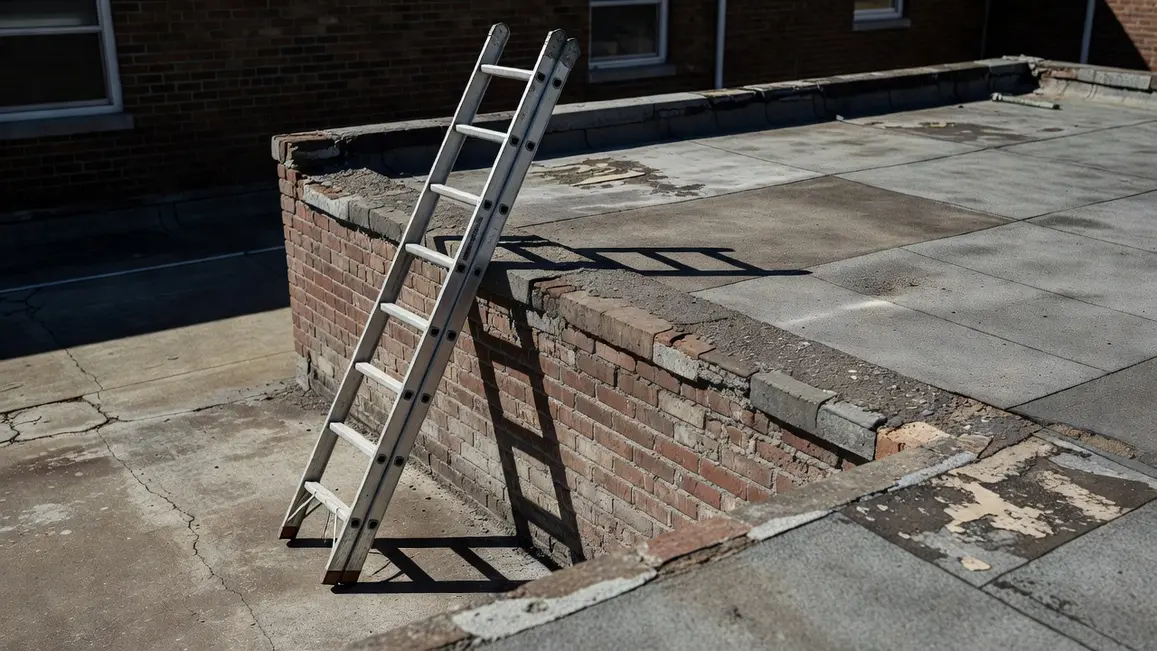
On 2 September 2024 a site supervisor employed by the Romero Catholic Academy Trust fell from an unsecured ladder while retrieving footballs from the roof of St Mary’s Catholic Primary School in Burnley. The Trust, which manages 16 schools, had no working-at-height risk assessment or safe system of work in place and the roof had no edge protection. The worker sustained life-changing injuries including a subdural hematoma, facial fractures and ongoing cognitive impairments. This case highlights critical failures in roof work safety that led to the Trust being prosecuted by the HSE.
The HSE investigation confirmed the complete absence of planning, risk assessment and control measures. The incident occurred during an inset day at the primary school. On 14 July 2026 the Romero Catholic Academy Trust was fined £32,000 at Warrington Magistrates’ Court for breaching Section 2(1) of the Health and Safety at Work etc. Act 1974. The worker continues to experience memory loss, speech difficulties and an inability to perform routine tasks.
Core safety lesson
The Hazard: Unsecured ladder used for roof access without fall prevention measures and absence of edge protection or fall-arrest systems on the roof.
The Control: Secure ladders at the correct 1:4 angle, tie them at top and bottom, ensure a second person foots the ladder, and install temporary or permanent edge protection or a fall-restraint system anchored to suitable points before any work at height begins.
These controls are non-negotiable because the absence of basic planning allowed a routine task to become life-altering. Without a documented risk assessment and written safe system of work, supervisors had no framework to identify or eliminate the fall hazard. Proper ladder securing combined with edge protection removes reliance on individual memory or luck and creates a physical barrier that prevents falls even if someone slips.
Roof work safety depends on every control being in place before access is permitted. The prosecution outcome demonstrates that regulators will hold organisations accountable when these fundamental measures are missing, regardless of the simplicity of the task.
Supervisor’s discussion guide
Q1: “Looking at our own equipment today, where is the biggest risk of an unsecured ladder being used for roof access?”
Q2: “Do we have edge protection or anchor points identified for every roof we may need to access?”
Q3: “How can we improve roof work safety on our sites by ensuring a written method statement exists before any task begins?”
Q4: “What immediate steps will each of us take if we are asked to retrieve an item from a roof without the required controls?”
Action plan & inspection
- Verify that every ladder on site has a securement method (tie-off points or footing procedure) documented and available.
- Confirm edge protection or fall-arrest anchor points are installed or readily deployable on all roofs requiring access.
- Ensure a specific work-at-height risk assessment and method statement exist and have been briefed to all relevant staff.
- Check that purpose-designed roof access equipment such as fixed ladders or mobile tower scaffolds with guardrails is available and inspected.
- Confirm all staff have received training on the controls and know they must not proceed without them.
Key takeaways
Roof work safety requires documented planning, physical fall prevention and trained personnel before any access occurs. The Burnley incident shows that skipping these steps can result in permanent injury and significant legal penalties for the organisation.
Every supervisor must treat roof access as a controlled activity that demands the correct equipment and paperwork. Implementing the controls outlined today eliminates the conditions that led to the £32,000 fine and life-changing harm in 2024.
Source & Disclaimer: This toolbox talk is for educational purposes based on public report. Read Original Report