Meeting details
Topic: Confined space entry safety review following the FleetPride fatality
Goal: This toolbox talk on confined space entry will review the January 7, 2026 FleetPride Inc. incident in Corpus Christi, Texas and prevent similar accidents in 2026.
The incident: what happened?
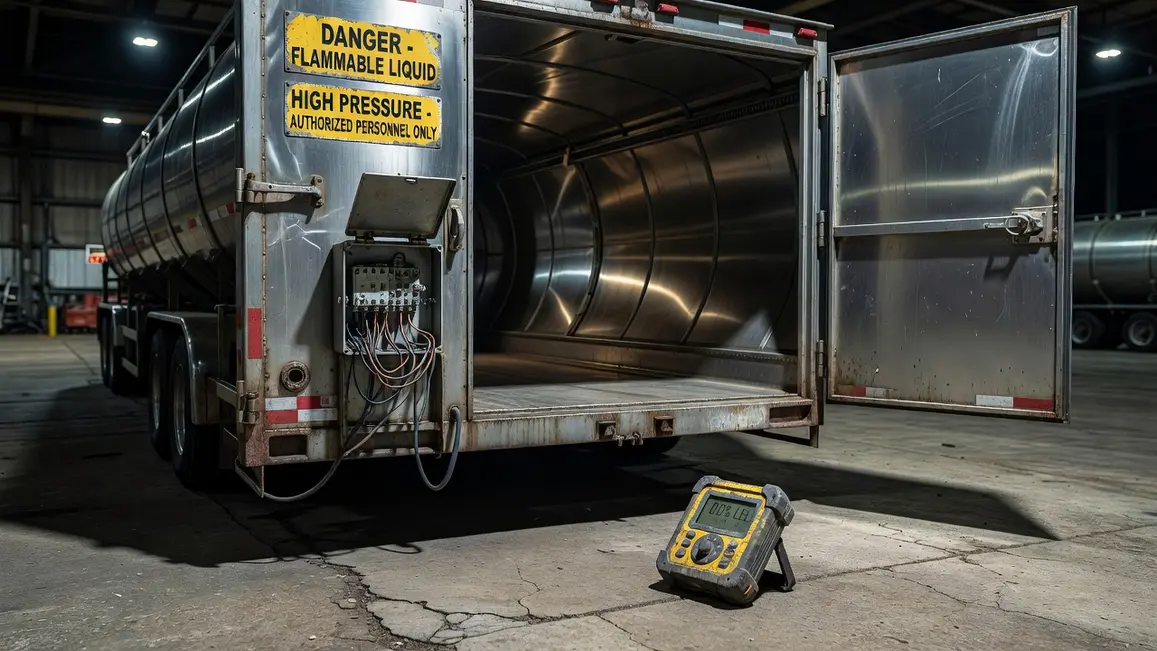
On January 7, 2026, an employee at FleetPride Inc.’s Corpus Christi, Texas facility entered the interior of a tanker trailer to perform an inspection. The worker asphyxiated during the task because the company had not implemented any confined space entry program. OSHA’s investigation found no pre-entry atmospheric testing, no entry permits, and no rescue planning in place before the employee entered the space.
The inspection also identified deficiencies in the respiratory-protection program along with additional electrical hazards. OSHA ultimately cited FleetPride for 16 serious and three other-than-serious violations and proposed penalties of $264,380. The absence of a formal confined space entry process directly contributed to the fatal outcome.
Core safety lesson
The Hazard: Uncontrolled entry into oxygen-deficient or IDLH atmospheres inside tanker trailers and similar vessels.
The Control: A written confined space entry program that requires atmospheric testing, permits, and rescue planning before any worker enters.
Without these steps, workers have no way to know whether the atmosphere inside a trailer is safe. Oxygen deficiency can occur rapidly and without warning, leading to immediate incapacitation. A complete program forces evaluation of every potential confined space and documents that conditions have been verified safe.
Respiratory protection and electrical controls are equally critical. NIOSH-approved respirators must be provided with medical evaluations and fit-testing whenever an oxygen-deficient atmosphere is possible. Electrical equipment must be guarded or de-energized and verified through lockout/tagout before work begins. These layered controls are non-negotiable because a single missing element can allow a fatal exposure to occur in seconds.
Supervisor’s discussion guide
Q1: “Looking at our own equipment today, where is the biggest risk of oxygen-deficient atmospheres during maintenance tasks?”
Q2: “Do we have a current written confined space entry program that includes permit issuance and rescue procedures for every tanker trailer on site?”
Q3: “When was the last time we verified that respirators are NIOSH-approved, fit-tested, and accompanied by medical evaluations for anyone who might enter a confined space?”
Q4: “What electrical equipment around our trailers still lacks proper guarding or lockout/tagout verification before inspection work begins?”
Action plan & inspection
- Confirm a written confined space entry program exists and is immediately available for review.
- Verify that pre-entry atmospheric testing equipment is calibrated and on site for all tanker trailers.
- Ensure entry permits are prepared and signed before any worker enters a confined space.
- Check that NIOSH-approved respirators have current fit-test records and medical evaluations on file.
- Inspect all electrical panels and equipment near trailers for proper guarding and lockout/tagout capability.
Key takeaways
Every confined space entry must be treated as potentially lethal until proven otherwise through testing and permitting. The FleetPride incident demonstrates that skipping these steps results in immediate tragedy and substantial regulatory penalties.
Supervisors must enforce the full program—atmospheric testing, permits, respiratory protection, and electrical controls—before any worker enters a tanker trailer or similar space. Consistent application of these requirements protects employees and keeps operations compliant throughout 2026 and beyond.
Source & Disclaimer: This toolbox talk is for educational purposes based on public report. Read Original Report