Meeting details
Date: April 30, 2026
Topic: Preventing Falsified Diving Medical Certificates
Goal: This toolbox talk on falsified diving medical certificates will review the Bournemouth recreational diving instructor incident and prevent similar accidents in 2026.
The incident: what happened?
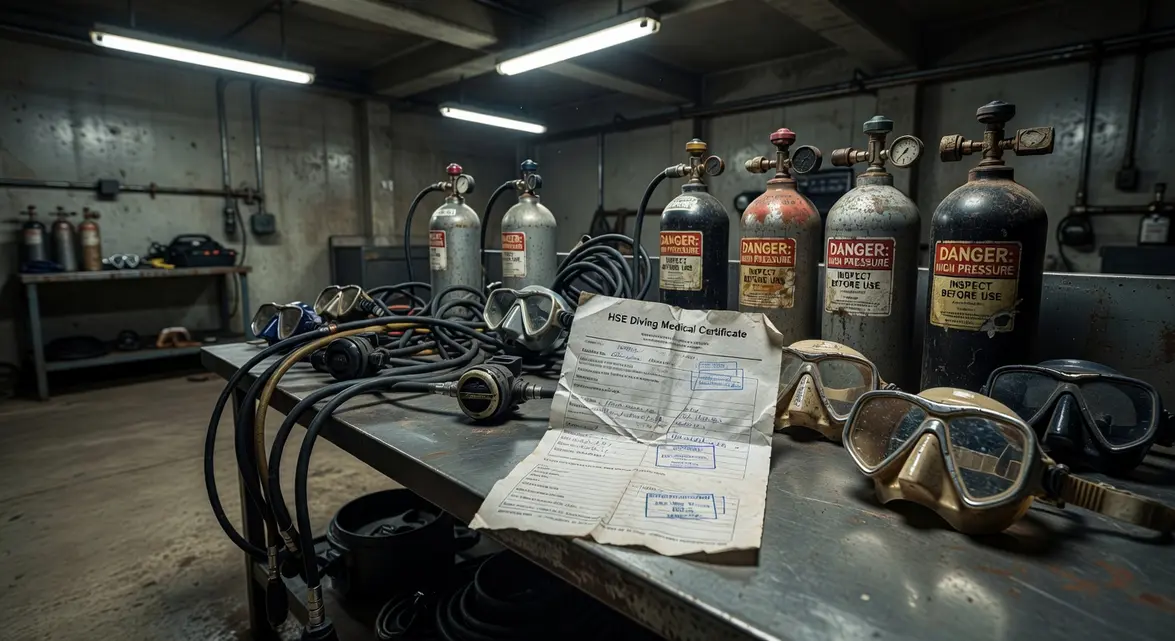
In March 2025, a recreational diving instructor in Bournemouth, UK, falsified an HSE commercial diving medical certificate to seek employment as a PADI instructor. The falsified diving medical certificate was quickly identified and reported by a local diving school to the Health and Safety Executive (HSE). An HSE investigation, supported by the Approved Medical Examiners of Divers (AMED) board, confirmed the forgery through official verification channels. This breach directly violated Section 33(1)(m) of the Health and Safety at Work etc. Act 1974 and the Diving at Work Regulations 1997, which require valid medical certificates issued by HSE-approved doctors to confirm fitness for high-risk underwater work, including training activities.
The instructor pleaded guilty at Bristol Magistrates’ Court on 17 April 2026, resulting in a £700 fine, £2,620 in costs, and a £280 victim surcharge. HSE inspector Christopher Booker emphasized the enforcement action, stating it protects divers, students, and colleagues from the dangers of unfit personnel. This case underscores how falsified diving medical certificates can infiltrate safety-critical operations, potentially leading to catastrophic outcomes in the high-pressure environment of commercial and recreational diving.
Core safety lesson
The technical failure in this incident stemmed from the instructor’s deliberate forgery of an official HSE medical document, bypassing mandatory health assessments designed for the physiological demands of diving. Without proper verification, an unfit individual could perform underwater training, exposing others to risks like sudden medical events at depth.
The Hazard: Use of falsified diving medical certificates leading to unfit divers conducting high-risk operations, with potential injuries or fatalities to students and colleagues, and erosion of trust in certification systems.
The Control: Implement mandatory verification protocols where employers cross-check certificates directly with HSE-approved doctors or AMED via official channels before hiring; enforce policies requiring original, unedited certificates and immediate reporting of suspected forgeries to HSE; conduct regular awareness campaigns and audits with legal deterrents under the Health and Safety at Work Act.
These controls are non-negotiable because diving involves extreme conditions—pressure changes, limited visibility, and reliance on shared air supplies—where any medical unfitness can cascade into drownings, decompressions sickness, or equipment failures. Verifying falsified diving medical certificates directly with issuers eliminates forgery risks, as seen when the local school reported the issue promptly. Regular audits and campaigns build a culture of compliance, deterring non-compliance and ensuring every team member is fit, protecting lives in this unforgiving industry.
Supervisor’s discussion guide
Use these questions to engage the crew in a 10-minute discussion:
Q1: “Looking at our own certification processes today, where is the biggest risk of falsified diving medical certificates?”
Q2: “How would you spot a potentially falsified diving medical certificate, and what immediate steps would you take?”
Q3: “Why do you think verification with HSE or AMED is critical before any dive operation?”
Q4: “What role does reporting suspicions play in preventing incidents like the Bournemouth case?”
Action plan & inspection
- Review all current team members’ diving medical certificates and cross-verify originals directly with issuing HSE-approved doctors or AMED within 24 hours.
- Implement a site policy requiring submission of unedited, original certificates for all hires, with digital scans retained for audits.
- Conduct an immediate inspection of all certification files for signs of tampering, such as inconsistent dates, stamps, or formatting anomalies.
- Post HSE Diving at Work Regulations signage and verification protocols in the dive prep area.
- Schedule a follow-up team training session on recognizing and reporting falsified diving medical certificates within one week.
Key takeaways
Falsified diving medical certificates represent a direct threat to life in high-risk diving operations, as demonstrated by the Bournemouth incident where forgery led to legal penalties and highlighted systemic vulnerabilities. Supervisors must lead by enforcing rigorous verification—contacting issuers directly—and fostering a no-tolerance culture for document manipulation. This not only complies with the Health and Safety at Work Act and Diving Regulations but safeguards every dive from preventable tragedies.
Immediate actions like certificate audits, policy enforcement, and crew discussions will embed these lessons. Remember Inspector Booker’s words: enforcement protects divers, students, and colleagues. By prioritizing authentic fitness certifications, we uphold the highest safety standards in 2026 and beyond.
Source & Disclaimer: This toolbox talk is for educational purposes based on public report. Read Original Report