Meeting details
Date: May 01, 2026
Topic: Turbine-Driven Feedwater Pump Failures at Surry Nuclear Power Plant
Goal: This toolbox talk on turbine-driven feedwater pump failures will review the Surry Nuclear Power Plant incidents during quarterly Technical Specification surveillance testing and prevent similar accidents in 2026.
The incident: what happened?
Dominion Energy’s Surry nuclear power plant in Surry, Virginia, experienced turbine-driven feedwater pump failures in its turbine-driven auxiliary feedwater pumps (TDAFWPs) during required quarterly Technical Specification (TS) surveillance testing. On January 14, 2025, Unit 1’s TDAFWP tripped on overspeed after approximately 5 seconds of operation, which was resolved by replacing the governor. Just over a month later, on February 18, 2025, Unit 2’s TDAFWP also tripped on overspeed, addressed by adjusting the governor compensating needle valve. These failures compromised the reliability of the auxiliary feedwater system, critical for emergency cooling in nuclear operations.
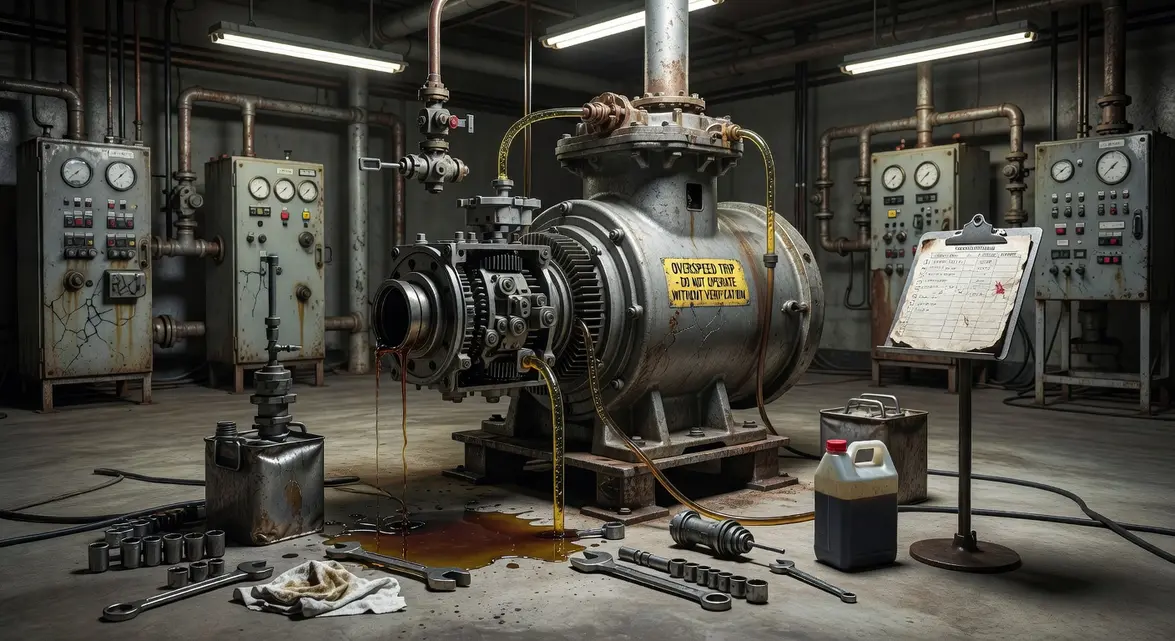
The root cause traced back to maintenance performed during the November 2024 Unit 2 refueling outage under procedure 0-MCM-1403-01 for a governor oil change. This procedure lacked clear instructions for essential post-maintenance steps, including venting the governor and optimizing the compensating needle valve. The Nuclear Regulatory Commission (NRC) issued a preliminary “White” finding of low safety significance for violating TS 6.4.A.7 on adequate written procedures. This has triggered a regulatory conference on May 6, 2026, in Atlanta, GA, where Dominion must respond before a final determination and potential escalated enforcement.
Core safety lesson
The technical failure at Surry stemmed from latent defects introduced during maintenance, manifesting as turbine-driven feedwater pump failures during surveillance testing. Improper governor settings after an oil change allowed overspeed conditions, tripping the pumps and rendering them inoperable when needed most for accident mitigation.
The Hazard: Inadequate maintenance procedures missing detailed instructions for critical post-maintenance steps, such as governor venting and compensating needle valve optimization, leading to equipment overspeed and surveillance test failures.
The Control: Implement procedure validation reviews with peer checks and simulations before use on safety-related equipment, per NRC guidelines; mandate functional testing and calibration verification immediately after governor maintenance or oil changes with predefined acceptance criteria; and establish a post-outage operability verification program including trend analysis of surveillance data.
This control is non-negotiable because auxiliary feedwater systems are vital safety barriers in nuclear plants, and any unavailability elevates risk during transients or accidents. Self-revealed failures during routine tests highlight how procedural gaps can evade detection until critical moments, as seen in the NRC’s Significance Determination Process evaluation. Supervisors must enforce these validations to uphold TS compliance, prevent regulatory findings, and ensure operational readiness—failure to do so directly threatens public safety and plant integrity.
Supervisor’s discussion guide
Engage your crew with these questions to drive home the lessons from the turbine-driven feedwater pump failures:
- Q1: “Looking at our own equipment today, where is the biggest risk of inadequate maintenance procedures?”
- Q2: “What post-maintenance steps on our governors or similar components might lack clear instructions in our procedures?”
- Q3: “How can we ensure functional testing happens immediately after oil changes or adjustments to prevent overspeed trips?”
- Q4: “In our post-outage verifications, what trends in surveillance data should we analyze to catch issues like those at Surry before they cause turbine-driven feedwater pump failures?”
Action plan & inspection
Immediately after this meeting, supervisors must verify and document the following 5 items:
- Review all maintenance procedures for safety-related pumps, ensuring explicit instructions for venting, valve optimization, and post-maintenance testing.
- Conduct peer validation and simulations on governor-related procedures before next use.
- Inspect governors on auxiliary feedwater pumps for proper calibration and oil levels, with functional overspeed tests if recently serviced.
- Perform trend analysis of recent surveillance test data across units to identify latent defects.
- Confirm post-outage operability verification program is active, with acceptance criteria tied to TS requirements.
Key takeaways
Turbine-driven feedwater pump failures at Surry underscore the dangers of incomplete maintenance procedures, particularly for governor oil changes lacking venting and adjustment steps. These incidents during January and February 2025 surveillance tests revealed how procedural shortcomings can lead to overspeed trips, NRC findings, and regulatory scrutiny—lessons we must apply rigorously in 2026 to maintain equipment reliability.
Commit to procedure validation, immediate post-maintenance testing, and trend analysis as non-negotiable controls. By prioritizing these, we prevent self-revealed failures, ensure TS compliance, and safeguard emergency cooling systems. Safety demands precision; no shortcuts on critical documentation or verification.
Source & Disclaimer: This toolbox talk is for educational purposes based on public report. Read Original Report