Meeting details
Date: March 26, 2026
Topic: Cisco Secure Boot Bypass in IOS XE Software
Goal: This toolbox talk on cisco secure boot bypass will review the Cisco IOS XE Secure Boot vulnerability (CVE-2026-20104) and prevent similar accidents in 2026.
The incident: what happened?
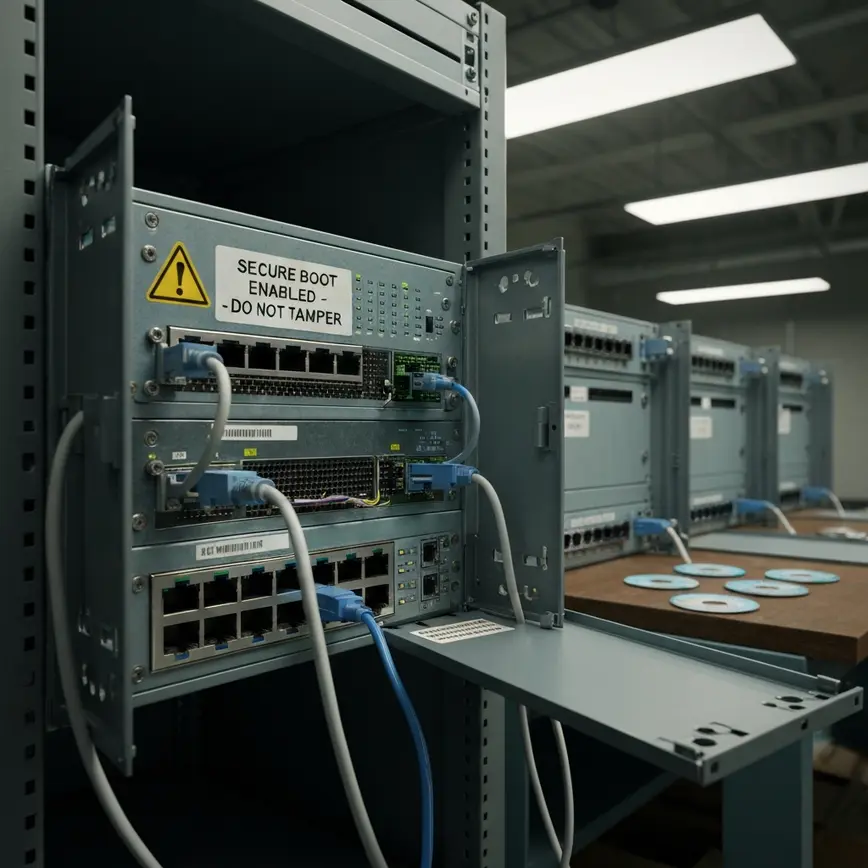
Cisco recently disclosed a high-rated vulnerability, CVE-2026-20104 with a CVSS base score of 6.1, affecting the bootloader in Cisco IOS XE Software, enabling a cisco secure boot bypass. This flaw impacts critical networking equipment including Cisco Catalyst 9200 Series Switches (such as 9200CX and 9200L models), Catalyst ESS9300 Embedded Series Switches, Catalyst IE9310 and IE9320 Rugged Series Switches, and IE3500 and IE3505 Rugged Series Switches. The vulnerability stems from insufficient validation of software during the boot process, allowing an authenticated local attacker with level-15 privileges or an unauthenticated attacker with physical access to manipulate loaded binaries, execute arbitrary code at boot time, bypass integrity checks, and break the chain of trust by running non-Cisco-signed images.
Cisco elevated the Security Impact Rating (SIR) to High from medium due to the bypass of this major security feature. No workarounds are available, and Cisco has released software updates as detailed in their advisory (cisco-sa-xe-secureboot-bypass-B6uYxYSZ), published on March 26, 2026, and categorized under “Incidents.” This cisco secure boot bypass represents a significant risk in industrial environments where these switches control safety-critical networks, potentially leading to unauthorized control over systems that monitor equipment and prevent hazards.
Core safety lesson
The technical failure in this incident revolves around inadequate bootloader validation in Cisco IOS XE Software, creating a pathway for attackers to exploit the cisco secure boot bypass. This allows manipulation of boot-time binaries, arbitrary code execution, and disruption of the device’s chain of trust, turning trusted hardware into a vector for persistent malware.
The Hazard: Bootloader integrity bypass via manipulated binaries, arbitrary code execution by authenticated level-15 users or physical attackers, and chain-of-trust breakage enabling persistent non-signed malware.
The Control: Apply Cisco’s released IOS XE software updates immediately to enforce proper validation of boot-time software signatures; restrict physical device access using locked enclosures or secure facilities and limit level-15 privilege assignments; enable and monitor Secure Boot features post-patch with regular firmware integrity verification using Cisco’s tools.
These controls are non-negotiable because in worksite environments, compromised network switches can cascade into physical safety failures—such as disabled emergency shutdowns, falsified sensor data, or uncontrolled machinery. Patching eliminates the root cause of the cisco secure boot bypass, while access restrictions address the physical attack vector inherent in rugged industrial deployments. Regular verification ensures ongoing integrity, preventing silent persistence of threats that could endanger crews long-term.
Supervisor’s discussion guide
Engage your team with these questions to drive home the risks:
Q1: “Looking at our own equipment today, where is the biggest risk of bootloader integrity bypass or cisco secure boot bypass?”
Q2: “Which of our sites use Cisco Catalyst 9200, IE9310, or similar affected switches, and how exposed is their physical access?”
Q3: “What level-15 privileges do we assign, and how can we minimize them without impacting operations?”
Q4: “How will we verify firmware integrity after applying patches, and what tools should we use?”
Action plan & inspection
- Inventory all Cisco IOS XE devices on site, specifically checking for Catalyst 9200 Series, ESS9300, IE9310/IE9320, IE3500/IE3505 models.
- Immediately download and schedule application of Cisco patches from advisory cisco-sa-xe-secureboot-bypass-B6uYxYSZ.
- Inspect physical enclosures for all affected switches, ensuring locks and secure mounting to prevent unauthorized access.
- Review and revoke non-essential level-15 privilege accounts on network management systems.
- Enable Secure Boot monitoring and perform initial firmware integrity checks using Cisco validation tools, documenting results.
Key takeaways
The cisco secure boot bypass vulnerability underscores that cybersecurity lapses in industrial networking directly threaten physical safety. Supervisors must prioritize immediate patching of CVE-2026-20104-affected devices, as delays invite exploitation via physical access or privileged accounts, potentially compromising safety interlocks and monitoring systems critical to our worksites.
Implement strict access controls, privilege minimization, and routine integrity checks as standard protocol. This proactive stance not only mitigates the specific IOS XE flaw but fortifies our overall defense against evolving threats, ensuring crew safety in 2026 and beyond.
Source & Disclaimer: This toolbox talk is for educational purposes based on public report. Read Original Report