Meeting details
Date: March 24, 2026
Topic: Wheel Loader Maintenance Safety
Goal: This toolbox talk on wheel loader maintenance safety will review the Mill Worker Fatality at West Fraser’s Slave Lake Pulp Operation and prevent similar accidents in 2026.
The incident: what happened?
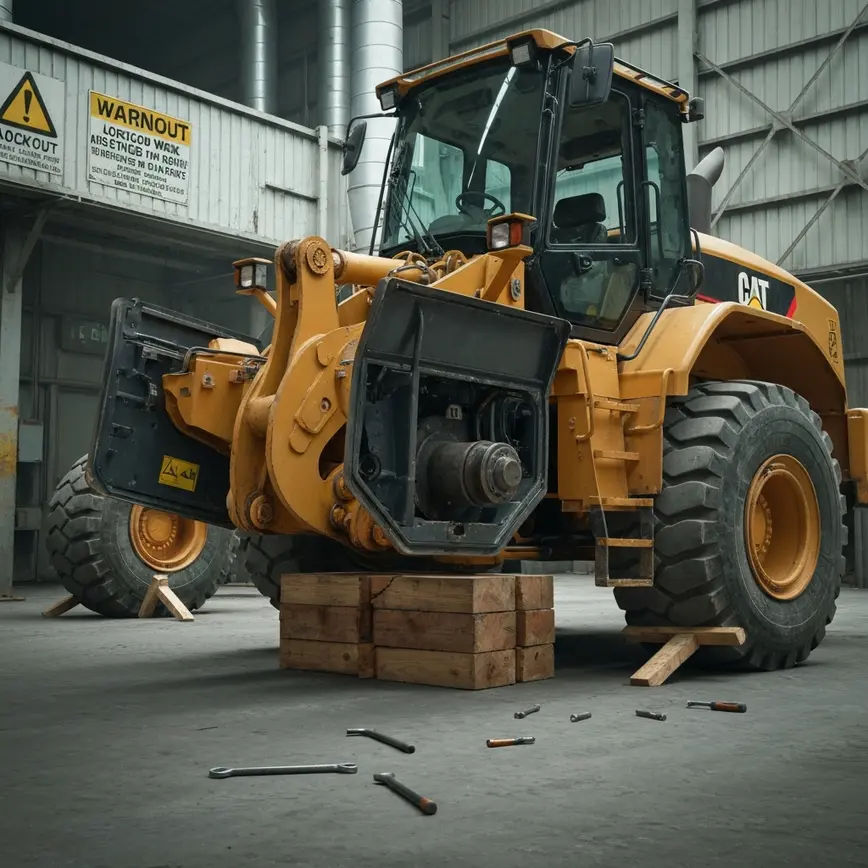
On March 13, 2024, a tragic fatality occurred at West Fraser Mills Ltd.’s Slave Lake Pulp operation in Cochrane, Alberta, Canada, during wheel loader maintenance safety procedures involving a Caterpillar 980M wheel loader. A worker was positioned underneath the elevated machine, which was supported only by a stack of two wooden blocks. These improvised supports proved inadequate when the equipment unexpectedly moved, resulting in fatal crushing injuries to the worker beneath it. This incident underscores critical lapses in wheel loader maintenance safety, including the use of wooden blocks that lacked sufficient size, strength, design, and material to handle the stresses involved.
Alberta Occupational Health and Safety (OHS) investigated and laid charges on March 5, 2026, against West Fraser Mills Ltd., West Fraser Mills Ltd. Slave Lake Pulp, and Pacesetter Equipment Ltd. All three entities face five counts under Alberta’s Occupational Health and Safety Code for multiple failures: using inadequate wooden blocks; not following manufacturer specifications for repairs, such as improper positioning of tooling for the front drive shaft and using only one person instead of the required two for drive shaft and parking brake removal; and failing to securely block elevated parts to prevent accidental movement. Pacesetter Equipment Ltd. faces an additional charge for permitting work under a suspended load without proper support systems. These violations directly contributed to the worker’s death and highlight systemic issues in maintenance protocols.
Core safety lesson
The incident at West Fraser’s Slave Lake Pulp operation reveals profound failures in wheel loader maintenance safety, particularly the reliance on improvised wooden blocks and inadequate isolation of machine movement. The technical breakdown began with the stack of two wooden blocks used to support the elevated Caterpillar 980M wheel loader. These blocks were insufficient in size, strength, design, and material, collapsing under the machine’s weight and stresses during servicing. Compounding this, the team deviated from manufacturer specifications, including improper tooling for the front drive shaft and insufficient personnel—one worker instead of the mandated two—for critical tasks like drive shaft and parking brake removal. No secure blocking prevented unexpected movement, turning a routine repair into a fatal event.
The Hazard: Inadequate mechanical support for elevated heavy equipment and unexpected movement of powered mobile equipment during maintenance, exacerbated by non-compliance with OEM procedures.
The Control: Use purpose-built, rated stands or jacks compliant with manufacturer specifications and load capacity; inspect supports before use and prohibit improvised materials like wood stacks. Implement lockout/tagout (LOTO) procedures to isolate power sources, engage parking brakes, and chock wheels; verify immobility with pre-work tests. Mandate adherence to OEM service manuals via job safety analyses (JSAs), with supervised work, minimum staffing, and competency verification for high-risk tasks.
These controls are non-negotiable because heavy equipment like wheel loaders exerts immense, dynamic forces—far beyond what wood can reliably withstand. Wooden blocks compress, split, or shift unpredictably under load, as seen in this case, where the stack of two failed catastrophically. Rated stands, engineered for specific capacities, provide proven stability with visual indicators for defects. LOTO and pre-work verification eliminate “surprise” movements from hydraulic leaks, electrical faults, or residual pressure, which investigations confirmed here. Deviating from OEM manuals ignores tested engineering data; for instance, requiring two personnel ensures safe handling of components like drive shafts that demand precise control to avoid imbalance. Enforcing these in every wheel loader maintenance safety task saves lives by design, not chance—compliance is the only acceptable standard on our sites.
Supervisor’s discussion guide
Use these questions to engage the crew in a 10-minute dialogue, ensuring everyone connects the incident to our operations:
- Q1: “Looking at our own equipment today, where is the biggest risk of unexpected movement or inadequate supports during wheel loader maintenance safety tasks?”
- Q2: “What specific manufacturer specs have we followed—or ignored—on recent repairs, and why does staffing matter for tasks like drive shaft removal?”
- Q3: “How do we verify that LOTO and wheel chocks are effective before anyone goes under elevated equipment?”
- Q4: “If we spot improvised supports like wooden blocks on site, what’s our immediate action, and who do we report it to?”
Action plan & inspection
Immediately after this toolbox talk, supervisors must conduct these 5 checks on all wheel loaders and maintenance areas. Document findings and correct deficiencies before resuming work:
- Inspect all elevated equipment supports: Confirm only rated stands/jacks are used—no wooden blocks or improvised materials; verify load ratings exceed machine weight by at least 150%.
- Test LOTO procedures: Isolate power on one machine, engage parking brake, chock all wheels, and perform a pre-work mobility test (attempt to move/rock it).
- Review OEM manuals: Pull service docs for drive shaft/parking brake tasks; confirm tooling positions and minimum two-person requirement for high-risk steps.
- Audit recent JSAs: Ensure every wheel loader maintenance safety plan includes support inspections, LOTO verification, and competency checks.
- Inventory supports: Tag and remove any inadequate items (e.g., undersized blocks); order replacements if rated stands are missing.
Key takeaways
Wheel loader maintenance safety demands zero tolerance for shortcuts: never use wooden blocks or improvised supports under elevated machines, as they failed fatally in the West Fraser incident with a Caterpillar 980M. Always deploy rated stands compliant with OEM specs, paired with rigorous LOTO—power isolation, brakes engaged, wheels chocked, and verified immobility. Non-compliance with manufacturer procedures, like solo drive shaft work or wrong tooling, invites disaster; mandate JSAs, supervision, and proper staffing to eliminate these gaps.
Today’s charges against West Fraser Mills Ltd., Slave Lake Pulp, and Pacesetter Equipment Ltd.—five counts plus one for suspended loads—remind us that accountability follows tragedy. Implement our action plan now: inspect, verify, adhere. Lives depend on it. Sign below to confirm understanding and commitment.
Source & Disclaimer: This toolbox talk is for educational purposes based on public report. Read Original Report