Meeting details
Date: February 24, 2026
Topic: Grain Bin Entry Safety
Goal: This toolbox talk on grain bin entry safety will review the serious injury at Alliance Grain Co. in Gibson City, Illinois, and equip supervisors and crews with controls to prevent similar accidents in 2026.
The incident: what happened?
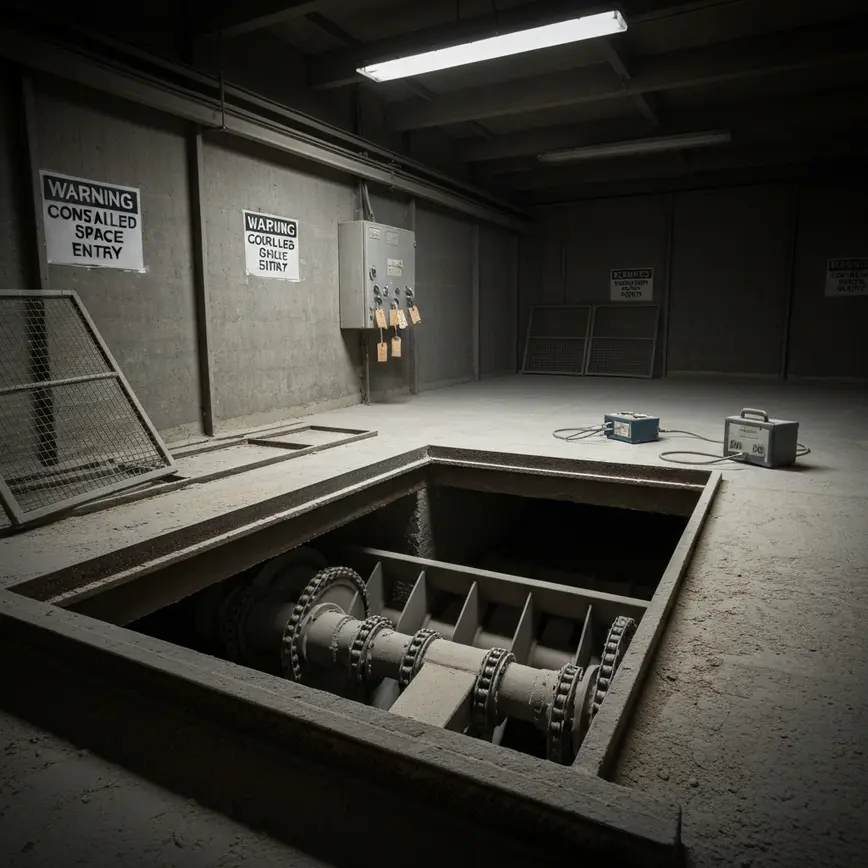
A seasonal laborer at Alliance Grain Co. in Gibson City, Illinois, suffered a serious foot injury during grain bin entry safety procedures when he stepped through an unguarded sump hole directly onto a moving paddle-style unloading conveyor. Federal OSHA investigators responded to the incident, uncovering critical lapses in grain bin entry safety protocols. The worker’s foot was severely injured by the conveyor’s moving parts, highlighting the deadly risks of entering grain storage areas without proper safeguards.
The inspection revealed multiple violations, including failure to properly guard machinery around the sump hole and conveyor, implement lockout/tagout (LOTO) procedures, provide grain handling training, issue bin entry permits, utilize an external observer, and test bin atmospheres before entry. OSHA issued two willful citations, one serious citation, and three other-than-serious citations, proposing a total of $276,407 in penalties. The company has 15 business days to comply, request a conference, or contest the citations before the Occupational Safety and Health Review Commission.
Core safety lesson
The incident at Alliance Grain Co. exemplifies how seemingly routine grain bin entry safety tasks can turn fatal without rigorous controls. The primary technical failures involved an unguarded sump hole that allowed direct access to a moving conveyor, combined with absent LOTO, no atmospheric testing, and lack of entry permits or observers.
The Hazard: Unguarded sump holes and moving conveyors during grain bin entry, plus untested atmospheres that could contain oxygen deficiencies or explosive gases, and no external monitoring.
The Control: Install physical guards or barriers around sump holes and conveyor mechanisms; enforce LOTO by de-energizing equipment, applying locks/tags, and verifying zero energy; implement a permit-required confined space program with atmospheric testing, mandatory external observers, and specific grain handling training.
These controls are non-negotiable because grain bins are confined spaces with engulfment risks from shifting grain, mechanical hazards from augers and conveyors, and atmospheric dangers like low oxygen or combustible dust. Skipping LOTO leaves machinery energized, as seen when the worker’s foot contacted the paddle conveyor. Atmospheric testing prevents asphyxiation or explosions, while observers and permits ensure rescue readiness. Enforcing grain bin entry safety saves lives—OSHA data shows these violations recur because complacency sets in during busy seasons, but zero tolerance is the only standard.
Supervisor’s discussion guide
Engage your crew with these questions to drive home grain bin entry safety lessons:
Q1: “Looking at our own equipment today, where is the biggest risk of unguarded sump holes or moving conveyors during bin entry?”
Q2: “Have we ever skipped LOTO or atmospheric testing on a grain bin entry? What happened, and why won’t it happen again?”
Q3: “Walk me through our process for issuing bin entry permits and assigning external observers—what gaps do we see?”
Q4: “How does proper grain bin entry safety training change the way we approach seasonal grain handling?”
Action plan & inspection
Immediately after this toolbox talk, conduct these 5 checks and document completion:
- Inspect all grain bins for unguarded sump holes and conveyor access points—install barriers or covers if missing.
- Verify LOTO procedures are posted and equipment has locks/tags available near every bin entry point.
- Review and update bin entry permit system, ensuring atmospheric testing kits are calibrated and on-site.
- Confirm external observer stations are designated with communication devices for every bin.
- Audit training records for grain handling and confined space entry—schedule retraining for any gaps within 7 days.
Key takeaways
Grain bin entry safety demands unwavering adherence to guards, LOTO, permits, observers, and atmospheric testing—failures like those at Alliance Grain Co. result in life-altering injuries from conveyors or unseen hazards. Supervisors must lead by enforcing these controls daily, turning this $276,407 OSHA penalty lesson into zero-incident performance in 2026.
Remember, every bin entry is a confined space operation with mechanical, engulfment, and atmospheric risks. Prioritize training, inspections, and documentation to protect your team—grain bin entry safety isn’t optional; it’s the line between productivity and tragedy.
Source & Disclaimer: This toolbox talk is for educational purposes based on public report. Read Original Report