Meeting details
Date: February 20, 2026
Topic: Roadside Traffic Control Safety
Goal: This toolbox talk on roadside traffic control will review the West Mercia Police incident where a student officer was seriously injured and prevent similar accidents in 2026.
The incident: what happened?
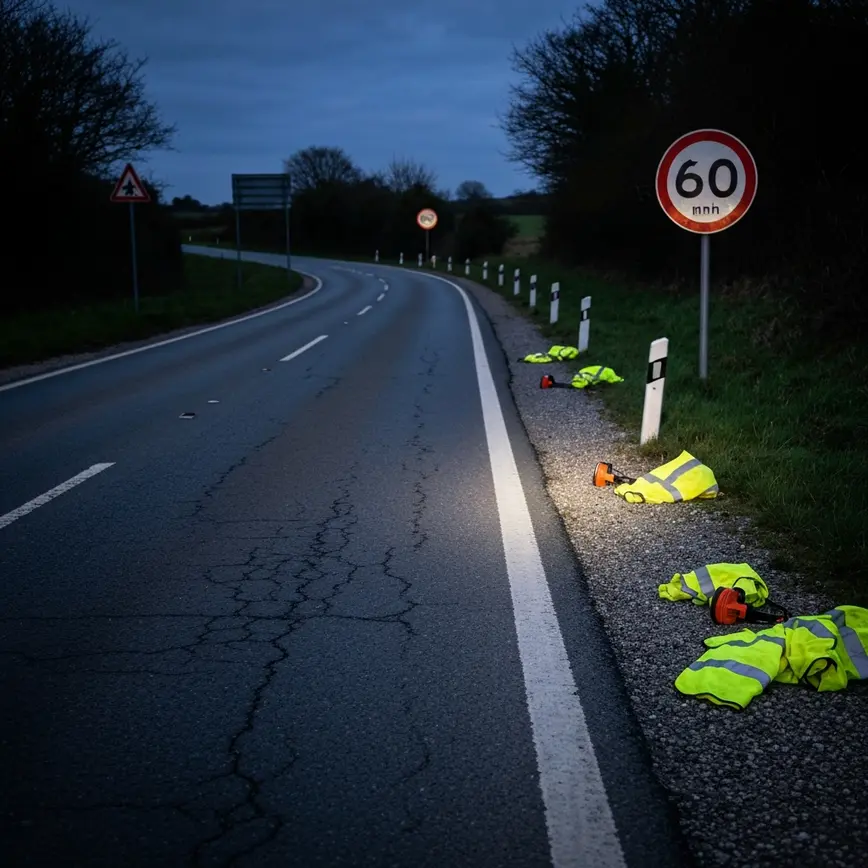
On Christmas Eve 2023, a 22-year-old student officer with West Mercia Police was managing roadside traffic control on a bend in an unlit single carriageway road in Bridgnorth, Shropshire, subject to a 60 mph national speed limit. While positioned to direct traffic in complete darkness, the officer was struck by a passing car, resulting in life-threatening and life-changing injuries. This tragic event highlighted critical shortcomings in roadside traffic control procedures, as the officer was exposed to high-speed vehicles without adequate safeguards.
The Health and Safety Executive (HSE) investigation revealed that the force failed to manage risks from traffic collisions, including inadequate risk assessments, equipment, information, instruction, and training. Despite prior recommendations from the National Police Chiefs’ Council (NPCC) in 2021, these lapses persisted. West Mercia Police pleaded guilty under Sections 2(1) and 3(1) of the Health and Safety at Work etc. Act 1974, leading to an £85,800 fine and £9,402 in costs at Birmingham Magistrates Court on 20 February 2026.
Core safety lesson
The core failure in this incident stemmed from poor roadside traffic control practices, exposing personnel to vehicles traveling at up to 60 mph on an unlit rural road bend. Root causes included ignored NPCC guidelines, lack of dynamic risk assessments, insufficient training, and inadequate equipment, turning a routine task into a near-fatal event.
The Hazard: High-speed traffic on unlit rural road bends, inadequate personal protective equipment for traffic management, and insufficient training and risk assessment for collision response.
The Control: Deploy illuminated traffic cones, delineators, or temporary speed restriction signage; provide high-visibility clothing with retro-reflective bands, impact-resistant vests, and head torches compliant with EN ISO 20471; implement mandatory NPCC-based training with scenario-based drills and site-specific dynamic risk assessments.
These controls are non-negotiable because roadside traffic control demands proactive visibility enhancement and speed reduction to counter the lethal kinetic energy of vehicles at 60 mph, especially in low-light conditions where reaction times plummet. Without illuminated signage and delineators, drivers cannot anticipate personnel, amplifying collision risks. Similarly, substandard PPE fails to provide the necessary conspicuity and protection, as retro-reflective materials are proven to increase detection distance by factors of 10 or more in darkness. Training ensures crews perform dynamic assessments, recognizing that static plans ignore evolving threats like weather or traffic volume, preventing complacency that HSE deemed culpable here.
Supervisor’s discussion guide
Engage your crew with these questions to drive home the lessons on roadside traffic control:
- Q1: “Looking at our own equipment today, where is the biggest risk of high-speed traffic exposure during roadside traffic control?”
- Q2: “How would you conduct a dynamic risk assessment on an unlit road bend before positioning anyone?”
- Q3: “What PPE gaps do we have for low-light roadside traffic control, and how do they compare to EN ISO 20471 standards?”
- Q4: “Recall a past job— what training or signage could have improved our roadside traffic control?”
Action plan & inspection
Immediately after this meeting, inspect and verify the following 5 items:
- Inventory all high-visibility clothing and confirm retro-reflective bands meet EN ISO 20471 for roadside traffic control.
- Check stock of illuminated traffic cones, delineators, and temporary speed restriction signs for immediate deployment.
- Review training records to ensure all personnel have completed NPCC-based roadside traffic control drills within the last 12 months.
- Conduct a spot audit of dynamic risk assessment templates for traffic management scenes.
- Inspect head torches and impact-resistant vests for functionality and compliance in low-light conditions.
Key takeaways
Roadside traffic control is inherently high-risk, as demonstrated by the West Mercia Police case, where failures in risk assessment, equipment, and training led to devastating injuries on a 60 mph unlit bend. Supervisors must enforce illuminated signage, compliant PPE, and rigorous NPCC-aligned training to mitigate collision hazards, ensuring every site-specific assessment accounts for speed, visibility, and dynamic changes.
Proactive controls like retro-reflective gear and speed restrictions are proven lifelines—non-compliance invites HSE enforcement, fines, and irreparable harm. Commit today to zero-tolerance for shortcuts in roadside traffic control, making safety the unbreakable foundation of every operation in 2026 and beyond.
Source & Disclaimer: This toolbox talk is for educational purposes based on public report. Read Original Report