Meeting details
Date: February 19, 2026
Topic: Sewer Gas Confined Space Hazards
Goal: This toolbox talk on sewer gas confined space will review the tragic sewer gas fatalities at the Mobile, Alabama worksite and prevent similar accidents in 2026.
The incident: what happened?
On August 11, 2025, three workers from Construction Labor Services Inc. were installing and repairing sewer lines inside a manhole in Mobile, Alabama, when they were suddenly overcome by sewer gas exposure in the confined space. The toxic gases rendered them unresponsive, with one worker managing to self-rescue after regaining consciousness, while the other two tragically succumbed to their injuries. This devastating event underscores the deadly risks of sewer gas confined space environments where hazardous atmospheres can accumulate rapidly without proper controls.
OSHA launched a thorough investigation, citing the employer with 16 serious violations, including the absence of a confined space entry program, procedures, worker training, emergency response plans, and protocols to determine acceptable entry conditions before work began. The penalties totaled $257,707, highlighting the severe consequences of failing to address sewer gas confined space hazards through established safety protocols. Root causes included no atmospheric testing, lack of ventilation, and inadequate rescue preparations, turning a routine sewer repair into a fatal incident.
Core safety lesson
The technical failures in this incident revolved around ignoring fundamental OSHA requirements for permit-required confined spaces, particularly those involving sewer gas confined space risks like hydrogen sulfide (H2S), carbon monoxide (CO), and oxygen deficiency.
The Hazard: Sewer gas exposure in confined space, which can lead to rapid unconsciousness, respiratory failure, and death due to toxic and asphyxiating gases that displace oxygen and overwhelm the body’s systems without warning.
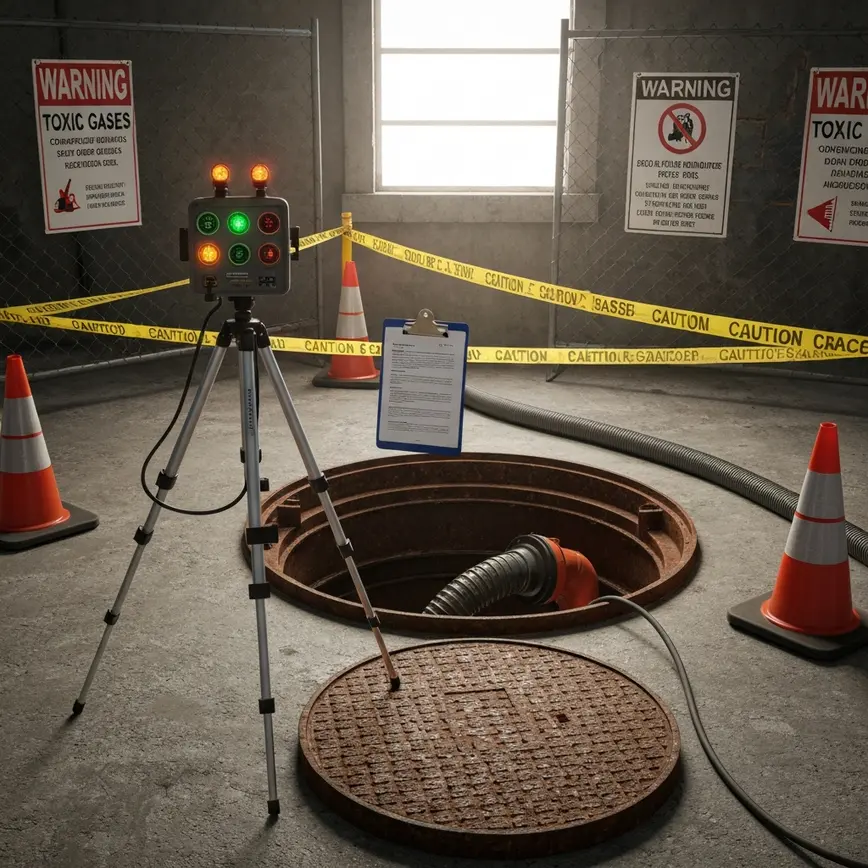
The Control: Implement atmospheric testing with calibrated gas monitors for H2S, CO, and O2 prior to entry, per OSHA 1910.146; develop a written permit-required confined space program with hazard evaluation, isolation, ventilation, and entry permits; provide OSHA-compliant training on hazards, PPE (respirators, harnesses), and emergencies; and establish rescue procedures with attendants, non-entry equipment like tripods and winches, plus coordination with trained external responders.
These controls are non-negotiable because sewer gas confined space atmospheres can change unpredictably—gases stratify, build up from decaying matter, or migrate from connected lines—making pre-entry testing the only reliable way to verify safe conditions. Without a full program, workers enter blindly, as seen in Mobile where no testing occurred, leading to three lives lost. Training ensures recognition of symptoms like dizziness or headaches, while rescue plans prevent secondary fatalities among rescuers. Skipping any element violates OSHA standards and invites catastrophe; compliance isn’t optional—it’s the line between life and death on every job.
Supervisor’s discussion guide
Engage your crew with these questions to drive home the lessons:
- Q1: “Looking at our own equipment today, where is the biggest risk of sewer gas confined space exposure?”
- Q2: “What steps would you take if a gas monitor alarms during atmospheric testing before entry?”
- Q3: “How do we verify that everyone on site has current confined space training and understands rescue signals?”
- Q4: “Walk me through our emergency response plan for a confined space incident—what equipment is ready, and who calls for external help?”
Action plan & inspection
Immediately after this meeting, conduct these 5 critical checks and document completion:
- Inspect all gas monitors for calibration dates and functionality—test with known gas if possible; tag out any overdue units.
- Review and update the site confined space entry program, ensuring permits include atmospheric data, ventilation plans, and attendant roles.
- Verify worker training records for OSHA-compliant confined space certification, including sewer gas confined space recognition and PPE donning.
- Inventory non-entry rescue equipment: tripods, winches, harnesses—confirm all are inspected and accessible near entry points.
- Confirm emergency response coordination: post contacts for local fire/rescue trained in confined space, and drill the plan with the crew.
Key takeaways
Sewer gas confined space work demands unwavering adherence to OSHA 1910.146—never enter without calibrated atmospheric testing, a permitted program, trained personnel, and robust rescue readiness. The Mobile tragedy proves that shortcuts kill: three workers lost because basics like gas monitoring and emergency plans were ignored, resulting in 16 citations and over a quarter-million in fines. Make this your mantra: test first, ventilate continuously, monitor constantly, and rescue smartly.
Supervisors, own this—lead by example, enforce controls daily, and discuss risks at every tailgate. In 2026, zero tolerance for sewer gas confined space complacency means zero fatalities. Sign below to commit, and stay vigilant to send everyone home safe.
Source & Disclaimer: This toolbox talk is for educational purposes based on public report. Read Original Report