Meeting details
Date: February 24, 2026
Topic: Lockout Tagout Procedures: Lessons from Cintas Fatality
Goal: This toolbox talk on lockout tagout procedures will review the Cintas Corporation fatality on July 23, 2025, and equip supervisors and crews with the knowledge to prevent similar accidents in 2026.
The incident: what happened?
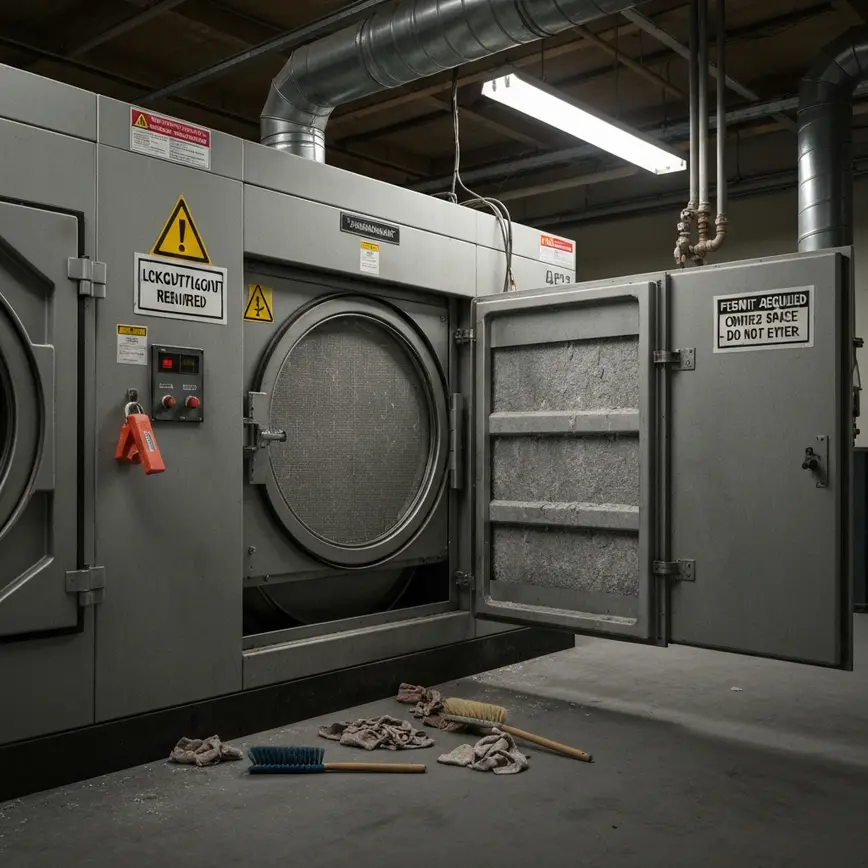
On July 23, 2025, at Cintas Corporation’s facility located at 4345 Federal Drive in Greensboro, North Carolina, a tragic fatality occurred involving 59-year-old employee Jasbeer Singh, a 25-year company veteran. While performing routine maintenance by cleaning a lint filter inside a natural gas-fired industrial dryer, the dryer’s cabinet unexpectedly closed on him, resulting in fatal crushing injuries. A critical failure in following established lockout tagout procedures allowed the equipment to remain energized, permitting this unanticipated movement during the cleaning task.
The North Carolina Department of Labor’s Occupational Safety and Health Division conducted an inspection from July 24, 2025, to January 22, 2026, uncovering multiple serious violations that contributed to the incident. The agency issued a total of $46,000 in fines, including a $16,550 penalty specifically for the lockout/tagout failure, and two $14,895 penalties for confined space violations. Additional issues identified included failure to test air quality for oxygen deficiency, flammable gases, carbon monoxide, and toxins; inadequate identification of hazards; lack of established safe entry conditions; insufficient ventilation in the confined spaces represented by the dryers; and improper reclassification of hazardous spaces without proper safety confirmation. The company was ordered to correct all violations immediately.
Core safety lesson
The technical failure in this incident stemmed from the absence of proper energy isolation during maintenance on energized equipment, compounded by unaddressed confined space hazards. Without lockout tagout procedures in place, the dryer’s mechanical and potential pneumatic or electrical energy sources were not controlled, leading to the fatal closure of the cabinet.
The Hazard: Hazardous energy release from unexpected equipment energization, particularly in confined spaces like industrial dryers, which can crush workers or expose them to asphyxiation, explosions, or toxic atmospheres.
The Control: Implement comprehensive lockout tagout procedures per OSHA 1910.147, which require isolating all energy sources—electrical, mechanical, pneumatic, hydraulic, and thermal—using personalized locks and tags before any maintenance. Verification must include testing for zero energy state prior to re-energization, with group lockout for multiple workers and annual audits of procedures.
Lockout tagout procedures are non-negotiable because they form the last line of defense against predictable yet deadly machine movements during maintenance. In the Cintas case, adherence could have prevented the cabinet’s closure entirely. Beyond LOTO, confined space controls under OSHA 1910.146 demand pre-entry atmospheric testing with calibrated 4-gas meters, continuous ventilation, attendant oversight, and rescue plans—skipping these invites silent killers like oxygen deficiency or flammable vapors. Supervisors must enforce these as a unified system; partial compliance fails everyone.
Supervisor’s discussion guide
Use these questions to engage the crew in a 10-minute dialogue, encouraging honest input on site-specific risks:
Q1: “Looking at our own equipment today, where is the biggest risk of unexpected energization during maintenance?”
Q2: “Have you ever encountered a situation where lockout tagout procedures were skipped? What was the near-miss outcome?”
Q3: “For our confined spaces, like dryers or vessels, what atmospheric tests do we perform before entry, and how do we document them?”
Q4: “How can we improve training and audits to ensure lockout tagout procedures are followed 100% of the time?”
Action plan & inspection
Immediately after this toolbox talk, conduct these 5 mandatory checks and implement corrective actions:
- Inspect all energy isolation points on dryers, presses, and similar equipment for accessible lockout/tagout devices; replace any missing or damaged locks/tags.
- Review and update site-specific lockout tagout procedures, including step-by-step energy isolation sequences for every machine type.
- Verify calibration dates on all 4-gas atmospheric monitors and confined space entry kits; test functionality on-site.
- Audit the last 10 confined space entry permits for complete hazard assessments, ventilation records, and attendant logs.
- Post LOTO and confined space warning signage at all relevant equipment and entry points, with immediate retraining for any non-compliant areas.
Key takeaways
The Cintas fatality underscores that skipping lockout tagout procedures turns routine maintenance into a death trap, as seen with the unexpected dryer cabinet closure that crushed a veteran worker. Every energy source must be isolated, locked, tagged, and verified zero-energy—without exception. Pair this with rigorous confined space protocols: test atmospheres, ventilate continuously, and never reclassify hazards without proof.
Supervisors, own this: enforce lockout tagout procedures daily through audits, training refreshers, and zero-tolerance accountability. In 2026, no fines, no fatalities—because we learned from July 23, 2025. Safe work saves lives; make it non-negotiable on every shift.
Source & Disclaimer: This toolbox talk is for educational purposes based on public report. Read Original Report