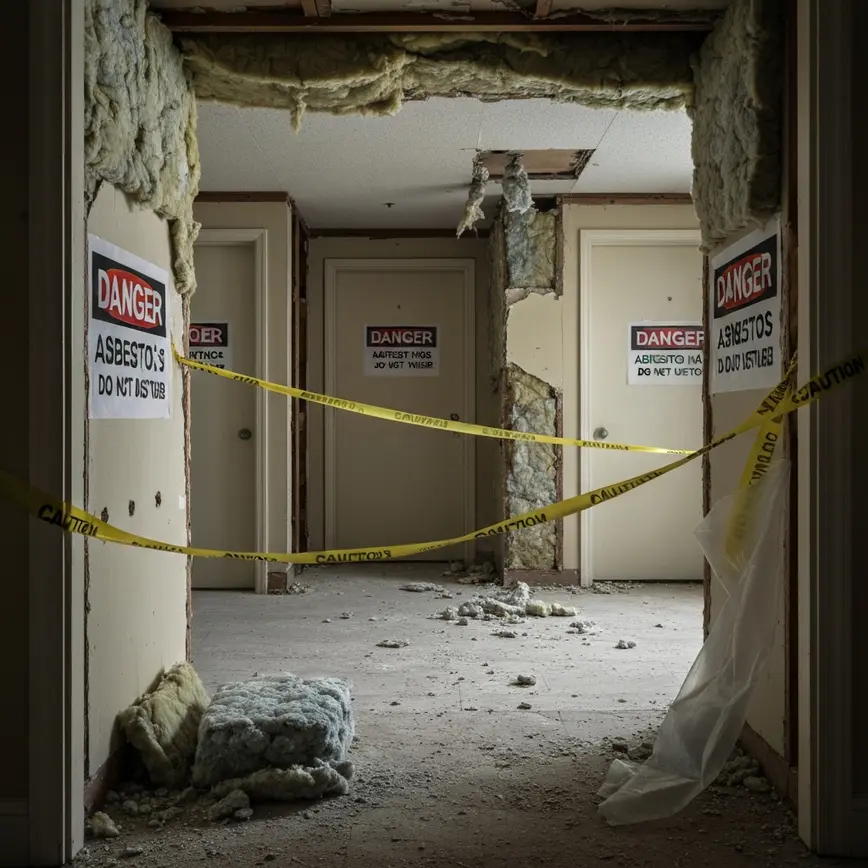
Meeting details
Date: February 12, 2026
Topic: Asbestos Safety Whistleblower Protections
Goal: This toolbox talk on asbestos safety whistleblower issues will review the Houston hotel repair incident involving retaliatory firings and prevent similar accidents in 2026.
The incident: what happened?
During repair work on a hotel damaged by Hurricane Beryl in Houston, Texas, two workers from Rise Construction LLC, owned by Jivar Foty, and Niko Group LLC, owned by Jessica Foty, raised serious concerns about asbestos safety whistleblower protections being ignored. The workers reported a lack of asbestos training, asbestos certification, personal protective equipment (PPE), and illegal dumping of asbestos to the company owners. In response, the workers were fired, which OSHA later determined was retaliatory under the Clean Air Act, Solid Waste Disposal Act, and Toxic Substances Control Act following a whistleblower complaint investigation.
The U.S. Department of Labor’s OSHA ordered the companies to reinstate the two workers and pay over $200,000 in back wages, interest, compensatory damages, and punitive damages. This incident, detailed in OSHA’s news release 25-1633-DAL on February 12, 2026, highlights the severe consequences of ignoring asbestos hazards and retaliating against employees who speak up on asbestos safety whistleblower matters.
Core safety lesson
The technical failures in this case centered on unaddressed asbestos exposure during renovation work, combined with retaliation against workers who flagged the issues, and improper hazardous waste disposal.
The Hazard: Asbestos exposure without proper training, certification, or PPE, leading to inhalation of carcinogenic fibers that cause diseases like mesothelioma; retaliatory discharge for safety complaints; and illegal dumping risking environmental contamination.
The Control: Conduct mandatory asbestos surveys and abatement by certified professionals before demolition or renovation, provide OSHA-compliant respirator PPE and annual training per 29 CFR 1926.1101; implement non-retaliation policies with anonymous reporting channels and train managers on 25 OSHA whistleblower statutes; use licensed hazardous waste haulers for asbestos with manifests complying with EPA Toxic Substances Control Act and Solid Waste Disposal Act.
These controls are non-negotiable because asbestos fibers are invisible, persistent, and incurable once inhaled, with latency periods of 20-50 years for diseases to manifest, making prevention the only defense. Ignoring whistleblowers erodes trust, discourages reporting, and invites OSHA penalties exceeding $200,000 as seen here. Proper disposal prevents widespread public health risks from contaminated sites, ensuring legal compliance and site safety.
Supervisor’s discussion guide
Engage the crew with these questions to reinforce asbestos safety whistleblower awareness:
Q1: “Looking at our own site today, where is the biggest risk of asbestos exposure during renovation work?”
Q2: “What steps would you take if you spotted improper asbestos handling or dumping?”
Q3: “How does our company’s policy protect asbestos safety whistleblower reports from retaliation?”
Q4: “What PPE and training do we have in place for potential asbestos hazards, and is it sufficient?”
Action plan & inspection
- Inspect all renovation areas for asbestos survey documentation and certification from licensed professionals.
- Verify availability and condition of OSHA-compliant respirators and PPE for asbestos handling.
- Review hazardous waste manifests and confirm use of licensed haulers for any asbestos-containing materials.
- Conduct a walkthrough to ensure warning signs are posted in potential asbestos zones.
- Distribute and confirm receipt of non-retaliation policy and whistleblower reporting channels to all crew members.
Key takeaways
This toolbox talk on asbestos safety whistleblower protections underscores that speaking up about hazards like missing training, PPE, or illegal dumping is protected by federal law, and retaliation leads to severe financial and operational consequences, as proven by the over $200,000 OSHA penalties in the Houston case. Supervisors must foster a culture where concerns are addressed immediately, not punished.
Implement rigorous controls—pre-job asbestos surveys, certified abatement, proper PPE per 29 CFR 1926.1101, and compliant waste disposal—to eliminate exposure risks. By prioritizing these, we safeguard worker health, comply with OSHA and EPA regulations, and avoid disruptions in 2026 and beyond.
Source & Disclaimer: This toolbox talk is for educational purposes based on public report. Read Original Report