Meeting details
Topic: Racking Collapse Hazards During Load Testing
Goal: This toolbox talk on racking collapse hazards will review the tragic racking collapse at Castefields Industrial Estate and prevent similar accidents in 2026.
The incident: what happened?
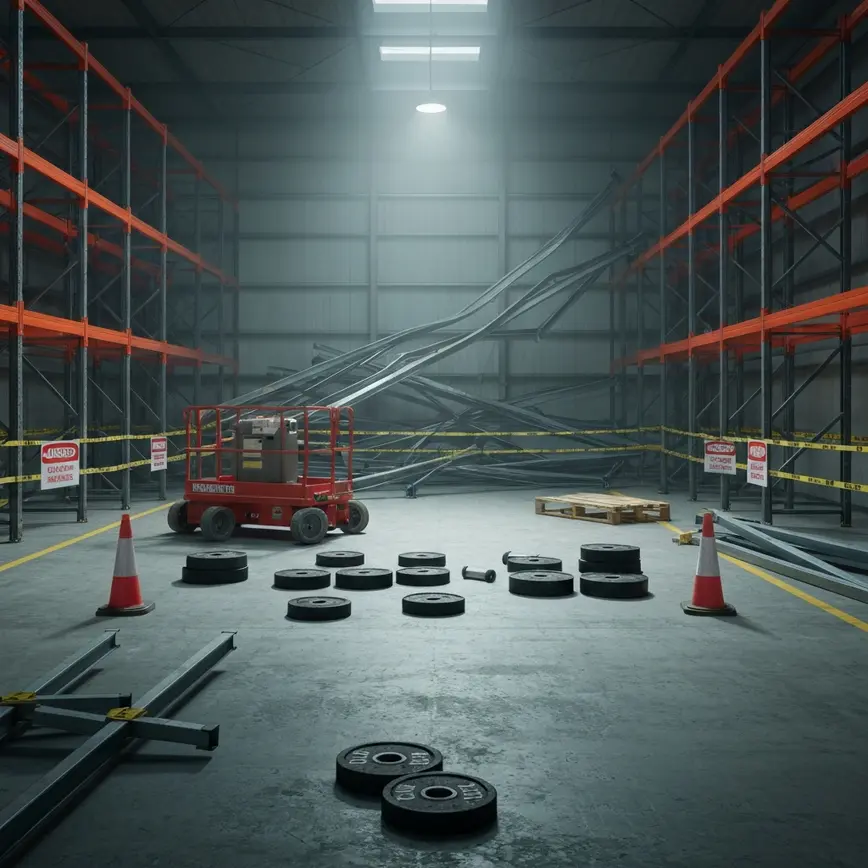
On 29 October 2020, at Castefields Industrial Estate in Bingley, near Bradford, West Yorkshire, an industrial racking system collapsed during load testing with weights up to two tonnes. This incident highlighted severe racking collapse hazards when workers were positioned too close to the structure. The collapsing racking struck a mobile elevating work platform (MEWP) positioned next to it, overturning the platform and resulting in the deaths of two workers: Lee Horton, 58, the managing director of Space Productiv Ltd, and Daron Pickstock, 43, a self-employed worker for Collins Site Services Ltd.
The Health and Safety Executive (HSE) investigation revealed critical failures in risk assessment and safe systems of work, with workers inside the collapse zone. On 11 February 2026, at Leeds Crown Court, Space Productiv Ltd was fined £97,500 plus £17,377 in costs for breaching Sections 2(1) and 3(1) of the Health and Safety at Work etc. Act 1974. Collins Site Services Ltd was fined £60,000 plus £10,292 in costs for breaching Section 3(1). These penalties underscore the deadly consequences of ignoring racking collapse hazards.
Core safety lesson
The technical failure stemmed from workers being inside the racking collapse zone during load testing, inadequate risk assessments, and unsafe MEWP positioning adjacent to the loaded structure. These lapses allowed heavy loads—up to two tonnes—to destabilize the racking without proper safeguards.
The Hazard: Workers positioned within the racking collapse zone during load testing, inadequate risk assessment for heavy loads, and unsafe MEWP use next to unstable racking.
The Control: Establish and enforce exclusion zones with barriers and signage; conduct thorough risk assessments with engineered controls like bracing and progressive loading; require method statements for MEWP use from safe distances with spotters and pre-use inspections.
These controls are non-negotiable because racking collapse hazards can release massive kinetic energy, as seen with two tonnes of weights, turning everyday testing into a fatal event. Exclusion zones ensure no one enters the danger area, while risk assessments identify site-specific weaknesses like structural fatigue or overload. MEWP protocols prevent secondary impacts, protecting against chain reactions. Implementing them rigorously saves lives and avoids crippling fines, as proven by the HSE prosecutions.
Supervisor’s discussion guide
Engage your crew with these questions to drive home the racking collapse hazards:
Q1: “Looking at our own equipment today, where is the biggest risk of racking collapse hazards during loading or testing?”
Q2: “What exclusion zone measures have we used before, and how can we improve them for load testing?”
Q3: “How would you ensure a thorough risk assessment identifies all potential collapse triggers on our site?”
Q4: “If using a MEWP near racking, what safe distancing and inspection steps must we follow?”
Action plan & inspection
Immediately after this meeting, verify and implement these 5 checks:
- Inspect all racking systems for damage, overload signs, or instability, documenting findings with photos.
- Establish marked exclusion zones around any racking under load testing or heavy use, using barriers and signage.
- Review and update risk assessments for all racking-related tasks, including load limits up to two tonnes.
- Confirm MEWP pre-use inspections and method statements prohibit positioning near potential racking collapse zones.
- Train spotters on remote monitoring protocols and enforce no-entry during testing.
Key takeaways
Racking collapse hazards demand zero tolerance: never allow personnel in collapse zones during load testing, always prioritize comprehensive risk assessments, and position equipment like MEWPs at safe distances. The Castefields tragedy—two lives lost, heavy fines levied—proves that shortcuts in these areas lead to irreversible consequences. Supervisors must lead by enforcing exclusion zones, barriers, signage, bracing, and inspections every time.
Make this toolbox talk actionable: commit to these controls today to protect your team in 2026 and beyond. Lives depend on vigilance against racking collapse hazards.
Source & Disclaimer: This toolbox talk is for educational purposes based on public report. Read Original Report