Meeting details
Topic: Chemical Decanting Safety
Goal: This toolbox talk on chemical decanting safety will review the Flowchem UK Ltd chemical burns incident and prevent similar accidents in 2026.
The incident: what happened?
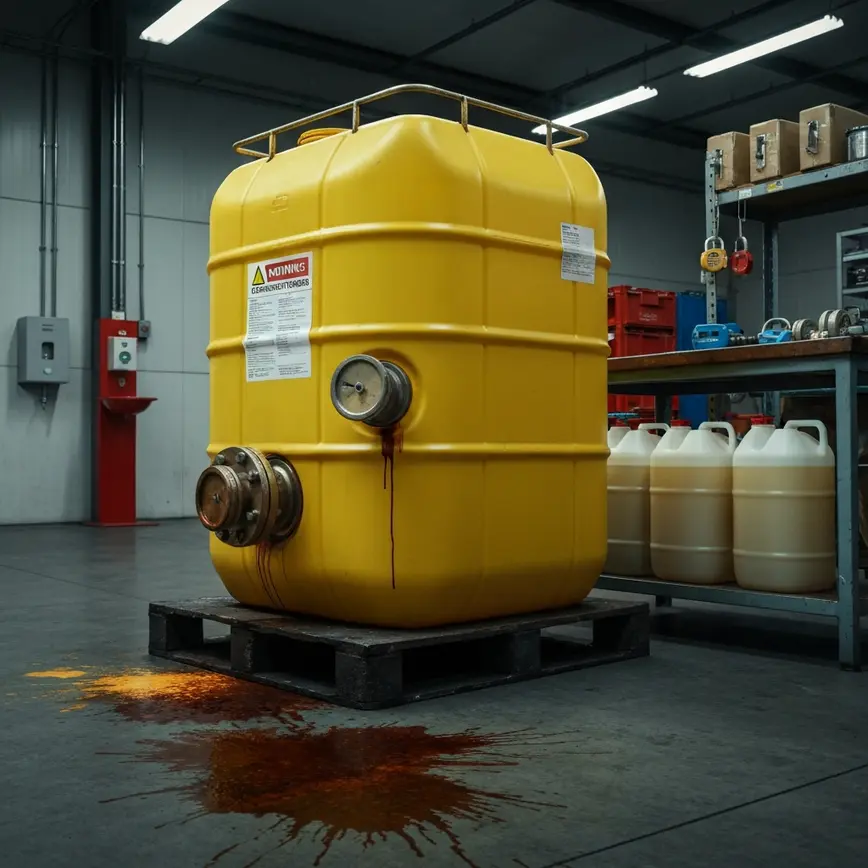
On 2nd November 2023 at Flowchem UK Ltd’s manufacturing site in Nottingham, agency worker Marzanna Sokolowska was involved in decanting operations, transferring corrosive sink and drain un-blocker from a 1,000-litre bulk container into smaller containers. During this process, critical lapses in chemical decanting safety led to tragedy when she accidentally opened the wrong valve, causing the highly corrosive liquid to spray under pressure directly onto her face, eye, neck, and arm, resulting in severe chemical burns. The HSE investigation revealed that the decanting setup was at shoulder height with no end cap on an adjacent valve, creating an immediate hazard for accidental release.
Compounding the incident were inadequate training, particularly for workers with limited English proficiency, routine non-use of provided personal protective equipment (PPE) due to poor supervision, and insufficient first aid facilities—only eye-wash bottles were available, with no emergency shower for large-scale exposure. Flowchem UK Ltd pleaded guilty to breaches of Sections 2(1) and 3(1) of the Health and Safety at Work etc. Act 1974. On 12 February 2026, at Nottingham Magistrates Court, the company was fined £50,000, ordered to pay £7,247.40 in costs, and a £2,000 victim surcharge.
Core safety lesson
The technical failure in this incident stemmed from multiple breakdowns in chemical decanting safety protocols, but the primary trigger was an unprotected outlet valve on the bulk chemical container, combined with flawed work systems and oversight.
The Hazard: Accidental release of corrosive liquid under pressure from an unprotected or uncapped valve during decanting, especially at shoulder height where splashes can directly impact the upper body, leading to severe burns without immediate mitigation.
The Control: Fit end caps or locks on all valves not in use, implement lockout/tagout (LOTO) procedures, provide task-specific training in accessible languages with competency checks, enforce PPE use through active supervision, and install COSHH-compliant emergency facilities like eyewash stations and deluge showers scaled to exposure risks.
These controls are non-negotiable because corrosive chemicals like sink un-blockers react instantly with skin and eyes, causing irreversible tissue damage in seconds—end caps and LOTO prevent unintended releases by design, eliminating human error as a factor. Training and supervision address comprehension gaps, particularly for agency workers, ensuring every team member recognizes hazards; without them, even provided PPE goes unused, as seen here. Finally, inadequate first aid amplifies minor exposures into life-altering injuries—proper showers neutralize chemicals rapidly, aligning with legal standards under COSHH and HSWA, protecting both workers and company liability.
Supervisor’s discussion guide
Engage your crew with these questions to drive home chemical decanting safety:
Q1: “Looking at our own equipment today, where is the biggest risk of accidental valve release during chemical decanting?”
Q2: “How can language barriers or agency worker status impact our training effectiveness, and what checks do we need?”
Q3: “What PPE is mandatory for chemical handling, and how do we ensure it’s worn every time?”
Q4: “If a splash occurs, what emergency steps are available here, and are they sufficient for a 1,000-litre release?”
Action plan & inspection
Immediately after this meeting, conduct these 5 checks and implement actions:
- Inspect all bulk chemical containers for end caps or locks on unused valves; apply immediately if missing.
- Review decanting setups—ensure no operations at shoulder height without barriers; relocate or engineer guards.
- Verify PPE stock and enforcement logs; conduct a spot audit on usage compliance.
- Audit training records for chemical decanting safety, especially agency staff; schedule retraining in plain language with assessments.
- Check emergency facilities—confirm eyewash stations are functional and install/verify deluge showers per COSHH for high-risk areas.
Key takeaways
Chemical decanting safety demands zero tolerance for shortcuts: unprotected valves, skipped training, ignored PPE, and weak emergency response turned a routine task into a £50,000 prosecution and lifelong injuries. Supervisors must lead by enforcing LOTO, competency-based training, and full PPE adherence, recognizing that agency workers or language barriers heighten risks without tailored oversight.
By prioritizing these controls today, we safeguard our sites in 2026 and beyond—inspect now, train rigorously, and supervise relentlessly. No incident is inevitable; every hazard has a proven control. Commit to chemical decanting safety as your non-negotiable standard.
Source & Disclaimer: This toolbox talk is for educational purposes based on public report. Read Original Report