Meeting details
Date: February 13, 2026
Topic: Preventing Combustible Dust Explosion Hazards
Goal: This toolbox talk on combustible dust explosion will review the tragic Horizon Biofuels incident in Fremont, Nebraska, and equip supervisors with actionable steps to prevent similar accidents in 2026.
The incident: what happened?
On July 29, 2025, a devastating combustible dust explosion rocked the Horizon Biofuels Inc. facility in Fremont, Nebraska, claiming the lives of a day-shift operator and his two daughters, aged 8 and 12, who were visiting in the break room. The blast originated from the ignition of a large release of combustible wood dust generated during processing operations. This primary explosion triggered extensive structural damage to the production tower, offices, and warehouse, followed by fires that smoldered for over a month, highlighting the severe destructive power of such events in small facilities with only 5 employees total, where the operator was working alone on shift.
The U.S. Chemical Safety and Hazard Investigation Board (CSB) preliminary findings confirmed the combustible dust explosion as the likely cause, while OSHA’s investigation, launched the same day, issued $147,542 in fines for willful and serious violations. These included combustible dust buildup throughout the facility, failure to protect equipment from ignition sources, and lack of fall protection for work above 4 feet. The incident underscores how unchecked dust accumulations and ignition risks can lead to catastrophic outcomes, even in low-staff environments.
Core safety lesson
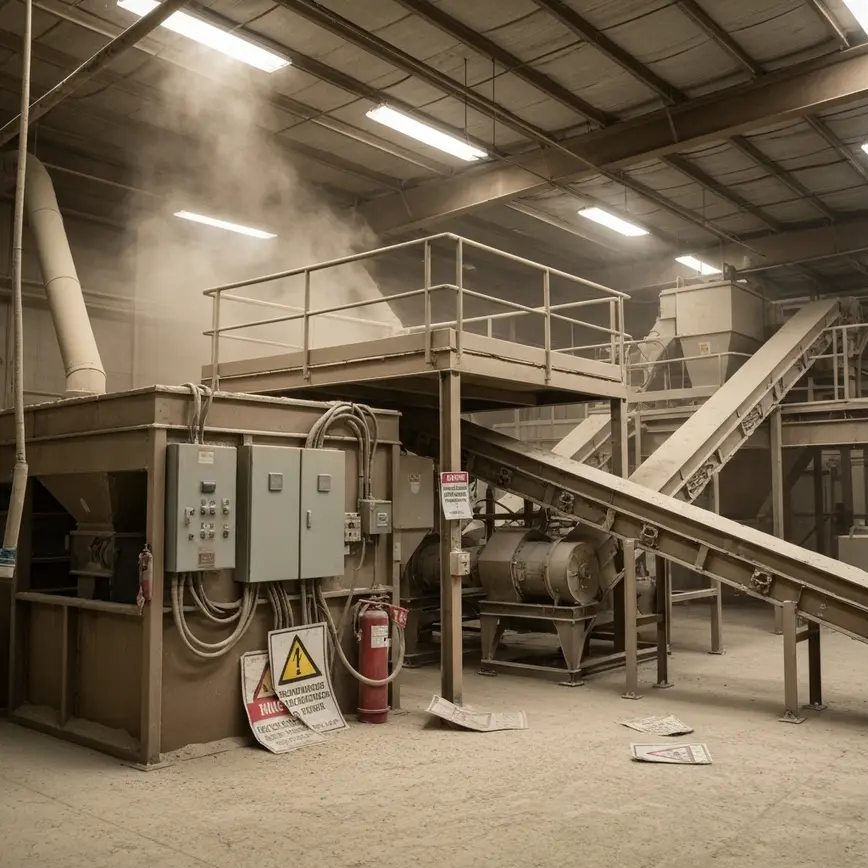
The Horizon Biofuels incident exemplifies how a combustible dust explosion can occur when fine particulate matter like wood dust accumulates and encounters an ignition source. The technical failures were multifaceted: excessive combustible dust buildup created a fuel source primed for explosion, unguarded ignition sources such as static sparks or hot equipment provided the trigger, and ancillary issues like missing fall protection compounded risks during response efforts.
The Hazard: Combustible dust explosion from wood dust accumulation, ignition sources, and unauthorized access in hazardous areas.
The Control: Rigorous housekeeping with dust collection systems per OSHA and NFPA 654 standards; explosion-proof electrical equipment, grounding/bonding, and hot work permits; plus fall protection systems (guardrails, harnesses) for heights over 4 feet and strict access controls prohibiting unauthorized personnel, including children, via signage and locks.
These controls are non-negotiable because combustible dust explosions propagate rapidly, creating overpressures that demolish structures and sustain fires, as seen with the month-long smoldering at Horizon Biofuels. Regular vacuuming and ventilation keep dust below explosive limits, while ignition controls eliminate sparks—static alone can ignite concentrations as low as 30-50g/m³. Fall protection and access restrictions prevent secondary injuries and ensure hazards remain isolated from non-essential personnel, saving lives in facilities where a single operator might be overwhelmed.
Supervisor’s discussion guide
Engage your crew with these 4 targeted questions to drive home the risks of a combustible dust explosion:
Q1: “Looking at our own equipment today, where is the biggest risk of combustible dust buildup?”
Q2: “What ignition sources have we seen lately, and how do we confirm our equipment is explosion-proof?”
Q3: “How do we enforce no unauthorized visitors, especially in break rooms near processing areas?”
Q4: “For any work above 4 feet, what fall protection do we have in place right now?”
Action plan & inspection
Immediately after this meeting, conduct these 5 critical checks and document findings:
- Inspect all surfaces—floors, beams, equipment—for combustible dust buildup exceeding 1/32 inch; vacuum and document removal.
- Verify explosion-proof ratings on electrical equipment, grounding straps, and absence of hot work without permits.
- Check elevated work areas (>4 feet) for guardrails, harnesses, or personal fall arrest systems; install if missing.
- Audit access points: confirm locks, signage prohibiting unauthorized entry (no children/visitors in hazardous zones), and visitor logs.
- Test dust collection systems and ventilation for proper function; schedule maintenance if airflow is inadequate.
Key takeaways
The Horizon Biofuels combustible dust explosion on July 29, 2025, serves as a stark reminder that even small facilities with minimal staff face lethal risks from wood dust accumulations and ignition sources. Key lessons include immediate implementation of NFPA 654 housekeeping, explosion-proof safeguards, and fall protection per OSHA 1910.28, alongside ironclad access controls to protect all personnel.
By prioritizing these measures today, we prevent history from repeating in 2026. Supervisors: lead by example, inspect daily, and report hazards promptly—because complacency costs lives, as tragically shown by the $147,542 fines and irreplaceable losses at Horizon Biofuels.
Source & Disclaimer: This toolbox talk is for educational purposes based on public report. Read Original Report