Meeting details
Date: January 29, 2026
Topic: Refinery Fire Prevention: Lessons from Pemex Dos Bocas Incident
Goal: This toolbox talk on refinery fire prevention will review the recent fire at the Pemex Dos Bocas Refinery and equip supervisors with strategies to prevent similar accidents in 2026.
The incident: what happened?
Last week, a small fire broke out at the Pemex 340,000 b/d Dos Bocas refinery in Paraíso, Tabasco, Mexico. This event highlights the ongoing challenges in refinery fire prevention within high-capacity processing environments where flammable hydrocarbons are handled daily. Although the specific ignition source was not detailed in reports, such incidents often stem from uncontrolled ignition near vapors or leaks, emphasizing why robust refinery fire prevention measures are essential in these operations.
Fortunately, the fire was quickly extinguished, and the refinery is now operating normally with no reported injuries or significant disruptions. The rapid resolution underscores the value of effective response systems, but it also serves as a stark reminder that even small fires in a facility of this scale—processing 340,000 barrels per day—can escalate rapidly without proper safeguards in place.
Core safety lesson
In refinery operations, fires typically arise from ignition of flammable hydrocarbons or vapors, equipment failures leading to leaks, or inadequate initial response. Drawing from this incident, we must prioritize three critical hazards and their controls to strengthen refinery fire prevention protocols.
The Hazard: Ignition of flammable hydrocarbons or vapors in refinery processing areas.
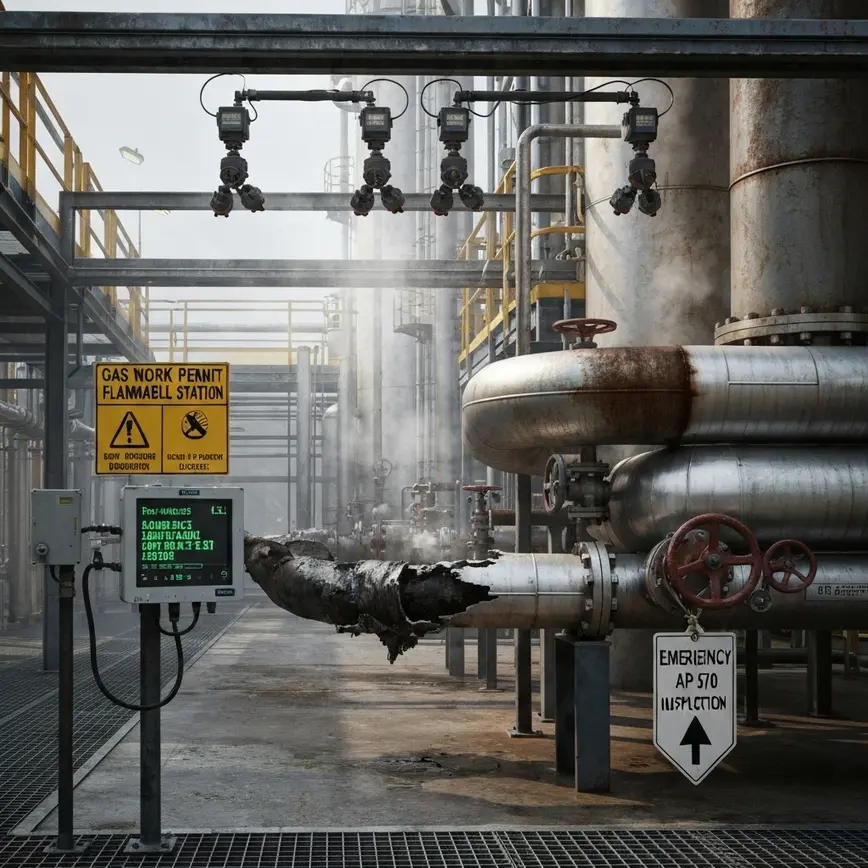
The Control: Implement hot work permits and gas detection systems to monitor LEL (lower explosive limit) levels before ignition sources are introduced.
This control is non-negotiable because refineries operate in atmospheres where vapors can accumulate invisibly, reaching explosive concentrations without warning. Gas detectors provide real-time LEL monitoring, alerting teams to evacuate or ventilate before hot work—like welding or grinding—begins, preventing sparks from igniting a catastrophe.
The Hazard: Equipment failure or leak leading to fire initiation in high-capacity refining operations (340,000 b/d scale).
The Control: Conduct regular preventive maintenance and integrity testing on process equipment per API 570/510 standards, including pressure relief and isolation valves.
Routine inspections per these API standards detect corrosion, wear, or weaknesses in piping and vessels before leaks occur, which could release fuel for a fire. In a 340,000 b/d facility, a single failure amplifies risks exponentially, making scheduled maintenance the backbone of refinery fire prevention.
The Hazard: Inadequate initial response allowing fire escalation in a hazardous materials environment.
The Control: Deploy automated deluge fire suppression systems and ensure emergency shutdown (ESD) procedures are tested quarterly with trained response teams.
Automated systems like deluge sprays activate instantly to cool and suppress flames, while ESD isolates fuel sources. Quarterly testing ensures reliability, as delays in response can turn a small fire into a major incident, saving lives and assets through proactive refinery fire prevention.
Supervisor’s discussion guide
Engage your crew with these questions to drive home the lessons:
Q1: “Looking at our own equipment today, where is the biggest risk of ignition from flammable vapors?”
Q2: “How do we ensure hot work permits and LEL monitoring are followed every time before starting tasks?”
Q3: “What maintenance records should we review right now to confirm API 570/510 compliance on critical valves?”
Q4: “In a refinery fire prevention scenario like Pemex, how quickly can our ESD and deluge systems activate, and when was the last test?”
Action plan & inspection
- Verify all hot work permits are current and LEL gas detectors are calibrated and operational in processing areas.
- Inspect pressure relief and isolation valves for leaks or wear, cross-referencing against latest API 570/510 inspection logs.
- Test emergency shutdown (ESD) buttons and confirm quarterly drill records are up to date.
- Check automated deluge fire suppression systems for nozzle blockages and water supply pressure.
- Review site maintenance schedules to ensure no overdue preventive tasks on hydrocarbon-handling equipment.
Key takeaways
Refinery fire prevention demands unwavering commitment to hot work permits, gas monitoring, preventive maintenance per API standards, and tested ESD/deluge systems. The Pemex Dos Bocas incident—a small fire swiftly contained—reminds us that proactive controls prevent escalation in 340,000 b/d operations, protecting personnel and operations from preventable losses.
As supervisors, lead by enforcing these measures daily. No shortcuts: inspect, test, and train relentlessly. This toolbox talk reinforces that refinery fire prevention is not optional—it’s the difference between normal operations and disaster in our high-hazard environments.
Source & Disclaimer: This toolbox talk is for educational purposes based on public report. Read Original Report