Meeting details
Topic: Interlock Gate Failures in Production Line Access
Date: January 30, 2026
Goal: This toolbox talk on interlock gate failures will review the Tarmac Building Products Limited incident at their Linford, Essex plant on 22 July 2022 and prevent similar accidents in 2026.
The incident: what happened?
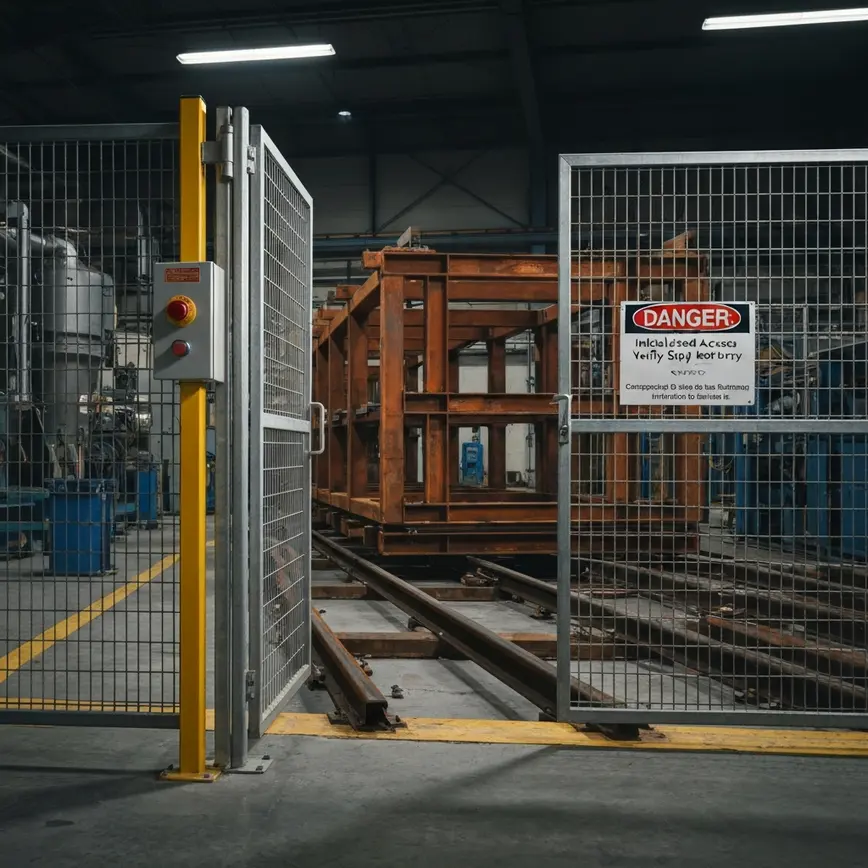
On 22 July 2022 at the Tarmac Building Products Limited plant in Linford, Essex, a worker named Richard Ogunleye entered a fenced area through an interlocked gate to manually clean and inspect one-tonne metal frames moving along a production line trackway. Due to interlock gate failures, the system did not stop power on the preceding track sections, allowing another heavy frame to continue moving into the fenced danger zone. This frame crushed and pinned his legs between the frames, and the continued motion began dragging him toward nearby machinery before a colleague activated the emergency stop, averting even more severe consequences.
Richard Ogunleye suffered a broken right leg, which required repair with a metal rod and screws, along with severe bruising to his left leg. He spent 2 weeks in the hospital, was off work for over a year, and underwent extensive physiotherapy. The HSE investigation uncovered prior near-misses on the same track section that had been ignored, as well as a risk assessment from years earlier that identified necessary controls which were not implemented until after the incident. Tarmac Building Products Limited pleaded guilty under Section 2(1) of the Health and Safety at Work etc. Act 1974 and was fined £633,300 plus costs at Chelmsford Magistrates’ Court on 29 January 2026.
Core safety lesson
The core issue in this incident stemmed from interlock gate failures that permitted access to a live danger zone without fully isolating upstream machinery motion. This highlights the critical need for robust engineering controls in environments with moving parts like production line trackways.
The Hazard: Inadequate interlock system on access gate failing to isolate power/motion on upstream track sections, allowing moving frames to enter the danger zone; unguarded access to moving machinery parts during cleaning/inspection, exposing workers to crush/pinch points; failure to investigate and act on prior near-misses and risk assessment recommendations.
The Control: Implement fully effective interlocks that cut power and halt motion across all relevant track sections upon gate opening, per HSE guidance on Provision and Use of Work Equipment Regulations (PUWER) L22; install fixed or interlocked guards preventing access to danger zones, with zero-energy state verification before entry; establish routine monitoring and investigation processes for all incidents/near-misses (per HSE HSG245 and HSG65), implementing identified control measures promptly with documented follow-up and worker training.
These controls are non-negotiable because interlock gate failures can turn routine tasks like cleaning into life-altering catastrophes, as seen with the one-tonne frames crushing legs and dragging a worker toward machinery. PUWER mandates that machinery must be safe under all foreseeable conditions, and partial interlocks create a false sense of security, ignoring the chain reaction of upstream motion. Equally vital is addressing near-misses proactively—ignoring them, as in this case, allows hazards to escalate, leading to preventable injuries and massive fines. Zero-energy verification ensures no residual motion, protecting workers every time, while documented investigations build a culture of accountability that HSE enforcement demands.
Supervisor’s discussion guide
Use these questions to engage the crew for 5-7 minutes, encouraging specific examples from our site:
- Q1: “Looking at our own equipment today, where is the biggest risk of interlock gate failures?”
- Q2: “Have we had any near-misses with access gates or moving parts on trackways, and what did we do about them?”
- Q3: “How do we verify zero-energy state before entering any fenced machinery area?”
- Q4: “What would you do if an interlock gate doesn’t fully stop upstream motion during a test?”
Action plan & inspection
Immediately after this toolbox talk, conduct these 5 checks and document results. Assign owners and due dates:
- Inspect all interlock gates on production lines/trackways to confirm they cut power and halt motion on all upstream sections when opened.
- Test emergency stops and zero-energy verification procedures for every guarded access point, simulating gate openings.
- Review logs for any prior near-misses or risk assessments related to machinery access, and implement overdue controls within 7 days.
- Verify fixed or interlocked guards are in place and secure around all crush/pinch points on moving equipment.
- Train all crew on PUWER requirements for interlocks and report any interlock gate failures immediately to supervision.
Key takeaways
Interlock gate failures are not just technical glitches—they are systemic risks that can crush limbs, end careers, and cost companies over £600,000 in fines, as proven by the Tarmac incident. Every supervisor must enforce full isolation of motion before entry, investigate near-misses without delay, and maintain guards that workers can trust. Complacency on prior warnings turns hazards into tragedies.
Commit to zero tolerance: test interlocks daily, document everything, and verify zero energy every time. This toolbox talk reinforces that proactive controls under PUWER and HSE guidance save lives—make it your standard for 2026 and beyond.
Source & Disclaimer: This toolbox talk is for educational purposes based on public report. Read Original Report