Meeting details
Date: January 28, 2026
Topic: Trench Collapse Prevention and Multi-Hazard Controls
Goal: This toolbox talk on trench collapse prevention will review the CB&A Construction trench collapse exposure incident in Bessemer, Alabama, and equip supervisors and crews with strategies to prevent similar accidents in 2026.
The incident: what happened?
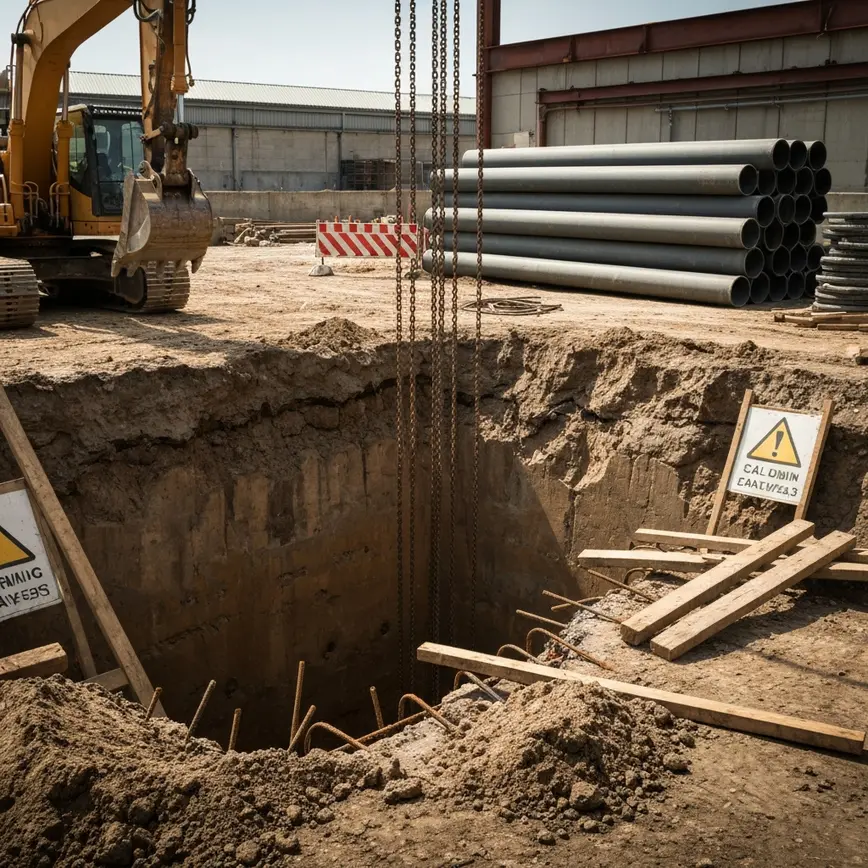
At a CB&A Construction LLC worksite in Jefferson County, Bessemer, Alabama—near the Birmingham area—workers faced severe risks during drain pipe removal and installation for Jefferson County. The U.S. Department of Labor’s OSHA investigation revealed that employees were exposed to trench collapse hazards while operating at the unguarded edge of an excavation under a suspended load. This incident underscores the critical need for trench collapse prevention measures, as the unprotected trench posed an imminent cave-in risk, compounded by the overhead load of pipes being handled directly above the work zone. Additional violations included workers lacking hard hats and operating without protective restraints, highlighting multiple layers of non-compliance in a high-hazard environment aligned with OSHA’s national emphasis program on trenching and excavation.
OSHA classified the primary violation as willful, proposing penalties of $170,145, with the company given 15 business days to respond. No injuries were reported in this case, but the exposure was extreme: workers positioned themselves at the trench edge without sloping, shoring, shielding, or trench boxes, directly beneath suspended loads from equipment. The absence of head protection further exposed them to falling objects or strikes from overhead activities, demonstrating how interconnected hazards can escalate rapidly on excavation sites.
Core safety lesson
The technical failures at this CB&A site boiled down to absent protective systems for excavations deeper than five feet, prohibited work under suspended loads, and non-enforced PPE usage. Trench collapse prevention was entirely overlooked, allowing vertical walls to remain unprotected and workers to encroach on the danger zone.
The Hazard: Trench collapse risk from unprotected excavations, working under suspended loads, and lack of head protection in a construction environment prone to falling objects.
The Control: Implement OSHA 1926.652 protective systems such as sloping, shoring, shielding, or trench boxes, with daily inspections by a competent person; strictly prohibit work under suspended loads per OSHA 1926.1423-1425 using exclusion zones, tag lines, and signal persons; and mandate ANSI-compliant hard hats via site-wide hazard assessments under OSHA 1926.100.
These controls are non-negotiable because trench collapses occur suddenly and without warning, with soil weights capable of exerting thousands of pounds per square foot—far exceeding human endurance. In 2026, as OSHA intensifies focus on high-hazard industries, willful neglect like this invites not just fines exceeding $170,000 but potential fatalities; prevention systems distribute loads and stabilize walls, buying critical seconds for escape. Suspended load prohibitions eliminate crush risks, as even momentary equipment failure can be lethal, while hard hats mitigate the blunt force of inevitable site debris, ensuring every layer of defense is active.
Enforcing these isn’t optional—it’s a legal and ethical imperative. Competent person inspections catch soil changes, water accumulation, or vibrations from nearby operations that precede collapses, directly addressing the Bessemer scenario where edge work amplified instability.
Supervisor’s discussion guide
Engage your crew with these questions to drive home the lessons (allow 2-3 minutes per response):
- Q1: “Looking at our own site today, where is the biggest risk of trench collapse?”
- Q2: “How would you identify if a trench needs immediate protective systems like shoring or a trench box?”
- Q3: “What steps do we take to ensure no one works under suspended loads, and why is exclusion zoning critical?”
- Q4: “In our daily hazard assessments, how do we enforce hard hat usage and restraints near excavations?”
Action plan & inspection
Immediately after this toolbox talk, conduct these 5 checks and document compliance:
- Inspect all active trenches for protective systems (sloping, shoring, shielding, or boxes) and verify daily competent person inspection logs.
- Review lifting plans to confirm no work zones under suspended loads, with visible exclusion zones marked and tag lines in use.
- Perform a site-wide PPE audit, ensuring 100% ANSI-compliant hard hats and restraints for edge work.
- Locate and test nearby utilities, confirming safe excavation distances per OSHA standards.
- Update job safety analyses (JSAs) to incorporate trench collapse prevention protocols specific to drain pipe operations.
Key takeaways
Trench collapse prevention demands unwavering commitment: always protect excavations with engineered systems, ban work under loads, and enforce PPE without exception. The CB&A incident in Bessemer proves that shortcuts lead to willful violations, massive penalties like $170,145, and crew endangerment—lessons we integrate today to safeguard 2026 operations under OSHA’s emphasis program.
Supervisors, lead by example: inspect daily, discuss hazards openly, and act decisively. Every trench, load, and helmet check reinforces our zero-tolerance culture, turning potential tragedies into testimonials of proactive safety.
Source & Disclaimer: This toolbox talk is for educational purposes based on public report. Read Original Report