Meeting details
Topic: Work-Related Fatalities Toolbox Talk: Lessons from the 2025/26 HSE Report
Goal: This toolbox talk on work-related fatalities toolbox talk will review the 2025/26 HSE statistics on worker deaths and prevent similar accidents in 2026.
The incident: what happened?
In this work-related fatalities toolbox talk we examine the official HSE figures for 2025/26 that record 126 worker fatalities across Great Britain. Construction accounted for 25 of these deaths and agriculture, forestry and fishing for a further 22, together representing 47 fatalities. Falls from height remained the leading cause with 31 deaths, while workers aged 60 and over suffered 40 fatalities despite forming only 12 % of the workforce. An additional 104 members of the public also lost their lives in work-related incidents during the same period.
The data confirm that Great Britain’s fatal-injury rate continues to rank among the lowest internationally when compared with 35 other countries, yet the concentration of deaths in two high-risk sectors and among older workers highlights persistent gaps in control measures. These figures represent the lowest provisional annual total outside pandemic years, underscoring both progress and the urgent need for renewed vigilance on every site.
Core safety lesson
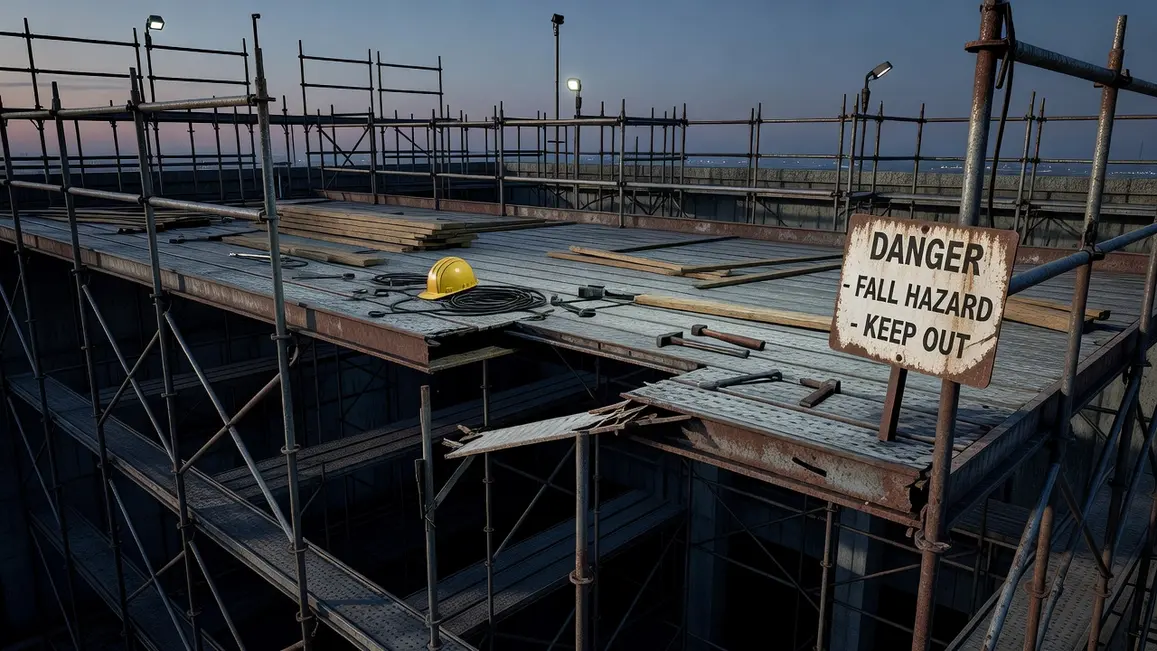
The Hazard: Falls from height during construction and maintenance tasks.
The Control: Mandatory use of collective protection (guardrails, scaffolding, MEWPs) and personal fall-arrest systems with 100 % tie-off, coupled with task-specific risk assessments and rescue plans.
Falls from height caused 31 of the 126 worker deaths, demonstrating that reliance on individual behaviour alone is insufficient. Collective protection systems create a physical barrier that remains effective even if a worker becomes distracted or fatigued, while 100 % tie-off ensures continuous connection to an anchor point. Without these layered controls, a momentary lapse can result in immediate fatality.
Task-specific risk assessments must identify every potential fall exposure before work begins, and rescue plans must be practised so that any fallen worker can be recovered within minutes. These measures are non-negotiable because the statistics show that older workers, who already face elevated risk, suffer disproportionately when such systems are absent or incomplete.
Supervisor’s discussion guide
Q1: “Looking at our own equipment today, where is the biggest risk of falls from height?”
Q2: “How do we currently verify that every harness is tied off at 100 % during elevated tasks?”
Q3: “What additional controls should we apply for workers aged 60 and over who perform the same high-risk activities?”
Q4: “In this work-related fatalities toolbox talk, which of the reported sectors most closely matches our current operations, and what lessons apply directly?”
Action plan & inspection
- Verify that all scaffolding and guardrail systems are complete and inspected before any work at height begins.
- Confirm every fall-arrest harness and lanyard has been checked for damage and that rescue kits are immediately available.
- Review risk assessments for tasks involving workers aged 60 and over and adjust duties where physical demands are excessive.
- Inspect all machinery guarding and roll-over protective structures on any agricultural or plant equipment present on site.
- Ensure operator certification and refresher training records are current for chainsaw users and MEWP operators.
Key takeaways
The 2025/26 figures demonstrate that falls from height, high-risk sectors and the vulnerability of older workers remain the primary drivers of work-related fatalities. Implementing collective protection, verified tie-off procedures and age-sensitive assessments directly addresses the root causes identified in the HSE report.
Every supervisor must treat these controls as mandatory daily requirements rather than optional extras. Consistent application of the measures outlined in this work-related fatalities toolbox talk will reduce exposure and help maintain Great Britain’s position among the safest working environments internationally.
Source & Disclaimer: This toolbox talk is for educational purposes based on public report. Read Original Report