Meeting details
Date: May 11, 2026
Topic: Preventing Falls from Unguarded Loft Hatches
Goal: This toolbox talk on unguarded loft hatch risks will review the tragic roofer fall incident involving Willow Services and prevent similar accidents in 2026.
The incident: what happened?
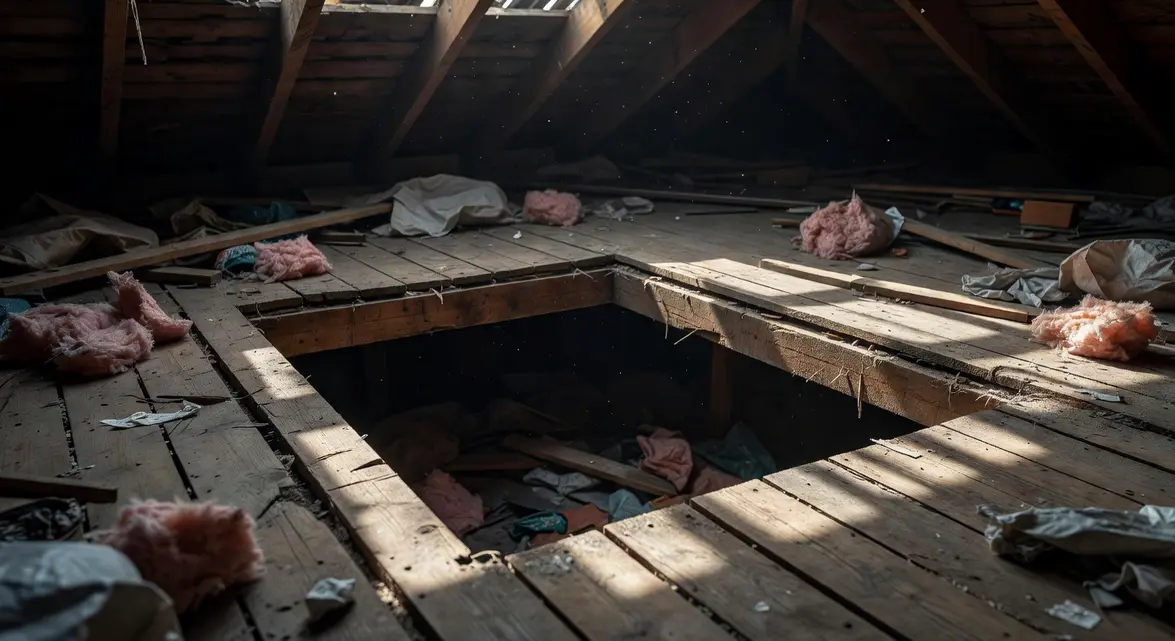
On 13 May 2024, 41-year-old roofer Mark Smith, employed by Willow Services (Southern) Limited based in Westbrooke Close, Waterlooville, Hampshire, was re-roofing a domestic house in Wimbledon. While stripping internal insulation in the roof space, he stepped onto an unguarded loft hatch that had not been identified or protected, plummeting approximately 11 feet to the floor below. This oversight turned a routine task into a catastrophe, highlighting the deadly danger of an unguarded loft hatch in confined roof spaces.
Mark suffered a fractured L1 vertebra and hip, resulting in life-changing injuries that prevented his return to work; his employment was subsequently terminated. The Health and Safety Executive (HSE) investigation revealed critical failures in planning work at height, inadequate fall prevention measures, and a lack of competent supervision and training for overseers. Willow Services pleaded guilty to breaching Regulation 4(1) of the Work at Height Regulations 2005 at Westminster Magistrates’ Court on 30 April 2026, receiving a £20,000 fine plus £5,607 in costs. This case underscores how preventable hazards like an unguarded loft hatch can lead to devastating consequences.
Core safety lesson
The technical failure in this incident stemmed from overlooked roof space hazards during internal work, where an unguarded loft hatch became a fatal trap. Root causes included no pre-work identification of openings, insufficient risk assessment, and reliance on inexperienced supervision, allowing the hazard to persist unchecked.
The Hazard: Unguarded loft hatch in roof space – an unprotected opening that poses an immediate fall risk of 11 feet or more during movement in low-light, cluttered environments.
The Control: Conduct thorough risk assessments to identify all potential openings like loft hatches pre-work; secure them with barriers, covers, or guard rails rated for the expected load, following HSE Work at Height guidance. Prioritize collective protection such as fixed barriers over personal measures.
This control is non-negotiable because loft spaces are inherently deceptive – hatches blend into flooring, especially under insulation or in dim conditions, making visual identification unreliable without systematic checks. Failing to guard an unguarded loft hatch not only violates Regulation 4(1) but exposes workers to irreversible injuries, as seen with Mark Smith’s fractured vertebra and hip. Detailed method statements must dictate work sequences, access points, and protections, ensuring every supervisor verifies controls before entry. Competent oversight, backed by qualifications like CISRS and site-specific training, prevents complacency; daily briefings reinforce vigilance, turning potential disasters into safe routines.
Supervisor’s discussion guide
Use these questions to engage the crew and apply lessons to our site:
- Q1: “Looking at our own equipment and work areas today, where is the biggest risk of an unguarded loft hatch or similar opening?”
- Q2: “What steps should we take in our risk assessments to identify and protect all loft hatches before starting roof space work?”
- Q3: “How can we ensure our supervisors are competent to spot and control work at height risks like this incident?”
- Q4: “If we found an unguarded loft hatch right now, what would be our immediate action plan?”
Action plan & inspection
Immediately after this meeting, perform these 5 checks and document results:
- Inspect all current and upcoming roof spaces for unguarded loft hatches or unprotected openings; mark and barrier them if found.
- Review and update site risk assessments and method statements to explicitly address loft hatch identification and fall prevention.
- Verify supervisor competencies with training records (e.g., CISRS certification) and conduct a quick height work quiz.
- Check access/egress routes in elevated areas for barriers, covers, or guard rails rated for load.
- Hold a 5-minute crew walkthrough of high-risk zones, confirming no unguarded loft hatches exist today.
Key takeaways
Never underestimate the hidden dangers in roof spaces – an unguarded loft hatch can end a career in seconds, as proven by the 11-foot fall that fractured Mark Smith’s L1 vertebra and hip. Always start with comprehensive planning: identify every opening via pre-work surveys, secure with robust collective protections, and enforce competent supervision through training and daily checks. Breaches like Willow Services’ lead to fines, prosecutions, and life-altering injuries; our zero-tolerance approach ensures 2026 remains incident-free.
Commit to this: risk assess rigorously, protect proactively, supervise expertly. By guarding against unguarded loft hatches and similar hazards, we safeguard our teams, comply with Work at Height Regulations, and build a culture where safety trumps shortcuts every time.
Source & Disclaimer: This toolbox talk is for educational purposes based on public report. Read Original Report