Meeting details
Topic: Underground cable safety briefing following electrical contact incident
Goal: This toolbox talk on underground cable safety will review the 2024 Manchester fencing contractor incident and prevent similar accidents in 2026.
The incident: what happened?
On 21 May 2024 at Meade Hill Road, Manchester, a 59-year-old employee of City Fencing Contractors Limited suffered an electric shock and multiple burn injuries to his stomach, chest, and arms after striking a live underground cable with a powered breaker. The worker was preparing to install security fencing when the mechanical excavation equipment made contact with the energised service. No prior cable location, identification, or marking had been carried out, and the HSE investigation found a complete absence of a safe system of work for underground services, leading directly to the injuries.
The company was prosecuted under Regulation 25(4) of the Construction (Design and Management) Regulations 2015 and fined £10,000 plus £5,487 in costs. This case highlights how the absence of proper underground cable safety procedures turns routine excavation into a life-threatening event. Effective underground cable safety measures must be applied on every site where powered tools are used near buried utilities.
Core safety lesson
The Hazard: Contact with live underground electrical cables during mechanical excavation.
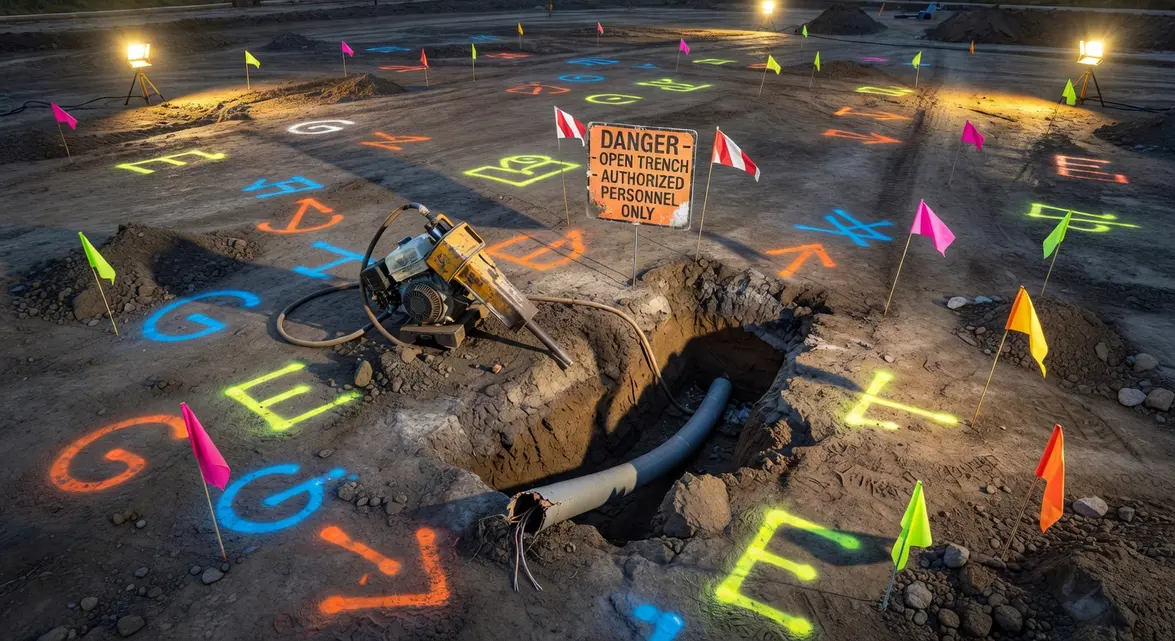
The Control: Obtain and review utility plans, then use competent personnel with suitable cable-locating devices to trace, identify, and clearly mark all underground services before any excavation begins.
This control is non-negotiable because mechanical breakers and excavators can instantly penetrate cable insulation, releasing high fault currents that cause severe burns and cardiac arrest. Without verified locations, workers have no way of knowing where services lie, turning every dig into a gamble with lethal consequences.
Site-specific risk assessments and documented safe systems of work must address local underground services before work starts. Safe digging practices that prohibit mechanical excavation until cables are located, identified, and marked, followed by careful hand-digging near marked services, eliminate the root cause of the 2024 incident. Underground cable safety depends on this sequence being followed without exception.
Supervisor’s discussion guide
Q1: “Looking at our own equipment today, where is the biggest risk of contact with live underground electrical cables during mechanical excavation?”
Q2: “What utility plans and cable-locating steps will we complete before the next excavation task?”
Q3: “How will we mark services clearly and switch to hand-digging methods once cables are identified?”
Q4: “Which underground cable safety controls from this incident should we add to our daily permit-to-dig process?”
Action plan & inspection
- Confirm current utility plans have been obtained and reviewed for the work area.
- Verify that competent personnel and calibrated cable-locating devices are available on site.
- Ensure all identified underground services are physically marked before any breaker or excavator use.
- Check that the documented safe system of work and risk assessment address buried services.
- Confirm prohibition of mechanical excavation until services are located, marked, and safe digging practices are in place.
Key takeaways
Underground cable safety requires obtaining utility records, using detection equipment, and marking every service before powered excavation begins. The 2024 incident demonstrates that skipping these steps leads to immediate electric shock and burn injuries, regulatory prosecution, and substantial financial penalties.
Supervisors must enforce the full sequence of planning, detection, marking, and controlled digging on every job. Consistent application of these controls protects workers and ensures compliance with the Construction (Design and Management) Regulations 2015.
Source & Disclaimer: This toolbox talk is for educational purposes based on public report. Read Original Report