Meeting details
Topic: Managing temporary support poles during structural assembly tasks
Goal: This toolbox talk on temporary support poles will review the Siemens Gamesa Renewable Energy Ltd incident and prevent similar accidents in 2026.
The incident: what happened?
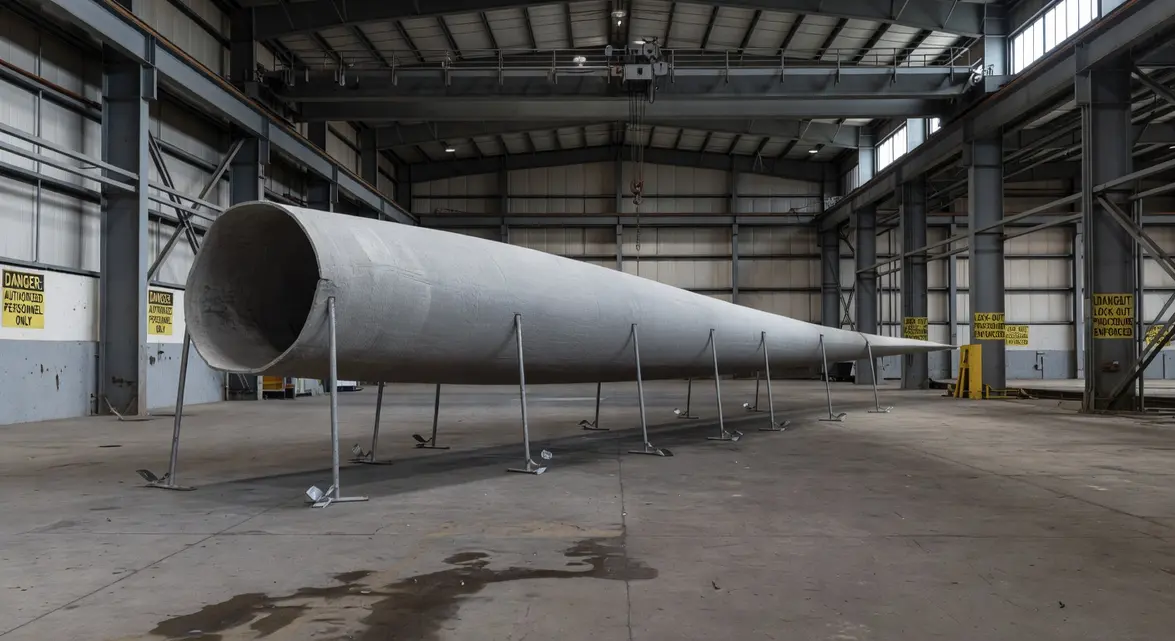
On 18 July 2024 at the Siemens Gamesa blade-construction site in Hull, a 37-year-old female employee was left paralysed from the waist down when an 800 kg pre-cast web section collapsed. The immediate cause was the unauthorised removal of temporary support poles before the section had been properly secured. An HSE investigation established that the company had failed to carry out an adequate risk assessment, had not established or enforced a safe system of work to prevent unauthorised removal of the poles, and had not trained staff in safe methods, allowing workers to develop their own unsafe practices.
Siemens Gamesa pleaded guilty under Section 2(1) of the Health and Safety at Work etc. Act 1974 and was fined £600,000 plus £7,980.80 costs at Grimsby Magistrates’ Court on 22 May 2026. Following the incident, the company introduced a keyed lock-off system for temporary support poles to ensure they cannot be removed without formal authorisation.
Core safety lesson
The Hazard: Unsecured temporary support of heavy structural components.
The Control: Implement a permit-to-work or staged-release procedure that physically locks temporary support poles in place until a nominated competent person verifies the next build stage is complete and authorises removal.
This control is non-negotiable because the collapse of an 800 kg component demonstrates how quickly an apparently stable load can become lethal when temporary support poles are removed without verification. Inadequate risk assessment and the absence of enforced procedures allowed informal, unsafe practices to develop, directly resulting in permanent injury and a substantial corporate fine.
Without physical lock-off devices and documented authorisation, reliance on verbal instructions or individual memory is insufficient. The post-incident introduction of a keyed lock-off system at the Hull facility shows that engineering controls, combined with training and supervision, are required to eliminate the possibility of unauthorised removal and to protect workers from high-consequence structural failures.
Supervisor’s discussion guide
Q1: “Looking at our own equipment today, where is the biggest risk of unsecured temporary support of heavy structural components?”
Q2: “How do we currently verify that temporary support poles remain in place until the next stage is complete?”
Q3: “What would happen on this site if someone removed a support without checking the risk assessment first?”
Q4: “Are our written safe systems of work for temporary support poles being followed exactly, or have any ad-hoc methods crept in?”
Action plan & inspection
- Confirm that all temporary support poles are fitted with functioning keyed lock-off devices.
- Verify that current risk assessments for structural assembly tasks are documented, dated, and signed by a competent person.
- Check that written safe systems of work for removal of temporary support poles are posted and have been read by every operative on the task.
- Ensure training records show that all relevant staff have received instruction on the authorised removal procedure within the last 12 months.
- Conduct an immediate audit of any in-progress assemblies to confirm no temporary support poles have been removed without recorded authorisation.
Key takeaways
Temporary support poles must remain locked and authorised for removal only after a competent person has confirmed the structure is stable. The Siemens Gamesa case proves that the absence of formal procedures, training, and physical controls leads directly to catastrophic injury and legal liability.
Every supervisor must enforce the permit-to-work or staged-release system without exception. Regular audits and refresher training will ensure that the prescribed methods replace any informal practices and keep heavy structural components secure throughout the build sequence.
Source & Disclaimer: This toolbox talk is for educational purposes based on public report. Read Original Report