Meeting details
Topic: Toxic Factory Fire Hazards and Prevention Controls
Goal: This toolbox talk on toxic factory fire will review the toxic factory fire in Wolverhampton, UK, on January 14, 2026, and prevent similar accidents in 2026.
The incident: what happened?
On January 14, 2026, a toxic factory fire erupted shortly after 7:30 a.m. at a large factory measuring 100m x 50m near Sunbeam Street’s junction with Upper Villiers Street in Blakenhall, Wolverhampton, United Kingdom. The building housed multiple industrial units and various businesses, where exploding cylinders inside intensified the blaze, producing thick toxic smoke that spread to nearby areas. Ashes fell on cars and homes, accompanied by a strong smoke odor, prompting a shelter-in-place order due to poor air quality from the hazardous plume. Up to 21 fire engines from the West Midlands Fire Service responded, managing to contain but not fully extinguish the fire by 12:30 p.m., with crews expected to remain on scene for 24 hours or overnight.
No injuries were reported, and no formal evacuations were ordered, though the West Midlands Ambulance Service’s hazardous area response team attended briefly to assess risks. An investigation into the cause of this toxic factory fire remains ongoing, highlighting the dangers of industrial fires involving unknown materials and pressurized gases in multi-tenant facilities. The incident underscores how quickly such events can escalate, affecting surrounding communities without immediate harm to occupants but posing significant environmental and inhalation hazards.
Core safety lesson
The toxic factory fire revealed critical failures in managing flammable materials and fire suppression, particularly with exploding pressurized cylinders and unchecked fire propagation in a multi-unit industrial space. These lapses allowed the fire to generate a toxic smoke plume that endangered air quality far beyond the site.
The Hazard: Exploding pressurized cylinders and toxic smoke plumes from chemical combustion, compounded by rapid fire spread in compartmented industrial buildings.
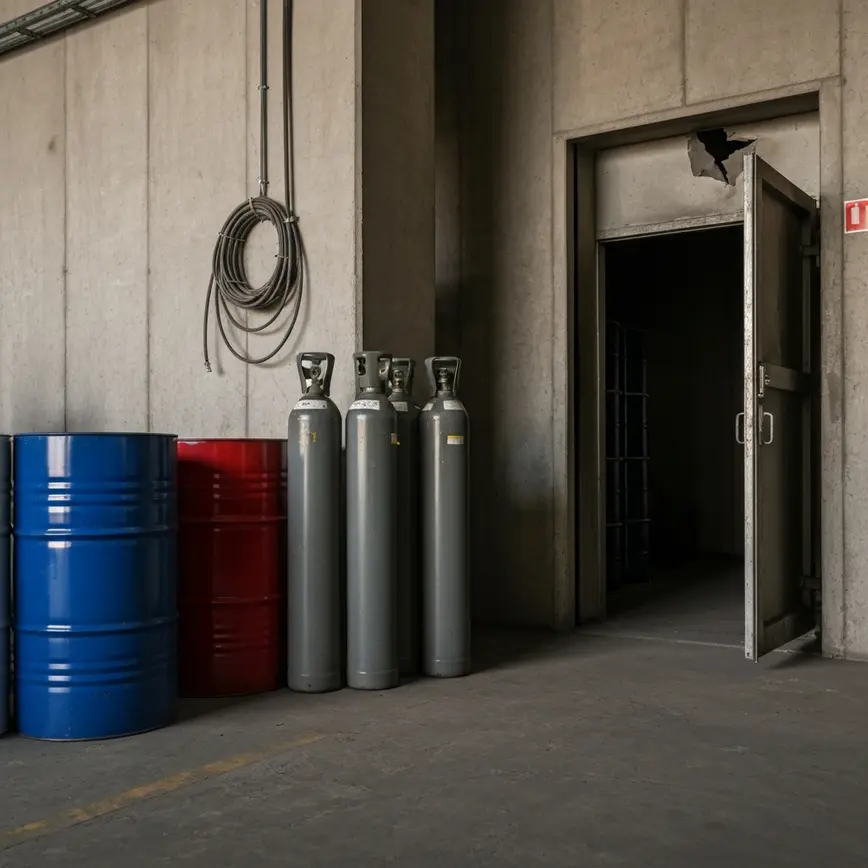
The Control: Implement regular inspections and secure storage of cylinders in fire-rated enclosures with blast venting per NFPA 55 standards; install automatic smoke detection and suppression systems (e.g., sprinklers) linked to early alarms; enforce fire-rated compartmentation, clear firefighting access, annual fire risk assessments, and hot work permits.
These controls are non-negotiable because pressurized cylinders can violently rupture under heat, propelling shrapnel and accelerating fire spread, as seen in this toxic factory fire where explosions fueled the blaze. Without fire-rated storage and venting, secondary blasts become inevitable, turning a containable incident into a widespread toxic event. Automatic suppression systems provide immediate response, buying critical time for evacuation or containment, while compartmentation prevents lateral spread in shared spaces—proven to reduce fire damage by up to 50% in industrial settings per NFPA data. Skipping air quality monitoring and public alerts ignores off-site risks, as toxic plumes can travel miles, affecting non-workers. Annual assessments identify ignition sources early, ensuring compliance and readiness; anything less invites catastrophe, endangering lives, property, and community health in 2026 and beyond.
Supervisor’s discussion guide
Engage your crew with these questions to drive home the lessons from the toxic factory fire:
Q1: “Looking at our own equipment today, where is the biggest risk of exploding pressurized cylinders?”
Q2: “How would toxic smoke from a factory fire like this impact our site’s neighbors, and what alerts do we have in place?”
Q3: “What fire-rated barriers or suppression systems do we have, and when were they last inspected?”
Q4: “If a hot work permit was overlooked here, what could trigger a similar toxic factory fire scenario?”
Action plan & inspection
Immediately after this meeting, supervisors must verify and document the following 5 items:
- Inspect all pressurized cylinders for secure storage in fire-rated enclosures with blast venting, confirming compliance with NFPA 55.
- Test automatic smoke detection and suppression systems (sprinklers/alarms) for functionality and tie-ins to early warning protocols.
- Review site compartmentation: check fire-rated walls, doors, and clear firefighting access paths for integrity.
- Conduct a spot air quality monitoring check and confirm public alert procedures for toxic smoke plumes.
- Audit hot work permits and ignition sources, scheduling any overdue annual fire risk assessments.
Key takeaways
The toxic factory fire in Wolverhampton on January 14, 2026, exemplifies how exploding cylinders and poor fire controls can unleash toxic smoke, affecting communities without direct injuries but with lasting hazards. Key is proactive prevention: secure gas storage, automatic suppression, and strict compartmentation are musts to halt escalation at the source.
Supervisors, lead by enforcing immediate inspections and crew discussions—turn this incident into zero-tolerance for risks. In 2026, our sites stay safe through vigilance, compliance with standards like NFPA 55, and readiness for toxic factory fire scenarios, protecting workers, neighbors, and operations alike.
Source & Disclaimer: This toolbox talk is for educational purposes based on public report. Read Original Report