
Meeting details
Date: January 13, 2026
Topic: Chemical Release Prevention: Lessons from the Lubrizol Incident
Goal: This toolbox talk on chemical release prevention will review the Lubrizol chemical release incident in Deer Park, Texas, and equip supervisors and crews with strategies to prevent similar accidents in 2026.
The incident: what happened?
On Friday, January 9, 2026, an unanticipated chemical release occurred at the Lubrizol Corporation facility in Deer Park, Texas, during maintenance activities on a non-operational processing unit. This incident underscores the critical importance of chemical release prevention measures, as the release prompted immediate response actions despite the unit being offline. Deer Park city officials issued a shelter-in-place order as a precaution for industrial sites north of Highway 225, including the Lubrizol facility and its industrial neighbors. Importantly, the order had no impact on offsite homes, limiting the scope to the immediate industrial area.
Lubrizol’s Emergency Response Team swiftly managed the situation, with emergency vehicles responding on site and Tidal Road temporarily closed before being reopened by Friday afternoon. A wind shift later that evening caused noticeable but non-harmful odors in the city; however, no public threat was reported, and the specific chemical involved was not identified in public reports. The article detailing the event was published on January 12, 2026, highlighting the rapid but precautionary measures taken to contain the release and mitigate any potential offsite dispersion.
Core safety lesson
The technical failure at Lubrizol stemmed from an unanticipated release during maintenance on non-operational equipment, compounded by potential vulnerabilities in isolation protocols and atmospheric conditions that allowed odor dispersion. This incident reveals how even offline units can pose severe risks if not properly managed, emphasizing that chemical release prevention must be proactive and rigorous across all phases of work.
The Hazard: Unanticipated chemical release from non-operational equipment during maintenance, with risks of offsite dispersion due to wind shifts and delayed notifications leading to traffic disruptions.
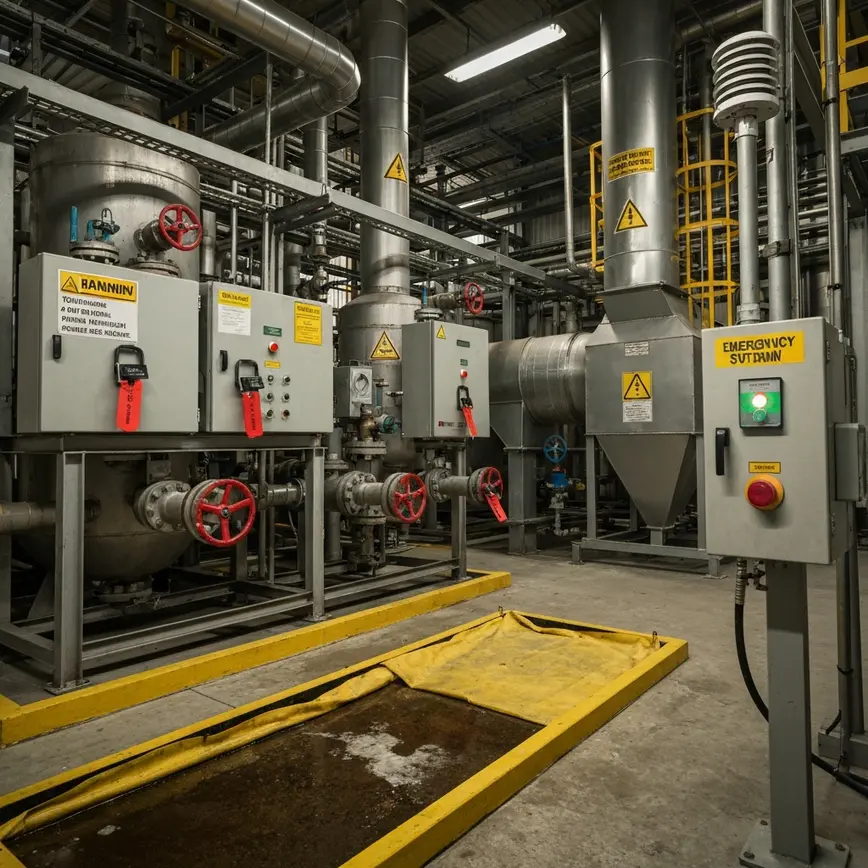
The Control: Implement Lockout/Tagout (LOTO) procedures, pre-maintenance depressurization protocols verified through job safety analyses (JSAs) and independent audits; conduct real-time atmospheric modeling with vapor containment systems like scrubbers or enclosures triggered by wind sensors; and establish integrated emergency communication systems with local authorities, including automated alerts and predefined road closure plans tested in drills.
These controls are non-negotiable because they address the root causes at multiple layers: LOTO and JSAs ensure physical isolation, preventing residual pressures or reactions in supposedly inert equipment—a common oversight in maintenance scenarios. Atmospheric modeling and containment systems provide real-time chemical release prevention by adapting to environmental variables like wind shifts, which can turn a contained event into a community concern. Finally, robust communication protocols minimize secondary hazards like panic or disruptions, ensuring coordinated responses that protect both workers and the public. Skipping any element invites catastrophe, as evidenced by Lubrizol’s precautionary shelter-in-place.
Supervisor’s discussion guide
Use these questions to engage the crew in a 3-5 minute discussion. Encourage specific examples from our site.
Q1: “Looking at our own equipment today, where is the biggest risk of unanticipated chemical release during maintenance?”
Q2: “How can wind shifts or atmospheric conditions affect chemical release prevention on our site, and what controls do we have in place?”
Q3: “What steps in our LOTO and JSA processes ensure chemical release prevention for non-operational units?”
Q4: “If a release occurred here, how would our emergency communication with local authorities prevent offsite impacts like those at Lubrizol?”
Action plan & inspection
Immediately after this toolbox talk, supervisors must conduct these 5 checks and document completion:
- Verify LOTO devices and tags on all non-operational processing units scheduled for maintenance this week, confirming depressurization via pressure gauges.
- Inspect vapor containment systems (scrubbers, enclosures) for functionality and test wind direction sensors with a simulated trigger.
- Review and update JSAs for any ongoing maintenance tasks, ensuring chemical release prevention protocols are explicitly included.
- Test emergency communication systems by sending a drill alert to local authorities and confirming receipt within 5 minutes.
- Conduct a walkthrough of access roads near hazardous areas, marking predefined closure points and signage for traffic control.
Key takeaways
The Lubrizol incident on January 9, 2026, serves as a stark reminder that chemical release prevention is paramount, even during maintenance on non-operational equipment. By prioritizing LOTO, JSAs, real-time atmospheric monitoring, and integrated emergency communications, we eliminate the pathways to unanticipated releases and offsite impacts. These controls are not optional—they are the backbone of safe operations in chemical facilities.
Supervisors, lead by example: enforce these measures daily, foster open discussions on risks, and commit to immediate inspections. In 2026, our sites will set the standard for chemical release prevention, ensuring no repeats of Deer Park. Sign off below to confirm understanding and action.
Source & Disclaimer: This toolbox talk is for educational purposes based on public report. Read Original Report
