Meeting details
Date: March 31, 2026
Topic: Tank Car Confined Space Fire Hazards
Goal: This toolbox talk on tank car confined space fire will review the fatal burn injury at TrinityRail’s tank car facility in Longview, Texas, and equip supervisors and crews with prevention strategies to avoid similar accidents in 2026.
The incident: what happened?
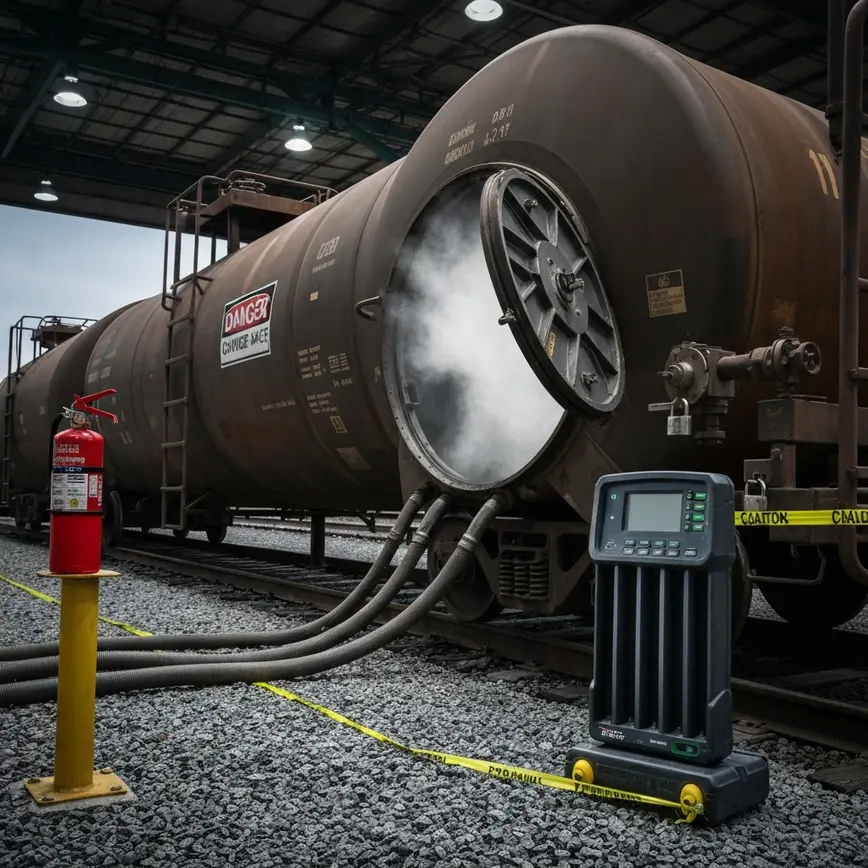
On Monday, March 30, 2026, at 10:27 a.m., a tragic tank car confined space fire occurred at TrinityRail’s production facility on the 700 block of Valley Road, also known as Jordan Valley Road, in Longview, Texas. A worker suffered severe, life-threatening burns while inside a tank car during production activities. The incident prompted an immediate response from the Longview Fire Department, which dispatched a fire engine and EMS. Fire crews identified the tank car as a confined space and took critical precautions: they monitored the atmosphere inside and outside the tank car, ventilated it with fresh air for 30 minutes, and conducted atmospheric sampling before any entry. Despite these efforts, the victim was transported to a local hospital but ultimately succumbed to his injuries.
No prior similar incidents had been reported at the facility, and all other employees remained safe. Operations were suspended immediately following the event. Investigations are underway by the Longview Fire Marshal’s office, the Occupational Safety and Health Administration (OSHA), and Gregg County Justice of the Peace, including a post-mortem examination. The exact cause of the tank car confined space fire has not yet been determined, but TrinityRail is fully cooperating with authorities. This incident underscores the deadly risks associated with confined spaces in industrial railcar manufacturing.
Core safety lesson
The technical failure in this tank car confined space fire centered on potential atmospheric hazards within the confined space of the tank car, such as flammable vapors or oxygen deficiency that could lead to ignition and rapid fire escalation. These conditions are common in tank car production where residues, cleaning agents, or manufacturing processes can create explosive atmospheres.
The Hazard: Confined space atmospheric hazards, including flammable vapors (measured by Lower Explosive Limit or LEL), oxygen deficiency, and toxic gases, which directly contributed to the fire that caused fatal burns.
The Control: Mandatory atmospheric testing using calibrated multi-gas detectors for LEL, oxygen, and toxics prior to entry, per OSHA 1910.146, with continuous monitoring during work; combined with hot work permits, lockout/tagout (LOTO) for energy sources, and intrinsically safe equipment.
This control is non-negotiable because confined spaces like tank cars trap hazards, allowing them to build to lethal levels without warning. A single spark from tools or static can ignite vapors, as likely happened here, turning a routine task into a fatal tank car confined space fire. Skipping testing bypasses the only reliable way to confirm safe entry conditions—ventilation alone isn’t enough, as seen when fire crews still needed 30 minutes of fresh air and sampling. Enforcing these measures, alongside emergency drills and fire suppression integration, saves lives by breaking the ignition chain every time.
Supervisor’s discussion guide
Use these questions to engage the crew and apply lessons from the tank car confined space fire to your site:
- Q1: “Looking at our own equipment today, where is the biggest risk of confined space atmospheric hazards?”
- Q2: “What steps would you take if you smelled unusual vapors near a tank car or similar confined space?”
- Q3: “How can we ensure atmospheric testing and LOTO are followed before any tank car confined space fire risk activity?”
- Q4: “Recall our last emergency drill—what improvements do we need for faster response in high-risk areas like tank car production?”
Action plan & inspection
Immediately after this meeting, conduct these 5 checks and document completion:
- Inspect all multi-gas detectors for calibration dates and functionality; tag out any overdue for service.
- Review and update hot work permits and LOTO procedures specific to tank cars and confined spaces.
- Verify atmospheric testing logs for recent entries into confined spaces; retrain any non-compliant personnel.
- Check fire suppression equipment (extinguishers, sprinklers) around tank car areas for accessibility and readiness.
- Post or refresh confined space warning signs and emergency response maps at all relevant workstations.
Key takeaways
The tank car confined space fire at TrinityRail reminds us that atmospheric hazards in confined spaces demand unwavering vigilance—testing with calibrated detectors before every entry is the unbreakable first line of defense. Pair this with LOTO, hot work controls, and intrinsically safe tools to eliminate ignition sources, preventing burns or explosions that claim lives without a second chance.
Supervisors, lead by example: integrate these into daily routines, drill emergency responses site-specifically, and ensure every crew member knows the stakes. By acting on this toolbox talk today, we honor the fallen worker and safeguard our teams against tank car confined space fire tragedies in 2026 and beyond.
Source & Disclaimer: This toolbox talk is for educational purposes based on public report. Read Original Report