Meeting details
Topic: Steel plant fire safety review following the Tata Steel incident
Goal: This toolbox talk on steel plant fire safety will review the June 3 fire at Tata Steel’s Port Talbot steelworks and prevent similar accidents in 2026.
The incident: what happened?
On June 3, 2026, a significant fire erupted inside Tata Steel’s Port Talbot steelworks in South Wales, prompting an immediate evacuation of affected areas and a multi-agency emergency response. Steel plant fire safety procedures were tested when Mid and West Wales Fire and Rescue Service deployed multiple engines and specialist units while South Wales Police secured the perimeter; firefighters contained the blaze using defensive tactics through the night.
No serious injuries were reported, but nearby residents were advised to shelter-in-place due to smoke. Tata Steel later confirmed mitigation plans to maintain customer supply while an investigation into the cause continues. The event highlights how quickly an ignition inside high-temperature steel-making equipment can escalate without robust controls.
Core safety lesson
The Hazard: Uncontrolled ignition within high-temperature steel-making equipment or stored combustibles.
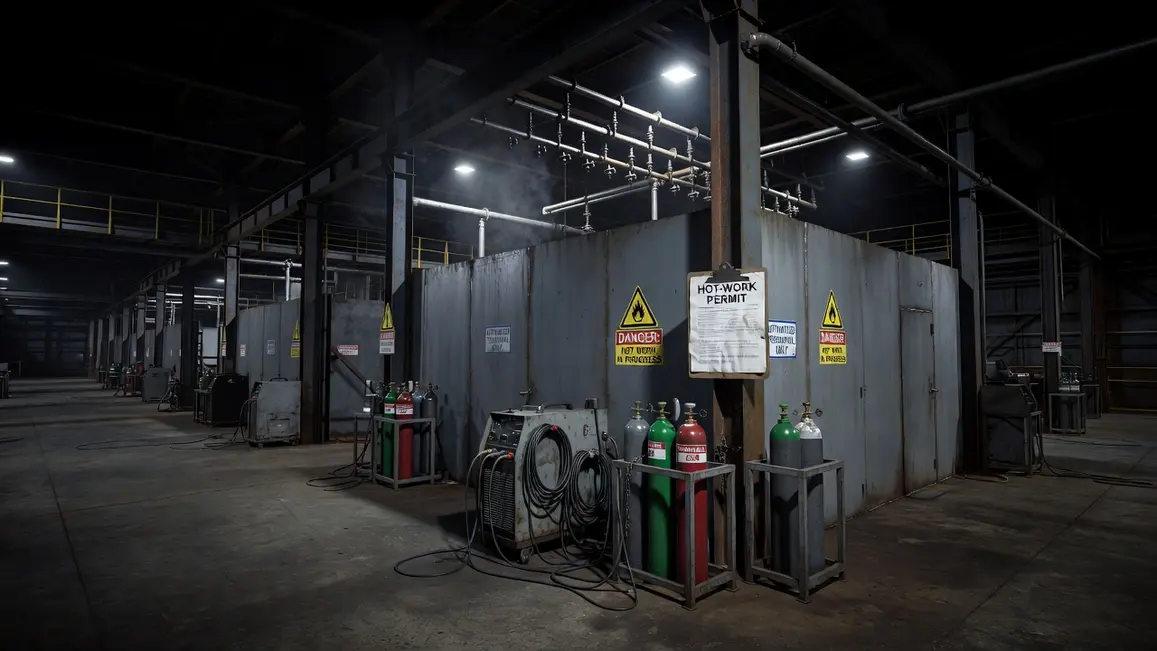
The Control: Implement a formal hot-work permit system with pre-task gas monitoring, fire-watch personnel, and post-task cool-down inspections.
This control is non-negotiable because steel plants contain continuous sources of ignition and large volumes of flammable materials. A single lapse in gas monitoring or failure to maintain a fire watch can allow a small spark to develop into a major incident, exactly as occurred at Port Talbot.
Automatic detection and suppression systems provide a critical second layer, yet they cannot replace disciplined permit procedures. Consistent application of the hot-work permit system ensures every task is evaluated for risk before work begins and that residual heat is monitored after completion, directly reducing the likelihood of recurrence in any steel plant fire safety program.
Supervisor’s discussion guide
Q1: “Looking at our own equipment today, where is the biggest risk of uncontrolled ignition within high-temperature steel-making equipment or stored combustibles?”
Q2: “Are our current hot-work permits being completed in full, including gas monitoring and cool-down checks?”
Q3: “How quickly can we activate site-wide alarms and evacuation routes if smoke is detected?”
Q4: “What improvements to steel plant fire safety can we implement before the next shift?”
Action plan & inspection
- Verify all active hot-work permits include completed gas monitoring records.
- Confirm fire-watch personnel are assigned and briefed for every permitted task.
- Inspect automatic fire-suppression systems in interconnected plant sections for operational status.
- Test fixed toxic-gas and smoke detection tied to site-wide alarms.
- Review and update public alert procedures including shelter-in-place notifications.
Key takeaways
Steel plant fire safety depends on strict adherence to hot-work controls and layered protection systems. The Port Talbot incident demonstrates that even with rapid emergency response, prevention through permits, monitoring, and compartmentation remains the only reliable way to protect workers and surrounding communities.
Supervisors must treat every permit as a critical control point and never allow shortcuts. Regular verification of these measures will keep steel plant fire safety standards high and reduce the chance of a similar event occurring at our site.
Source & Disclaimer: This toolbox talk is for educational purposes based on public report. Read Original Report