Meeting details
Date: March 20, 2026
Topic: Packaging Plant Pressure Tank Explosions
Goal: This toolbox talk on packaging plant pressure tank explosions will review the recent double incidents at the NaturPak food packaging facility in Janesville, Wisconsin, and equip supervisors and crews with critical prevention strategies to avoid similar accidents in 2026.
The incident: what happened?
On March 18, 2026, at 1:15 p.m., a catastrophic explosion rocked the NaturPak food packaging facility on the 100 block of Innovation Drive in Janesville, Wisconsin, due to over-pressurization of a process tank. This packaging plant pressure tank explosion released a violent burst of steam and hot liquid, severely injuring three workers: two were airlifted to hospitals with life-threatening burns, while the third was transported by ambulance and is expected to recover. Just weeks earlier, on February 11, 2026, at 4:15 p.m., another explosion occurred at the same facility, triggered by a malfunctioning pressure relief valve on a broth-boiling tank, injuring two workers—one airlifted with life-threatening injuries and the other expected to recover.
Janesville Fire Department Battalion Chief Tyler Johnson described the March incident as a confined release of steam and hot liquid with no threat to the public. Following the February event, a facility manager reportedly instructed employees not to speak with law enforcement. Investigations by the Janesville Police Department, Janesville Fire Department, and OSHA are ongoing to determine exact causes, compliance issues, and relationships between the two packaging plant pressure tank explosions. These back-to-back tragedies underscore the deadly risks in food processing environments where high-pressure vessels are commonplace.
Core safety lesson
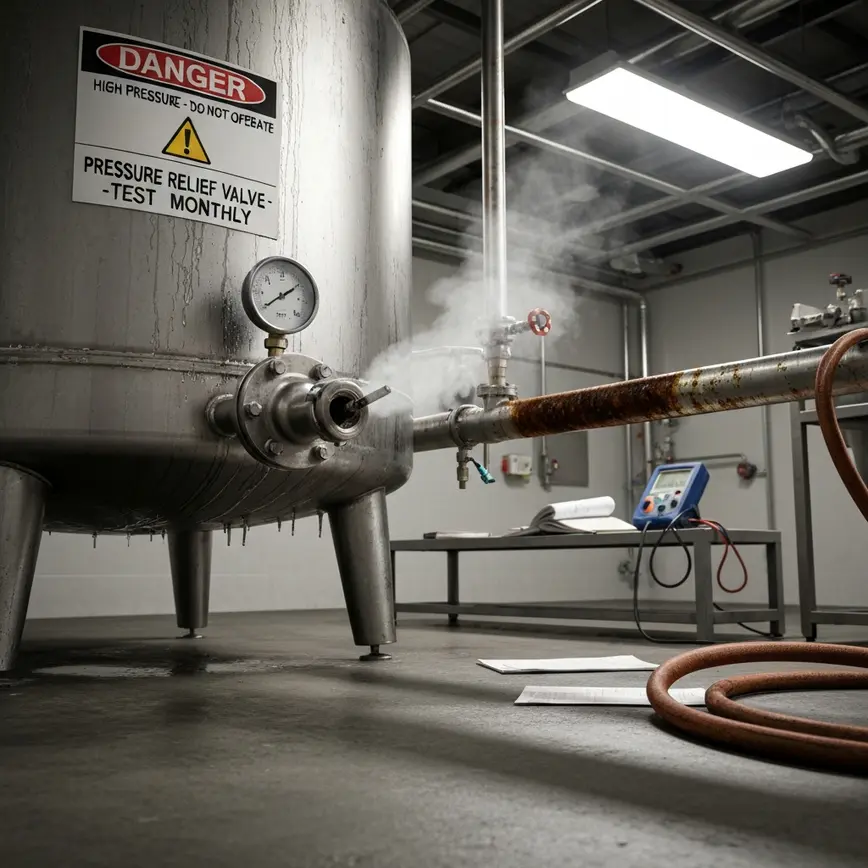
The core technical failures in these packaging plant pressure tank explosions were over-pressurization of process tanks and malfunctioning pressure relief valves (PRVs), compounded by inadequate burn protection during emergencies. In the March incident, a tank exceeded safe pressure limits, violently rupturing and ejecting superheated steam and liquids. The February blast stemmed directly from a PRV failure during broth boiling operations, allowing unchecked pressure buildup.
The Hazard: Over-pressurization of process tanks and PRV malfunctions, which can lead to explosive releases of steam, hot liquids, and shrapnel, causing life-threatening burns and structural damage.
The Control: Install redundant PRVs with automatic shutdown interlocks tied to pressure sensors per OSHA 1910.106; conduct preventive maintenance including ultrasonic testing and functional proof-testing every 6-12 months, daily visual inspections, and SCADA-logged calibrations. Additionally, equip sites with proximity-rated PPE like aluminized suits and face shields, plus quarterly emergency drills and on-site eyewash/drench stations.
These controls are non-negotiable because pressure vessels in packaging plants operate under extreme conditions—high temperatures, corrosive broths, and rapid cycles—that degrade components silently. A single overlooked inspection can cascade into catastrophe, as seen at NaturPak where two incidents in five weeks hospitalized five workers. Redundant systems provide fail-safes; without them, human error or wear amplifies risks. Training ensures crews report anomalies early, turning potential disasters into preventable maintenance tasks. Ignoring this invites OSHA violations, lawsuits, and irreplaceable losses—lives depend on proactive enforcement.
Supervisor’s discussion guide
Engage your crew with these targeted questions to drive home the lessons from the packaging plant pressure tank explosions:
- Q1: “Looking at our own equipment today, where is the biggest risk of over-pressurization or PRV failure?”
- Q2: “Have you noticed any pressure gauges trending high or PRVs that look corroded during recent shifts? What did you report, and why?”
- Q3: “In a packaging plant pressure tank explosion scenario here, what’s our exact path to PPE and emergency eyewash stations?”
- Q4: “How can we improve our daily inspections to catch issues before they escalate like at NaturPak?”
Action plan & inspection
Immediately following this toolbox talk, conduct these 5 mandatory checks on all pressure-related equipment:
- Visually inspect all PRVs for corrosion, leaks, or damage; test functionality on at least one per vessel.
- Verify pressure sensors and interlocks are operational via SCADA logs; calibrate setpoints if overdue.
- Confirm proximity PPE (aluminized suits, face shields) is accessible and in serviceable condition near high-temp tanks.
- Test eyewash/drench stations for flow and pressure; ensure clear paths to burn treatment areas.
- Review maintenance schedules—flag any PRV overdue for ultrasonic or proof-testing within 6-12 months.
Key takeaways
Packaging plant pressure tank explosions, like those devastating NaturPak twice in early 2026, remind us that over-pressurization and PRV failures are predictable killers if ignored. Supervisors must enforce redundant safety systems, rigorous maintenance, and anomaly reporting to halt pressure buildups before they erupt. Every gauge, valve, and drill is a frontline defense—complacency costs lives, as evidenced by five injured workers across two blasts.
Commit today: inspect now, train relentlessly, and audit compliance weekly. By embedding these controls, we transform hazard zones into safe operations, honoring OSHA standards and protecting our teams from the scalding fury of unchecked pressure. No shortcuts—safety is our unbreakable protocol.
Source & Disclaimer: This toolbox talk is for educational purposes based on public report. Read Original Report