Meeting details
Topic: Oil Spill Response: Lessons from the Caroline Bezengi Grounding
Goal: This toolbox talk on oil spill response will review the Caroline Bezengi tanker grounding and prevent similar accidents in 2026.
The incident: what happened?
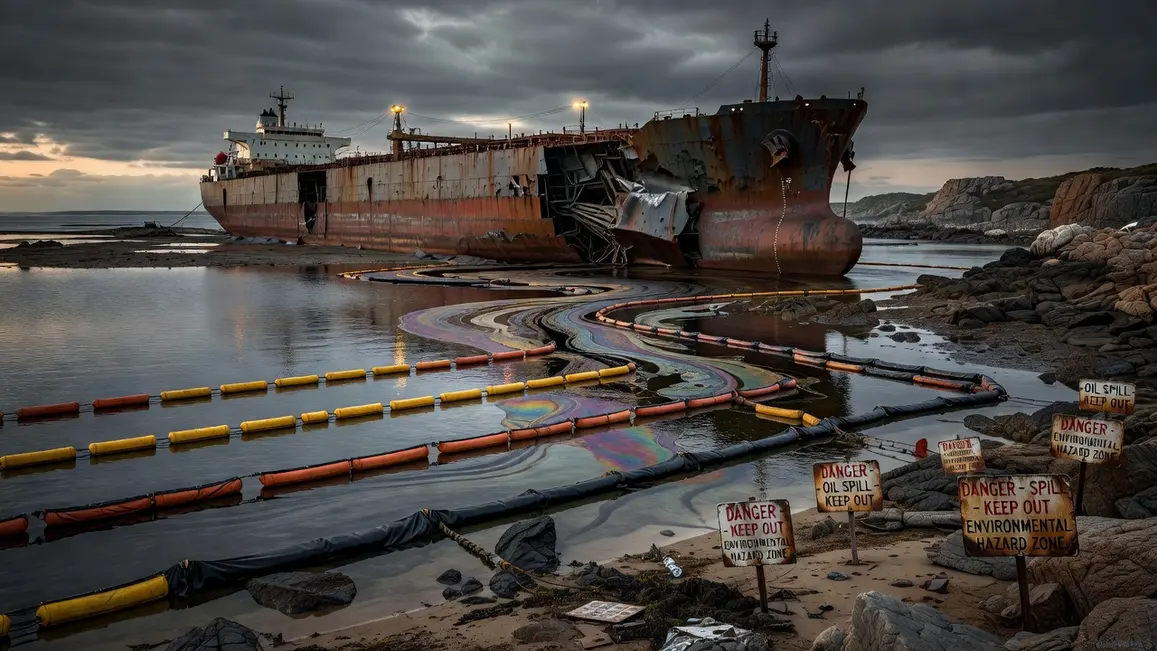
The Caroline Bezengi, a sanctioned vessel operating as part of Russia’s shadow fleet, was carrying approximately 800,000 barrels of oil when an unidentified incident occurred on June 6 outside Omani territorial waters. The tanker subsequently ran aground off Al-Qibliyyah Island, Oman, on June 21. Oil leakage was first detected in early July, and by August 4 the spill had already covered 230 square miles. By August 13 the contamination had expanded to 500 square miles, fragmenting into multiple areas and reaching 25 miles of mainland shoreline at Ras Madrakah, 124 miles from the grounded vessel. Effective oil spill response was immediately complicated by monsoon conditions and the vessel’s remote location.
The spill now threatens coral reefs, seagrass meadows, turtle nesting beaches, and critical habitats for the endangered Arabian Sea humpback whale. Omani authorities have advised citizens to avoid fishing in affected areas while seafood testing continues. International salvage teams have deployed more than 100 tons of equipment, yet the rapid expansion of the spill highlights the challenges of containing large-volume releases from damaged tankers in ecologically sensitive zones.
Core safety lesson
The Hazard: Uncontrolled release of large volumes of oil from a damaged vessel.
The Control: Implement rigorous pre-voyage structural integrity inspections and real-time hull stress monitoring systems on tankers, especially those operating in high-risk or geopolitically sensitive areas.
This control is non-negotiable because once a hull breach occurs, the volume of oil released can overwhelm containment efforts within days. The Caroline Bezengi incident demonstrates how a single structural failure on a sanctioned vessel allowed 800,000 barrels to escape, producing a 500-square-mile slick in just over five weeks. Without continuous monitoring, minor stress points can escalate undetected until grounding or collision forces a catastrophic release.
Real-time hull stress systems provide early warning that enables crews to alter course or request assistance before a spill begins. In remote or monsoon-affected waters, such as those around Al-Qibliyyah Island, delayed detection multiplies both environmental damage and response costs. Pre-voyage inspections combined with live monitoring therefore form the first and most reliable line of defense in any oil spill response strategy.
Supervisor’s discussion guide
Q1: “Looking at our own equipment today, where is the biggest risk of uncontrolled oil release?”
Q2: “What pre-voyage checks would have identified hull stress on a vessel like the Caroline Bezengi?”
Q3: “How quickly could we deploy containment resources if a spill were detected 124 miles from our primary site?”
Q4: “Which sensitive habitats near our operations require prioritized booming as part of our oil spill response plan?”
Action plan & inspection
- Verify that all tankers under supervision have completed documented structural integrity inspections within the last 30 days.
- Confirm real-time hull stress monitoring systems are active and data is reviewed at the start of every shift.
- Inspect emergency response equipment stockpiles to ensure booms, skimmers, and dispersants are pre-positioned for rapid deployment.
- Review and update shoreline protection plans for any ecologically sensitive areas within 150 miles of current operations.
- Schedule a joint spill-response drill with local authorities within the next 14 days.
Key takeaways
The Caroline Bezengi spill shows that even a single hull failure on a large tanker can generate a 500-square-mile contamination zone within weeks when oil spill response is delayed. Supervisors must treat pre-voyage inspections and continuous hull monitoring as mandatory controls rather than optional procedures.
By embedding these controls into daily operations, teams reduce the likelihood of uncontrolled releases and strengthen their capacity for effective oil spill response. Consistent application of these lessons protects both marine environments and operational integrity throughout 2026.
Source & Disclaimer: This toolbox talk is for educational purposes based on public report. Read Original Report