Meeting details
Topic: Laminator Roller Safety Briefing Following Recent Incident
Goal: This toolbox talk on laminator roller safety will review the crush injury at Reflex Flexible Packaging Limited and prevent similar accidents in 2026.
The incident: what happened?
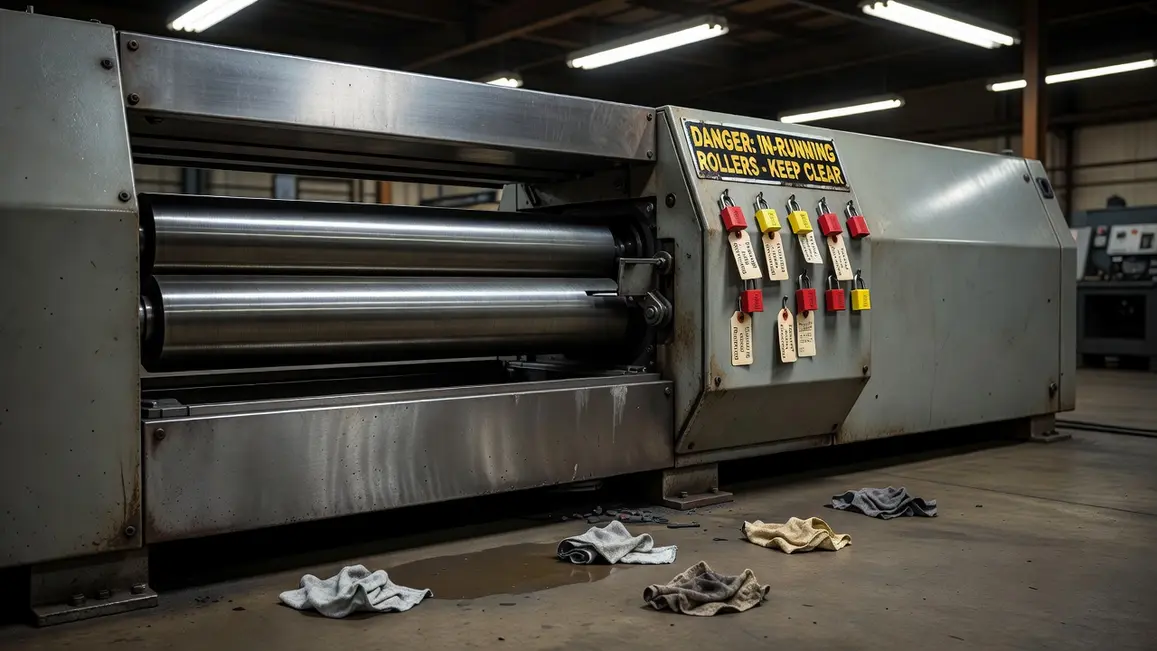
On 17 January 2025 at the company’s Telford site, a laminator operative and shift supervisor suffered a severe crush injury to their left hand when it was drawn into the in-running rollers of a laminating machine during cleaning operations. The incident occurred because a rag used for cleaning became caught between two rollers, pulling the worker’s hand into the nip point up to the wrist. The company had failed to provide a fixed guard to prevent access to the dangerous nip point during cleaning, and their risk assessment and safe system of work were deemed unsuitable and insufficient. This event directly highlights critical gaps in laminator roller safety practices.
The HSE investigation confirmed the absence of effective engineering controls and inadequate consideration of cleaning tasks in risk assessments. The company had previously been fined £277,500 in November 2025 following a fatal incident at another site and was fined an additional £60,000 plus £4,464 in costs for this incident at Birmingham Magistrates’ Court on 10 August 2026. These repeated enforcement actions underscore the ongoing need for rigorous laminator roller safety measures across all packaging operations.
Core safety lesson
The Hazard: In-running nip point between laminator rollers during cleaning.
The Control: Install fixed guards that physically prevent access to the nip point during both production and cleaning operations, ensuring guards cannot be easily removed or bypassed.
Fixed guards represent the only reliable barrier against entanglement at in-running nip points. Without them, any cleaning activity near moving rollers creates an immediate and foreseeable risk of severe injury, as demonstrated when loose material was drawn into the machine. Relying on administrative controls or worker vigilance alone has proven insufficient, especially when tasks require close proximity to rotating components.
Task-specific risk assessments must explicitly address cleaning, maintenance, and repair activities to identify all potential access points to dangerous moving parts. Detailed safe operating procedures must then specify isolation methods, emergency stop use, and a prohibition on loose materials like rags near in-running rollers. These layered requirements are non-negotiable because the absence of engineering controls directly enabled the January 2025 injury and contributed to the company’s second prosecution within a year.
Supervisor’s discussion guide
Q1: “Looking at our own equipment today, where is the biggest risk of in-running nip point exposure?”
Q2: “How do we currently verify that fixed guards remain in place and secure during cleaning operations?”
Q3: “What changes are needed in our risk assessments to fully cover non-production tasks around laminator rollers?”
Q4: “Are our safe systems of work for laminator roller safety clear enough that every team member can describe the isolation steps without hesitation?”
Action plan & inspection
- Verify that fixed guards are installed and cannot be easily removed or bypassed on all laminating machines.
- Confirm task-specific risk assessments explicitly include cleaning operations and identify all nip point access points.
- Review and update safe operating procedures to prohibit loose materials near in-running rollers and mandate isolation methods.
- Ensure all operatives have received documented training on the revised procedures for laminator roller safety.
- Schedule immediate follow-up inspection within 48 hours to confirm corrective actions remain in place.
Key takeaways
Effective laminator roller safety depends first on engineering controls such as fixed guards that cannot be bypassed. Risk assessments and safe systems of work must treat cleaning tasks with the same rigor as production activities, or preventable injuries will continue to occur.
Supervisors must lead by confirming these controls exist and function before any work begins. Consistent application of these lessons protects workers and helps avoid the regulatory consequences already experienced by the company involved in the January 2025 incident.
Source & Disclaimer: This toolbox talk is for educational purposes based on public report. Read Original Report