Meeting details
Date: January 27, 2026
Topic: Fragile Rooflights Safety
Goal: This toolbox talk on fragile rooflights safety will review the High Wycombe worker fall through a fragile rooflight incident and prevent similar accidents in 2026.
The incident: what happened?
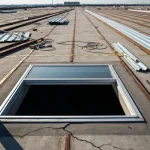
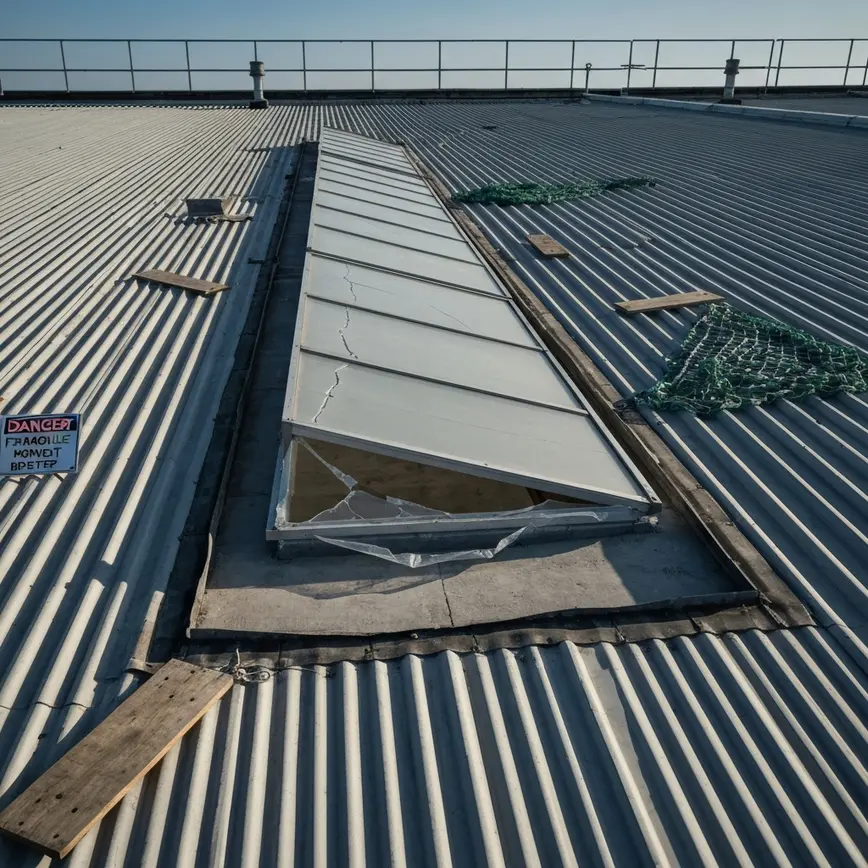
On 12 August 2023, a worker was cleaning and repairing gutters and drains on an industrial estate roof in High Wycombe when he fell four meters through a fragile rooflight. Operating alone on behalf of sole trader Daniel Jenner of Jenner Roofing and Building Services, the worker stepped onto what appeared to be a stable surface, but fragile rooflights safety was not addressed, leading to a catastrophic failure. He plummeted through the rooflight, landing on concrete below and sustaining life-changing injuries, including a fractured skull and cheekbone, a fractured leg, and a broken wrist.
The HSE investigation revealed critical lapses: no work-at-height measures to prevent falls from unguarded roof edges or through fragile surfaces, and no mitigation for fall distance or impact. Daniel Jenner pleaded guilty to breaching Regulation 6(3) of the Work at Height Regulations 2005. On 21 January 2026, at High Wycombe Magistrates’ Court, he received an eight-month suspended sentence, 280 hours of unpaid work, and was ordered to pay £500 in costs. This incident underscores the deadly risks when fragile rooflights safety protocols are ignored.
Core safety lesson
The technical failure in this incident stemmed from inadequate identification and protection of fragile surfaces on the roof. Fragile rooflights and sheets, often appearing solid but unable to support a worker’s weight, pose an immediate fall hazard, especially during tasks like gutter cleaning where access requires traversing the roof.
The Hazard: Fragile rooflights/surfaces and unguarded roof edges, compounded by working alone at height.
The Control: Conduct thorough risk assessments to identify fragile areas, mark or barrier them off, and use crawl boards, reinforced covers, or barriers; install guardrails, safety nets, or personal fall arrest systems around edges; and implement lone working protocols with check-ins and emergency procedures.
These controls are non-negotiable because falls from height remain a leading cause of fatalities in construction and maintenance. Fragile rooflights safety demands collective protection first—guardrails and barriers prevent access to danger zones before work starts, eliminating reliance on individual error. Working alone amplifies risks, as no buddy can intervene, and without mitigation like nets, a four-meter fall guarantees severe injury or death on hard surfaces like concrete. HSE guidance is clear: avoid work at height where possible, but when unavoidable, plan meticulously to enforce fragile rooflights safety every time.
Supervisor’s discussion guide
Use these questions to engage the crew in a 10-minute discussion. Encourage honest input and tie responses back to fragile rooflights safety.
Q1: “Looking at our own sites today, where is the biggest risk of falls through fragile rooflights?”
Q2: “What steps have we taken to mark or barrier fragile surfaces before starting roof work?”
Q3: “How do we ensure no one works alone at height without check-ins and emergency plans?”
Q4: “If we spot an unguarded edge or fragile rooflight, what’s our immediate stop-work action?”
Action plan & inspection
Immediately after this toolbox talk, conduct these 5 checks and document findings:
- Inspect all current and upcoming roof work areas for fragile rooflights; mark them with warning signs and barriers if not already done.
- Verify installation of guardrails or collective protection around all roof edges on site.
- Review lone working permits: ensure risk assessments include check-in schedules for any height work.
- Check stock of crawl boards, reinforced covers, and fall arrest systems; confirm they are inspected and tagged.
- Audit recent risk assessments for roof tasks to confirm fragile rooflights safety measures are explicitly addressed.
Key takeaways
Fragile rooflights safety is paramount—always assume surfaces are fragile until proven otherwise through assessment. This High Wycombe incident proves that skipping risk assessments, edge protection, and lone working controls leads to life-changing injuries and legal consequences. Prioritize collective measures like barriers and crawl boards over personal gear, and never allow solo work at height without oversight.
Enforce these standards daily to eliminate falls: identify hazards pre-work, implement controls rigorously, and discuss as a team. By committing to fragile rooflights safety in every toolbox talk and inspection, we protect our crews and avoid HSE prosecutions in 2026 and beyond.
Source & Disclaimer: This toolbox talk is for educational purposes based on public report. Read Original Report