
Meeting details
Date: April 24, 2026
Topic: Caustic Soda Exposure Prevention
Goal: This toolbox talk on caustic soda exposure prevention will review the Industrial Chemicals Limited (ICL) incidents involving serious caustic soda burns and outline critical controls to prevent similar accidents in 2026.
The incident: what happened?
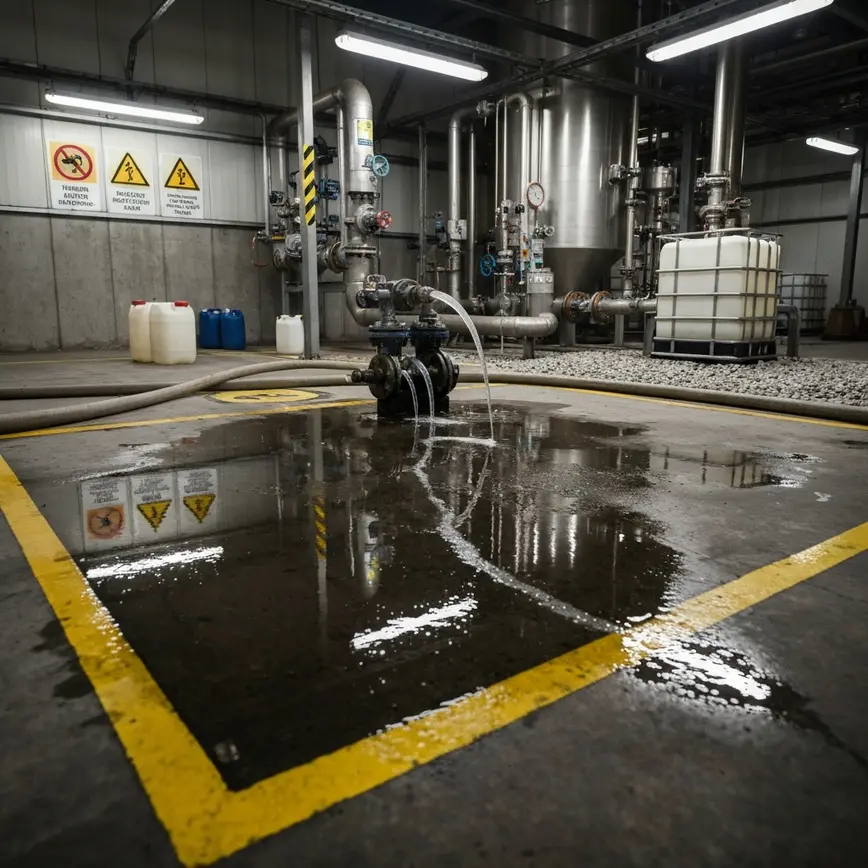
Industrial Chemicals Limited (ICL), based in Essex, was fined £3.8 million at Southwark Crown Court on 21 April 2026 following a Health and Safety Executive (HSE) investigation into breaches of COSHH Regulations 2002. The investigation uncovered failures in caustic soda exposure prevention that led to two severe incidents. In the first, on 6 December 2019 at the West Thurrock site, employee Michael Bartholomew stepped into a puddle of caustic soda caused by leaks from pipework, valves, hoses, and vessels. His substandard safety boots, not tested to British Standards, offered no protection, resulting in severe burns and a below-knee leg amputation.
The second incident occurred on 30 August 2022 at the Grays Titan Works site, where an employee suffered foot burns requiring skin grafts. This happened during manual decanting of 50% caustic soda using a hose into 25-litre containers, with drips falling directly onto his foot. Root causes included inadequate maintenance of equipment, substandard PPE, and a lack of proper risk assessments and safe systems of work, highlighting systemic failures in handling this highly corrosive substance.
Core safety lesson
The technical failures at ICL stemmed from preventable issues in equipment integrity, PPE standards, and work processes. Effective caustic soda exposure prevention demands rigorous controls at every level, starting with engineering solutions over reliance on human intervention.
The Hazard: Leaks from pipework, valves, hoses, and vessels creating hazardous puddles; inadequate or substandard PPE like untested safety boots; and lack of risk assessment for manual handling/decanting of hazardous substances.
The Control: Implement inspection, maintenance, and testing systems for equipment; ensure PPE meets British Standards with regular testing and replacement; conduct risk assessments and safe systems of work, prioritizing automation like fixed pipework and remote controls or pre-mixed materials to eliminate manual handling.
These controls are non-negotiable because caustic soda is an extremely corrosive substance that causes immediate, irreversible tissue damage upon contact. Puddles from leaks turn walkways into hidden traps, and substandard PPE fails catastrophically under exposure, as seen in the amputation and grafts. Prioritizing prevention through maintenance and automation eliminates reliance on last-resort measures, complying with COSHH and avoiding fines, prosecutions, and life-altering injuries. Supervisors must enforce these as daily imperatives, not optional checks.
Supervisor’s discussion guide
Use these questions to engage the crew and identify site-specific risks:
Q1: “Looking at our own equipment today, where is the biggest risk of leaks from pipework, valves, hoses, or vessels creating caustic soda puddles?”
Q2: “How do we verify that our safety boots and other PPE meet British Standards, and when was the last test or replacement?”
Q3: “For any manual handling of caustic soda or similar chemicals, have we conducted a full risk assessment and documented safe systems of work?”
Q4: “What opportunities do we have to automate processes, like using fixed pipework for dosing, to improve caustic soda exposure prevention?”
Action plan & inspection
Immediately after this meeting, conduct these 5 checks and document findings:
- Inspect all pipework, valves, hoses, and vessels for leaks, corrosion, or wear; schedule maintenance for any issues found.
- Review PPE inventory, focusing on safety boots—verify British Standards compliance via testing records and replace substandard items.
- Examine walkways and ground conditions; ensure designated paths and made-up ground to prevent puddle accumulation.
- Conduct or update risk assessments for all caustic soda handling tasks, confirming safe systems and automation feasibility.
- Check decanting setups for hoses and containers; prioritize fixed pipework or remote controls to eliminate manual exposure risks.
Key takeaways
Caustic soda exposure prevention starts with proactive engineering controls: robust inspection and maintenance regimes prevent leaks, while automation eliminates high-risk manual tasks. Never treat PPE as a primary defense—substandard gear leads to catastrophe, as proven by ICL’s £3.8 million fine and the employees’ life-changing injuries. Prioritize risk assessments under COSHH to identify and mitigate hazards before they harm.
Today’s toolbox talk reinforces that supervisor vigilance turns these lessons into action. By checking equipment, PPE, and processes now, we safeguard our teams in 2026 and beyond, avoiding the puddles, drips, and failures that cost ICL dearly. Commit to zero tolerance for shortcuts—safety is non-negotiable.
Source & Disclaimer: This toolbox talk is for educational purposes based on public report. Read Original Report
