Meeting details
Topic: Hydrogen Sulfide Exposure Prevention During Cold-Weather Shutdowns
Goal: This toolbox talk on hydrogen sulfide exposure will review the Woodland Pulp LLC incident and prevent similar accidents in 2026.
The incident: what happened?
On January 27, 2026, at the Woodland Pulp LLC facility in Baileyville, Maine, two workers suffered fatal hydrogen sulfide exposure during a cold-weather shutdown procedure. Kasie Malcolm, a 20-year-old chemical engineering co-op student, and Allen Hornberger, a 26-year-old process engineer, were both killed by uncontrolled hydrogen sulfide gas. OSHA’s investigation later confirmed multiple failures in process safety management that allowed the toxic release to occur without adequate detection or protection.
A secondary chemical fire took place on March 7, 2026, when 4,400 gallons of 50% hydrogen peroxide mixed with accumulated wood pulp. The employer ultimately received four willful and eight serious citations carrying proposed penalties of $794,456. The facility had already been inspected 13 times by OSHA since 2017, including a 2017 chemical exposure event that hospitalized 14 employees.
Core safety lesson
The Hazard: Uncontrolled hydrogen sulfide release during shutdown procedures.
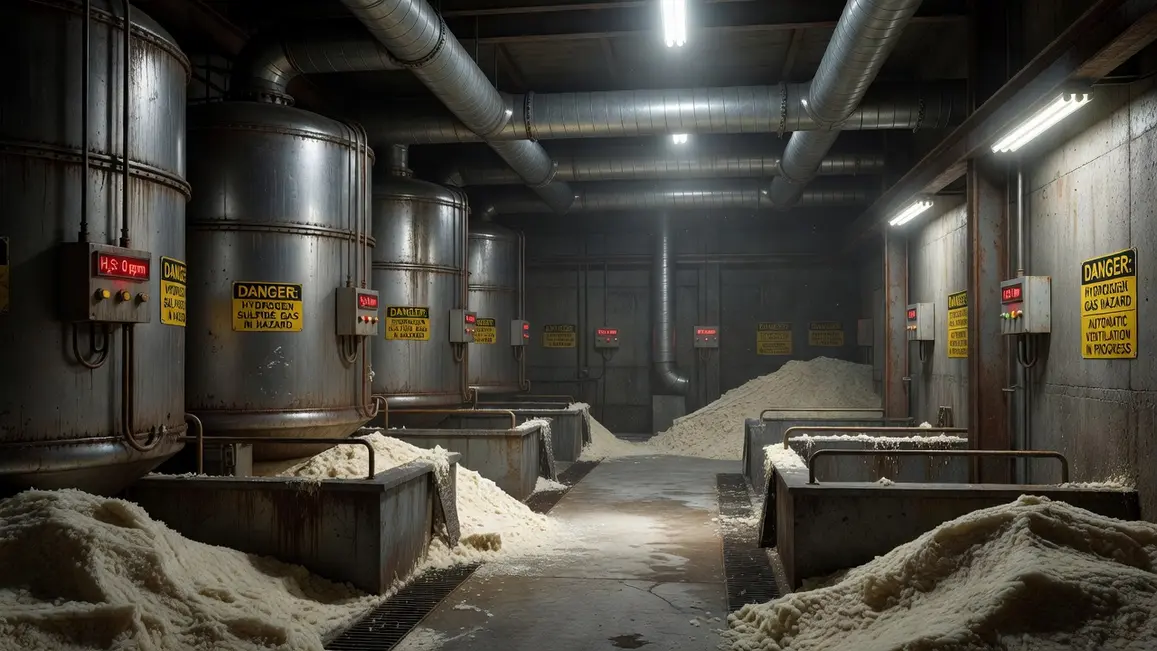
The Control: Implement and enforce a comprehensive process safety management (PSM) program that includes mandatory pre-shutdown hazard assessments, continuous atmospheric monitoring with calibrated H₂S sensors, and automatic emergency ventilation systems triggered by gas detection.
Without these layered controls, even brief process upsets can release lethal concentrations of hydrogen sulfide before workers have time to react. The Woodland Pulp LLC incident demonstrates that relying on informal procedures or incomplete monitoring leaves employees completely unprotected when gas accumulates in confined or poorly ventilated areas.
Continuous, calibrated monitoring combined with automatic ventilation is non-negotiable because hydrogen sulfide is both odorless at high concentrations and rapidly incapacitating. A single missed pre-shutdown assessment or an uncalibrated sensor can eliminate the only warning window available, turning a routine shutdown into a double fatality. Facilities must treat these engineering controls as the primary defense rather than depending on individual worker actions after the release has begun.
Supervisor’s discussion guide
Q1: “Looking at our own equipment today, where is the biggest risk of hydrogen sulfide exposure?”
Q2: “Are our supplied-air respirators and emergency escape respirators inspected, accessible, and properly maintained at every workstation?”
Q3: “What housekeeping gaps exist right now that could allow wood pulp or other materials to accumulate near process chemicals?”
Q4: “How would we confirm that all H₂S sensors are calibrated and that automatic ventilation activates before any shutdown begins?”
Action plan & inspection
- Verify that all H₂S sensors in shutdown areas are calibrated and functioning with documented test records.
- Confirm supplied-air respirators or SCBAs are available, inspected, and fit-tested for every worker entering potential exposure zones.
- Conduct an immediate housekeeping audit of all process areas to remove accumulated wood pulp and verify spill containment systems.
- Review the pre-shutdown hazard assessment checklist and ensure it is completed before the next cold-weather shutdown.
- Test automatic emergency ventilation activation tied to gas detection alarms and document results.
Key takeaways
Hydrogen sulfide exposure remains a lethal hazard whenever process equipment is taken offline without rigorous PSM controls. The January 27, 2026 fatalities at Woodland Pulp LLC prove that missing monitoring, ventilation, and respiratory protection requirements can result in immediate deaths and substantial regulatory penalties.
Supervisors must enforce pre-shutdown assessments, continuous calibrated sensing, and strict housekeeping every shift. These measures directly address the root causes identified in the OSHA citations and protect workers from both primary toxic releases and secondary chemical reactions.
Source & Disclaimer: This toolbox talk is for educational purposes based on public report. Read Original Report