Meeting details
Topic: Preventing temporary platform collapse during concrete operations
Goal: This toolbox talk on temporary platform collapse will review the Paxton House incident and prevent similar accidents in 2026.
The incident: what happened?
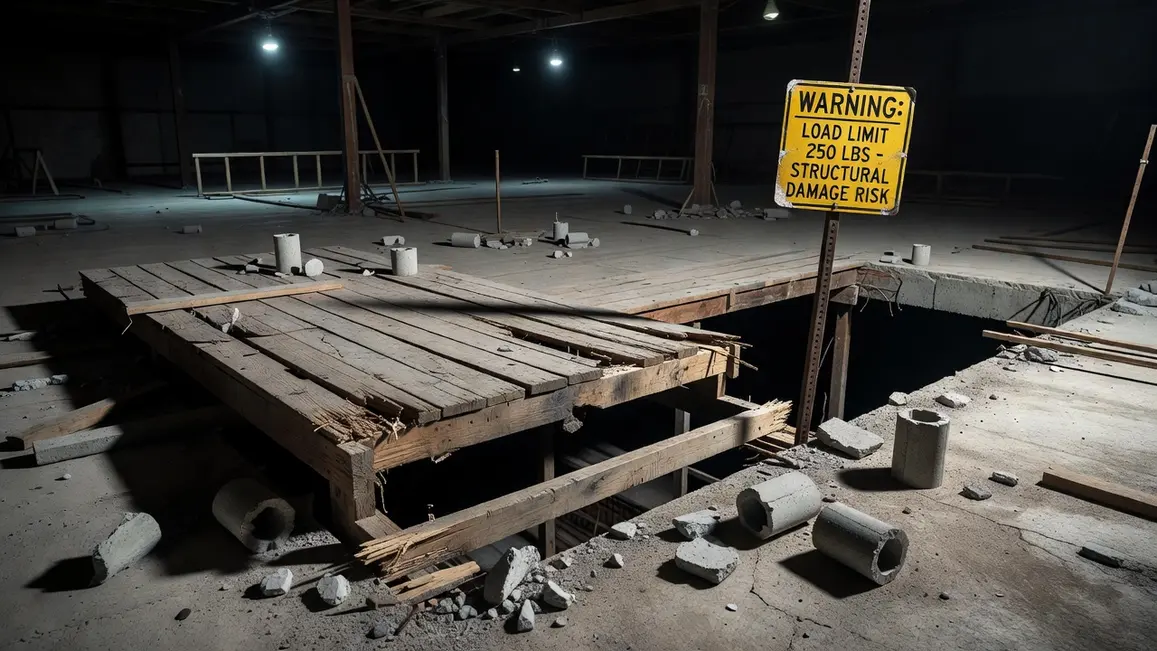
On 23 February 2024 a temporary platform collapse occurred at Paxton House in the City of London during a multi-floor concrete cutting operation. Temporary wooden platforms had been erected by the principal contractor, Roots Contractors Ltd, to catch 16 kg concrete cores, yet no structural calculations, design drawings or safe working load had ever been established. An inspection form was completed by a non-competent person who failed to identify the design deficiencies. A drilling operative working directly beneath the platform was struck by falling concrete debris and platform sections, sustaining neck and back fractures together with a brain bleed that has left the worker unable to return to work.
The Health and Safety Executive investigation found that verbal instructions to keep the platforms clear were never supported by monitoring or defined load limits. Poor coordination between contractors meant the operative was positioned directly below an active work area, breaching the verbal “do not work below one another” rule. Both Roots Contractors Ltd and Diacutt Ltd were prosecuted under CDM 2015 Regulations 16(2) and 15(2) respectively and fined a combined £32,333 plus costs.
Core safety lesson
The Hazard: Uncontrolled loading of temporary platforms
The Control: Temporary works must be formally designed by a competent temporary works designer, with calculated safe working loads clearly marked and communicated; regular documented inspections by a qualified temporary works coordinator are required.
This control is non-negotiable because temporary platforms without engineered load calculations can fail suddenly under even modest debris accumulation, as demonstrated by the Paxton House temporary platform collapse. The absence of a competent designer and qualified inspector allowed a structure to be used that had no verified capacity, turning routine concrete coring into a life-changing event.
Furthermore, daily supervision that verifies debris is cleared before loads approach any design limit ensures the original calculations remain valid throughout the work. Without this active monitoring, verbal rules alone proved insufficient to protect workers positioned below the platform.
Supervisor’s discussion guide
Q1: “Looking at our own equipment today, where is the biggest risk of uncontrolled loading?”
Q2: “Who on this site is formally appointed as the temporary works coordinator and how do we confirm their competence?”
Q3: “How are exclusion zones and work sequencing communicated between contractors to prevent anyone working directly below active cutting?”
Q4: “What documented checks would have identified the deficiencies that led to the temporary platform collapse at Paxton House?”
Action plan & inspection
- Confirm every temporary platform has current design calculations and marked safe working load signed by a competent temporary works designer.
- Verify that a qualified temporary works coordinator has completed and signed the most recent inspection form.
- Check that exclusion zones and sequencing are clearly defined in the integrated method statement and understood by all contractors.
- Ensure daily logs record debris clearance before any load approaches the stated safe working load.
- Confirm that no operative is scheduled to work directly below active concrete cutting or material-drop zones.
Key takeaways
Every temporary platform must be treated as a designed structural element with verified capacity, competent inspection and active monitoring. The Paxton House temporary platform collapse shows that shortcuts in design, inspection and coordination produce catastrophic injuries and regulatory penalties.
Supervisors must enforce these controls immediately and without exception. Only through rigorous adherence to formal temporary works procedures can similar incidents be prevented on sites in 2026 and beyond.
Source & Disclaimer: This toolbox talk is for educational purposes based on public report. Read Original Report