Meeting details
Topic: Vehicle pedestrian separation at waste and recycling facilities
Goal: This toolbox talk on vehicle pedestrian separation will review the fatal incident involving a reversing telehandler at H. Wicks (Lindal) Limited and prevent similar accidents in 2026.
The incident: what happened?
On 12 May 2022, a 44-year-old worker at H. Wicks (Lindal) Limited’s waste and recycling facility in Barrow-in-Furness, Cumbria, was fatally struck by a reversing telehandler. The root cause was a clear failure in vehicle pedestrian separation, as the site layout allowed pedestrians and vehicles to occupy the same uncontrolled space without adequate barriers or designated routes. The Health and Safety Executive investigation confirmed that the company had breached Section 2(1) of the Health and Safety at Work etc. Act 1974 by not organising the site so that pedestrians and vehicles could move safely.
The company pleaded guilty and was sentenced at Warrington Magistrates’ Court on 26 May 2026, receiving a £60,000 fine plus £6,624.75 in costs and a £2,000 surcharge. This case highlights how the absence of proper vehicle pedestrian separation in busy recycling environments can turn routine vehicle movements into fatal events when traffic routes and pedestrian areas are not physically kept apart.
Core safety lesson
The Hazard: Uncontrolled reversing vehicle movements combined with poor site layout that permits direct vehicle–pedestrian interaction.
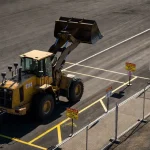
The Control: Install banksmen or reversing alarms/camera systems, enforce one-way traffic routes with clear signage and physical barriers, and maintain clearly marked, physically segregated pedestrian routes through barriers, kerbs or raised walkways.
These controls are non-negotiable because reversing telehandlers have limited visibility and large blind spots. When vehicle pedestrian separation is not enforced through physical measures, workers on foot can enter the path of a moving machine without the driver’s knowledge. Regular audits and worker briefings ensure the separation remains effective as site conditions change.
A site-specific traffic management plan that separates vehicle routes from pedestrian areas must be treated as a living document. Without consistent enforcement, even well-designed layouts degrade over time, allowing the same conditions that led to the 2022 fatality to reappear. Physical barriers and one-way systems remove reliance on human vigilance alone and create a more reliable layer of protection.
Supervisor’s discussion guide
Q1: “Looking at our own equipment today, where is the biggest risk of uncontrolled reversing movements?”
Q2: “Are our current pedestrian routes physically separated from vehicle paths, or do they rely only on painted lines?”
Q3: “How can we improve vehicle pedestrian separation here before the next shift change?”
Q4: “What changes to signage or barriers would make the safest routes obvious even to a new visitor?”
Action plan & inspection
- Verify that all vehicle routes are one-way with functioning signage and physical barriers in place.
- Confirm pedestrian walkways are marked and separated by kerbs, barriers or raised sections with no gaps.
- Test reversing alarms and camera systems on every telehandler and similar plant before use.
- Review the current traffic management plan and note any areas where vehicle pedestrian separation has been compromised.
- Brief all arriving workers on the designated pedestrian routes and prohibited crossing points before they enter active zones.
Key takeaways
Effective vehicle pedestrian separation requires more than painted lines or verbal instructions. Physical barriers, one-way systems, and active controls such as banksmen or camera systems must work together to keep pedestrians and reversing vehicles apart at all times. The 2022 incident at the Cumbria facility demonstrates that when these measures are absent or poorly maintained, the consequences can be immediate and irreversible.
Supervisors must treat every shift as an opportunity to audit separation measures and correct deficiencies before work begins. Consistent application of these controls protects workers and helps prevent the financial and human costs seen in the £68,624.75 total penalty handed down in May 2026.
Source & Disclaimer: This toolbox talk is for educational purposes based on public report. Read Original Report