Meeting details
Topic: Offshore Grating Safety on Offshore Rigs
Goal: This toolbox talk on offshore grating safety will review the Valaris 121 incident and prevent similar accidents in 2026.
The incident: what happened?
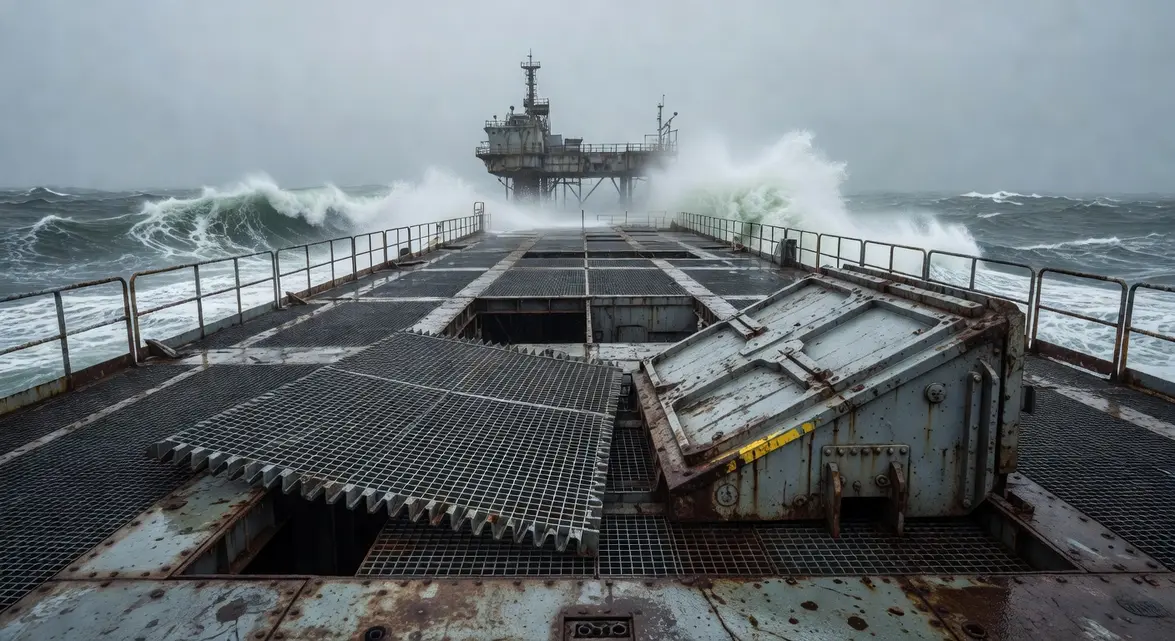
On 22 January 2023, the Valaris 121 offshore rig was under tow toward Dundee for maintenance when a serious failure in offshore grating safety led to tragedy. Around 4 pm, deck foreman Jason Thomas went missing after a colleague heard a loud noise and found a displaced grating panel immediately outside the deck 1 airlock door. HSE investigators determined that Mr Thomas fell through the unsecured grating into the North Sea amid deteriorating weather conditions, with winds exceeding 30 mph and waves over 5 m. The grating had not been secured according to OEM specifications, and inspections had failed to confirm the proper deployment of Hilti clips.
Ensco Offshore UK Limited later pleaded guilty to breaching Section 3(1) and 33(1)(a) of the Health and Safety at Work etc. Act 1974. The company was fined £267,000 at Aberdeen Sheriff’s Court on 18 May 2026. This case underscores how even experienced personnel remain vulnerable when basic securing procedures for deck grating are overlooked during rig moves.
Core safety lesson
The Hazard: Unsecured or improperly installed deck grating that can be displaced by wave action.
The Control: Ensure all grating panels are secured using OEM-approved fixings (e.g., Hilti clips) and verify correct installation during every pre-tow and weather-related risk assessment.
This control is non-negotiable because wave action and vessel motion can rapidly dislodge unsecured panels, creating sudden openings in walking surfaces. On the Valaris 121, the absence of verified Hilti clips allowed the grating to shift without warning, directly contributing to the fall. Routine visual checks alone proved insufficient when sea states deteriorated.
Documented verification by a competent person adds an essential layer of accountability. It forces teams to confirm fixings are present and correctly engaged before exposure to higher-risk conditions. Without this step, assumptions replace evidence, and minor oversights become fatal gaps in protection.
Supervisor’s discussion guide
Q1: “Looking at our own equipment today, where is the biggest risk of unsecured grating displacing during a move?”
Q2: “What steps do we currently take to confirm Hilti clips or equivalent fixings are in place before adverse weather arrives?”
Q3: “How can we strengthen our pre-tow checks to improve offshore grating safety across all deck areas?”
Q4: “If a grating panel appears displaced, what is our immediate reporting and access-control procedure?”
Action plan & inspection
- Visually inspect every accessible grating panel for correct OEM fixings before the next rig move.
- Confirm Hilti clips (or approved equivalents) are fully engaged on all panels near airlock doors and exposed deck edges.
- Complete and sign off a documented grating-fixing checklist with a competent person.
- Review current weather forecasts and restrict access to open deck areas if wave heights approach 5 m.
- Verify that life vests and harness points remain readily available and in good condition near high-risk zones.
Key takeaways
Offshore grating safety depends on verified physical fixings and disciplined inspection routines rather than assumptions. The Valaris 121 incident demonstrates that even brief lapses during deteriorating sea states can produce irreversible outcomes when panels are not properly secured.
Supervisors must treat every pre-tow and weather check as a critical control point. Consistent application of OEM-approved fixings and signed verification protects personnel and meets the legal standards expected across the sector.
Source & Disclaimer: This toolbox talk is for educational purposes based on public report. Read Original Report