Meeting details
Topic: Compliance with the asbestos control limit under current GB regulations
Goal: This toolbox talk on asbestos control limit will review a scenario of potential fibre release from inadequate training and supervision on a licensed removal project and prevent similar exposure risks in 2026.
The incident: what happened?
A licensed contractor was engaged to remove asbestos insulating board from a commercial refurbishment site. Despite the established asbestos control limit of 0.1 fibres per millilitre as a 4-hour time-weighted average, gaps in worker competence and on-site supervision allowed materials to be broken rather than removed intact. Personal monitoring later showed elevated fibre levels that could have been avoided, highlighting that the existing limit itself was not the issue but rather failures in applying the Control of Asbestos Regulations 2012 framework.
The HSE policy review of December 2025 examined this type of event alongside international evidence and the EU decision to reduce its occupational exposure limit to 0.01 f/ml from 21 December 2025. The review concluded that lowering Great Britain’s asbestos control limit would bring most work into licensed scope without delivering measurable health benefits. Instead, the primary drivers of risk remain training, site discipline, and regulatory enforcement, exactly as identified during the May 2025 industry workshop.
Core safety lesson
The Hazard: Inadequate training and supervision leading to non-compliance with control measures.
The Control: Mandatory licensed contractor requirements including pre-work notification to HSE, independent four-stage clearance process, personal exposure monitoring, and regular medical checks for workers.
The asbestos control limit of 0.1 f/ml remains effective only when these controls operate together. Notification ensures HSE oversight before work begins, while the four-stage clearance verifies that fibre levels have returned below the limit. Personal monitoring provides real-time data to confirm that exposures stay as low as reasonably practicable, and medical surveillance detects any early health effects in workers who may have been exposed over time.
These measures are non-negotiable because the December 2025 review found no clear evidence that a numerical reduction alone would improve outcomes. Compliance gaps in training and supervision create the actual risk, not the value of the asbestos control limit. When every step is followed, the current regulatory framework protects workers without unnecessary expansion of licensing requirements.
Supervisor’s discussion guide
Q1: “Looking at our own equipment today, where is the biggest risk of fibre release during AIB removal?”
Q2: “How do we confirm that all workers have completed the required training before starting licensed tasks?”
Q3: “What checks ensure we notify HSE and complete the four-stage clearance without shortcuts?”
Q4: “In what ways could our site discipline affect whether we stay below the asbestos control limit?”
Action plan & inspection
- Verify current asbestos awareness and refresher training records for every operative on site.
- Confirm HSE notification has been submitted at least 14 days before any licensed work.
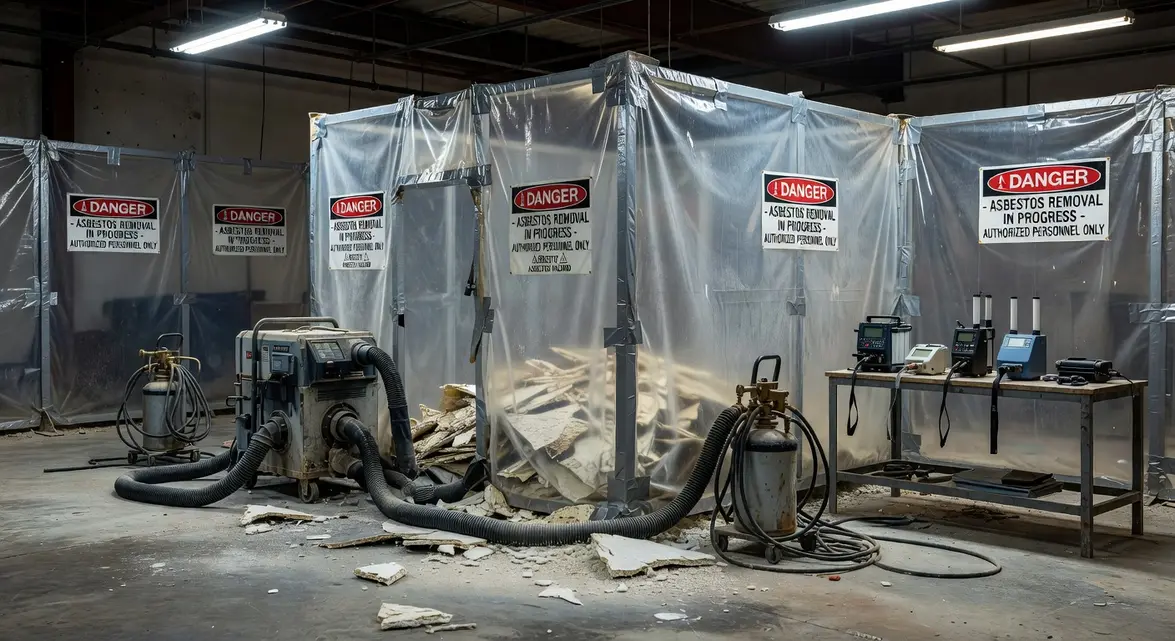
- Inspect the availability and condition of shadow vacuums, wetting equipment, and RPE for the task.
- Review the method statement to ensure materials will be removed intact rather than broken.
- Schedule independent analyst attendance for the four-stage clearance and document personal exposure monitoring results.
Key takeaways
The HSE review confirms that Great Britain’s asbestos control limit of 0.1 f/ml, combined with strict application of ALARP principles, continues to protect workers when training, supervision, and site discipline are maintained. Lowering the numerical value would not address the real causes of exposure identified in the policy analysis.
Supervisors must therefore enforce every control measure on every job. Pre-notification, competent workers, personal monitoring, and proper clearance procedures turn the existing asbestos control limit into an effective safeguard rather than a line that is crossed through avoidable mistakes.
Source & Disclaimer: This toolbox talk is for educational purposes based on public report. Read Original Report