Meeting details
Topic: Conveyor Belt Entanglement Hazards and Prevention
Goal: This toolbox talk on conveyor belt entanglement will review the serious incident at Mains of Auchenbadie Farm near Banff on 15 October 2024 and prevent similar accidents in 2026.
Date: May 14, 2026
Duration: 10 minutes
Attendees: Site supervisors and crew
Presenter: Safety Director
The incident: what happened?
On 15 October 2024, a worker at Mains of Auchenbadie Farm near Banff experienced a severe case of conveyor belt entanglement during a routine cleaning operation. His clothing became caught in the in-running nip point between a pressure roller and the underside of an upper manure conveyor belt. He had climbed into the confined space between two manure conveyor belts without stopping the machinery to investigate an unusual noise. This tragic oversight led to serious nerve damage in both arms, though full function was restored to his right arm after three months of recovery.
The worker was eventually freed when a colleague activated an emergency stop button, but the situation required intervention from emergency services. Following an HSE investigation, Duncan Farms Limited was fined £53,000 at Aberdeen Sheriff Court on 7 May 2026 for breaching PUWER Regulations 11(1) and (2), as well as Section 33(1)(c) of the Health and Safety at Work etc. Act 1974. Key root causes included the absence of fixed or interlocking guarding at the drive end of the manure conveyors, despite existing risk assessments and instructions for workers to wear close-fitting clothing.
Core safety lesson
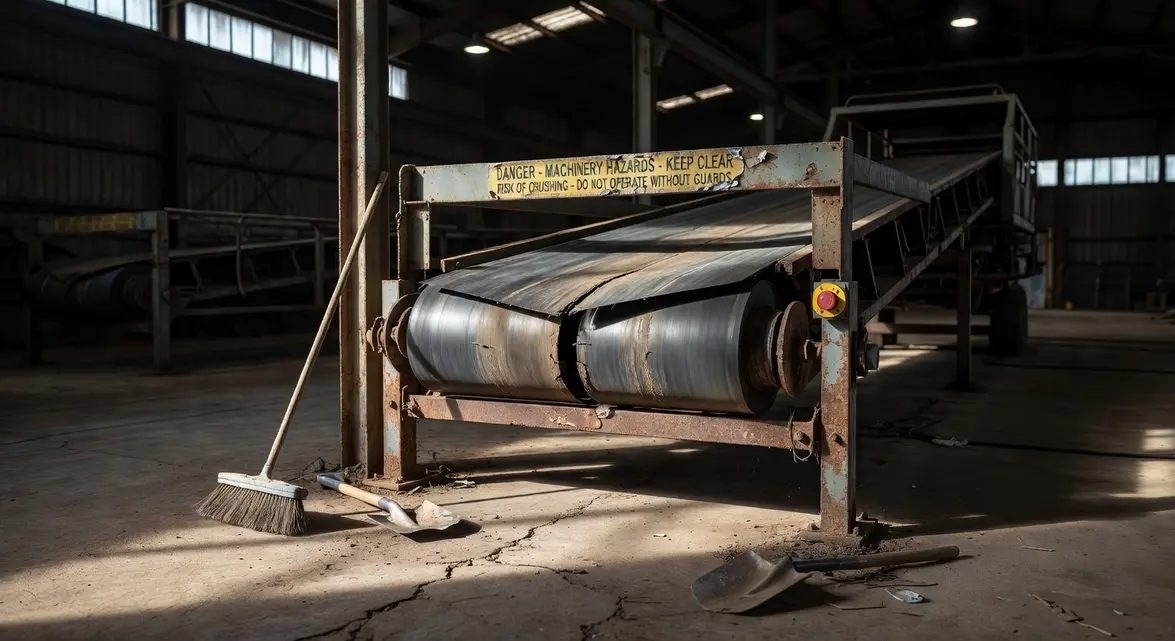
The technical failure in this incident stemmed from inadequate machine guarding and poor isolation procedures, allowing access to dangerous moving parts during operation. The Hazard: Entanglement in in-running nip points of operating conveyor belts, particularly in confined spaces like those between manure conveyors, where clothing or body parts can be drawn into the machinery instantaneously.
The Control: Install fixed or interlocking guarding at dangerous parts, such as the drive end, to physically prevent access while machinery is running, as mandated by PUWER Reg 11. Additional measures include barriers or interlocks that automatically stop the belt before a person can reach nip points, and strict enforcement of lockout/tagout (LOTO) protocols for cleaning or inspections.
These controls are non-negotiable because training and personal protective equipment instructions, like wearing close-fitting clothing, are insufficient against the mechanical forces of in-running nips, which can cause irreversible injuries in seconds. Risk assessments existed in this case, yet the lack of engineering controls failed to eliminate reliance on human behavior. Supervisors must prioritize physical guards and LOTO to create layered defenses, ensuring no worker can access hazards unintentionally. In 2026, with HSE enforcement intensifying, compliance isn’t optional—it’s a legal and ethical imperative to protect lives.
Supervisor’s discussion guide
Use these questions to engage the crew and identify site-specific risks. Allow 3-4 minutes for discussion.
- Q1: “Looking at our own equipment today, where is the biggest risk of conveyor belt entanglement?”
- Q2: “What steps do we take before entering any confined space around conveyors or similar machinery?”
- Q3: “Have you ever noticed missing guards on our conveyors? What should we do about it?”
- Q4: “How can we improve our LOTO procedures to prevent rushing into inspections without isolation?”
Action plan & inspection
Immediately after this meeting, conduct these checks and document findings. Assign owners and due dates.
- Inspect all conveyor belts for fixed or interlocking guarding at drive ends and nip points; install or repair any deficiencies within 48 hours.
- Verify LOTO kits are complete, accessible, and tagged on all relevant machinery; test emergency stop buttons.
- Review and update risk assessments for conveyor operations, emphasizing confined spaces and cleaning procedures.
- Check for barriers or interlocks that prevent access to in-running nips during operation; retrofit if absent.
- Retraining confirmation: Ensure all crew sign off on PUWER Reg 11 compliance and conveyor belt entanglement prevention protocols.
Key takeaways
Conveyor belt entanglement remains a critical hazard that demands engineering controls over behavioral reliance. The Mains of Auchenbadie Farm incident underscores that even routine tasks like cleaning can turn deadly without proper guarding and isolation—serious nerve damage was narrowly avoided from becoming permanent. Always stop, isolate via LOTO, and verify before entering confined spaces around moving parts.
In 2026, commit to zero tolerance: fixed guards at nip points, interlocked access, and rigorous inspections. This toolbox talk equips you to lead safely—report hazards immediately, and remember, compliance with PUWER and HSWA protects your team and avoids fines like the £53,000 levied against Duncan Farms Limited.
Source & Disclaimer: This toolbox talk is for educational purposes based on public report. Read Original Report