Meeting details
Date: April 21, 2026
Topic: Electronics Warehouse Fire Hazards and Prevention
Goal: This toolbox talk on electronics warehouse fire will review the major blaze at Electronic Scrap Recycling Inc. in Houston, Texas, and prevent similar accidents in 2026.
The incident: what happened?
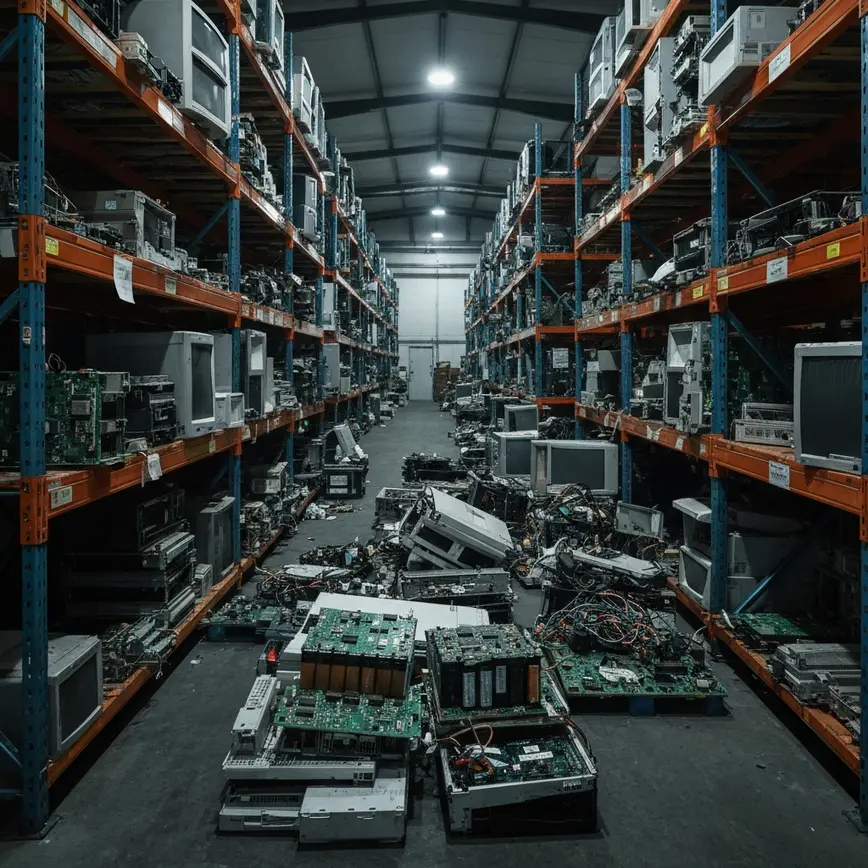
On Thursday, April 2, at 1:30 a.m., a fully involved electronics warehouse fire broke out at Electronic Scrap Recycling Inc. on Springer Street in Houston, Texas. The warehouse was filled with recycled computers, and the fire produced loud “booms” and “bangs” likely from explosive ignition of materials like batteries and capacitors inside the e-waste. The business was closed at the time, resulting in no injuries to civilians or firefighters, but the incident required a massive response to contain the spread.
Emergency crews deployed 60 firefighters and 15 units, employing a defensive strategy with hand lines, deck guns, and aerial ladders to battle the blaze and protect nearby structures, including a tire storage building. The fire’s high fuel load from combustible metals and plastics fueled rapid spread, but responders successfully prevented exposure fires. The cause remains under investigation, with crews monitoring the scene for ongoing suppression needs.
Core safety lesson
The electronics warehouse fire highlighted critical failures in managing high-risk e-waste storage, where explosive components like batteries and capacitors ignited violently, producing dangerous booms and bangs. This incident underscores the rapid escalation possible in environments with dense, combustible recyclables.
The Hazard: Explosive ignition from stored e-waste (e.g., batteries, capacitors in recycled computers) and rapid fire spread in high-fuel-load warehouses, plus exposure risks to adjacent structures like tire storage.
The Control: Implement regular inventory audits and segregation of high-risk components per NFPA 70E standards, using fire-rated containers; install automatic sprinkler systems and maintain clear access aisles per NFPA 13; establish fire walls or separation distances per IBC Section 705.
These controls are non-negotiable because e-waste contains volatile elements that can self-ignite or explode under heat, turning a minor spark into a structure fire requiring 60 firefighters. Without segregation and sprinklers, fires spread uncontrollably through plastics and metals, overwhelming suppression efforts. Fire walls prevent domino effects to exposures, ensuring defensive tactics succeed without loss of life or property—proven essential in this electronics warehouse fire scenario.
Supervisor’s discussion guide
Engage your crew with these questions to drive home the lessons from the electronics warehouse fire:
Q1: “Looking at our own equipment and storage today, where is the biggest risk of explosive ignition from e-waste like batteries or capacitors?”
Q2: “How do our current aisles and separations measure up to NFPA 13 and IBC requirements for preventing rapid fire spread?”
Q3: “What pre-planned tactics would we use if a fire threatened nearby exposures, like the tire storage in this incident?”
Q4: “Have we conducted recent inventory audits on high-risk materials, and what gaps do we see?”
Action plan & inspection
- Conduct immediate inventory audit of all e-waste, segregating batteries and capacitors into fire-rated containers per NFPA 70E.
- Inspect warehouse aisles for clear access (minimum 44 inches wide) and verify automatic sprinkler system functionality per NFPA 13.
- Measure separation distances to adjacent structures and confirm fire walls meet IBC Section 705 standards.
- Check for high-fuel-load areas (e.g., piled plastics/metals) and install fixed suppression if needed.
- Review and update site emergency response plan, including defensive tactics for exposures like tire storage.
Key takeaways
The electronics warehouse fire at Electronic Scrap Recycling Inc. serves as a stark reminder that e-waste is not inert—batteries and capacitors can explode, fueling booms, bangs, and rapid spread that demands massive resources like 60 firefighters and 15 units. Prioritizing NFPA 70E segregation, NFPA 13 sprinklers, and IBC fire walls is critical to containing such hazards before they escalate.
Supervisors must lead immediate inspections and discussions to embed these controls. No injuries occurred here due to the off-hours timing, but complacency risks lives—make prevention non-negotiable to safeguard our sites in 2026 and beyond.
Source & Disclaimer: This toolbox talk is for educational purposes based on public report. Read Original Report