Meeting details
Date: April 21, 2026
Topic: Machinery Cleaning Safety: Lessons from Tyco Electronics Incident
Goal: This toolbox talk on machinery cleaning safety will review the Tyco Electronics UK Limited machinery injury and prevent similar accidents in 2026.
The incident: what happened?
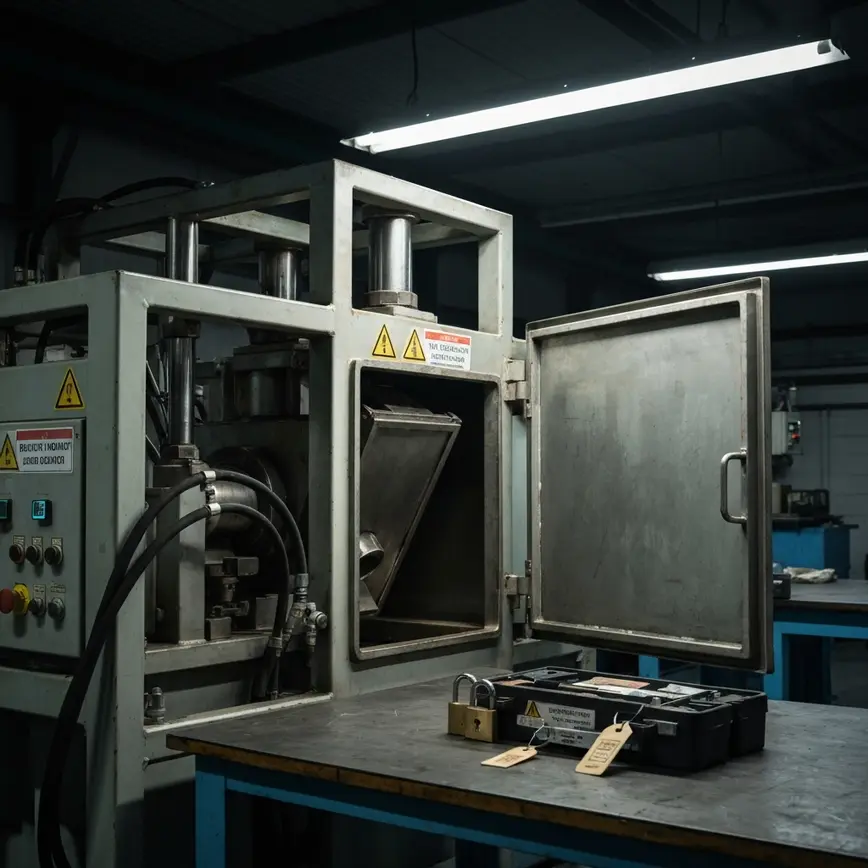
On 7 March 2023, during a night shift at Tyco Electronics UK Limited’s premises on Faraday Road, Swindon, a 42-year-old worker was seriously injured while performing machinery cleaning safety tasks on a machine used to manufacture pellets. He manually raised the hydraulic ram, opened the door, and reached in with his left hand to clean. As he withdrew his arm, the door fell unexpectedly, activating the ram and trapping his limb inside the machine. This incident underscores critical failures in machinery cleaning safety protocols, leading to torn nerves and tendons in his arm and hand.
The worker required three operations to reattach fingers, spent 10 days in hospital, and underwent twice-weekly treatments at Southmead Hospital. He continues to suffer from loss of sensation and movement in his fingers, with only some recovery in his thumb. An HSE investigation revealed failures in risk prevention measures, inadequate information and instruction, poor training, and insufficient supervision. The company pleaded guilty to breaching Section 2(1) of the Health and Safety at Work etc. Act 1974 and was fined £340,000 plus £5,145 in costs at Bristol Magistrates’ Court on 17 April 2026.
Core safety lesson
The technical failure in this incident stemmed from uncontrolled hydraulic ram activation during cleaning, combined with inadequate machine guarding, door instability, and a lack of proper training and supervision. These elements created a perfect storm where a simple cleaning task turned catastrophic.
The Hazard: Uncontrolled hydraulic ram activation and unstable machine doors during cleaning, allowing inadvertent machinery start-up and limb entrapment.
The Control: Implement safe isolation and lock-off procedures to fully isolate machinery from all power sources before cleaning; install and maintain fixed or interlocked guards on access points; provide comprehensive, machine-specific training on safe cleaning procedures with ongoing supervision.
These controls are non-negotiable because machinery cleaning safety demands zero tolerance for energy sources that can activate unexpectedly. Hydraulic systems retain pressure even when powered off, and a falling door can trigger mechanisms without proper interlocks, as seen here. Skipping isolation risks instant, irreversible injuries like nerve damage. Guards and interlocks physically prevent access to danger zones, while training ensures workers recognize and mitigate site-specific risks—without them, even experienced employees falter under fatigue or pressure, especially on night shifts.
Enforcing these measures not only complies with HSE guidance on work equipment but builds a culture where every cleaning task is treated as high-risk. The £340,000 fine highlights the legal and financial consequences, but more importantly, it prevents lifelong disabilities that no worker should endure.
Supervisor’s discussion guide
Use these questions to engage the crew in a 10-minute discussion. Encourage honest input on our site’s machinery cleaning safety practices.
Q1: “Looking at our own equipment today, where is the biggest risk of uncontrolled hydraulic ram activation or door instability during cleaning?”
Q2: “What steps do we currently take to isolate power before cleaning, and are they consistently followed?”
Q3: “How confident are you in the training you’ve received for safe machinery cleaning on our specific machines?”
Q4: “What one change could we make tomorrow to improve supervision during cleaning tasks?”
Action plan & inspection
Immediately after this meeting, supervisors must conduct these checks and document completion:
- Inspect all machinery for stable doors and interlocked guards; tag any defects for immediate repair.
- Verify lockout/tagout kits are fully stocked and accessible at every machine station.
- Review training records for the past 12 months to confirm machine-specific cleaning instruction for all operators.
- Perform a walkthrough of cleaning procedures on high-risk machines, ensuring full isolation before access.
- Post updated machinery cleaning safety signage with isolation steps at all relevant workstations.
Key takeaways
Machinery cleaning safety is never optional—always isolate power sources, secure guards, and confirm training before entering any machine. The Tyco incident proves that shortcuts during routine tasks like cleaning can lead to permanent injuries, hefty fines, and operational shutdowns. By prioritizing lock-off procedures and supervision, we eliminate the risks of hydraulic traps and unstable access points.
Commit today: No cleaning without isolation, no access without guards, no operation without verified training. This toolbox talk reinforces that proactive controls protect lives, ensure compliance, and keep our sites running safely in 2026 and beyond.
Source & Disclaimer: This toolbox talk is for educational purposes based on public report. Read Original Report