Meeting details
Date: April 16, 2026
Topic: Trenching Safety Hazards
Goal: This toolbox talk on trenching safety hazards will review the Breland Homes Inc. trenching collapse incident from December 2025 and equip supervisors and crews with the knowledge to prevent similar accidents in 2026.
The incident: what happened?
In December 2025, a construction laborer employed by Breland Homes Inc., a Huntsville, Alabama-based home builder, was fatally injured when a trench collapsed during the installation of a sewage drainpipe in a Madison County subdivision. This tragic event underscores the deadly consequences of trenching safety hazards, particularly when protective systems are absent. The unsupported trench walls gave way, burying the worker and highlighting how quickly soil instability can turn a routine excavation into a catastrophe without proper safeguards in place.
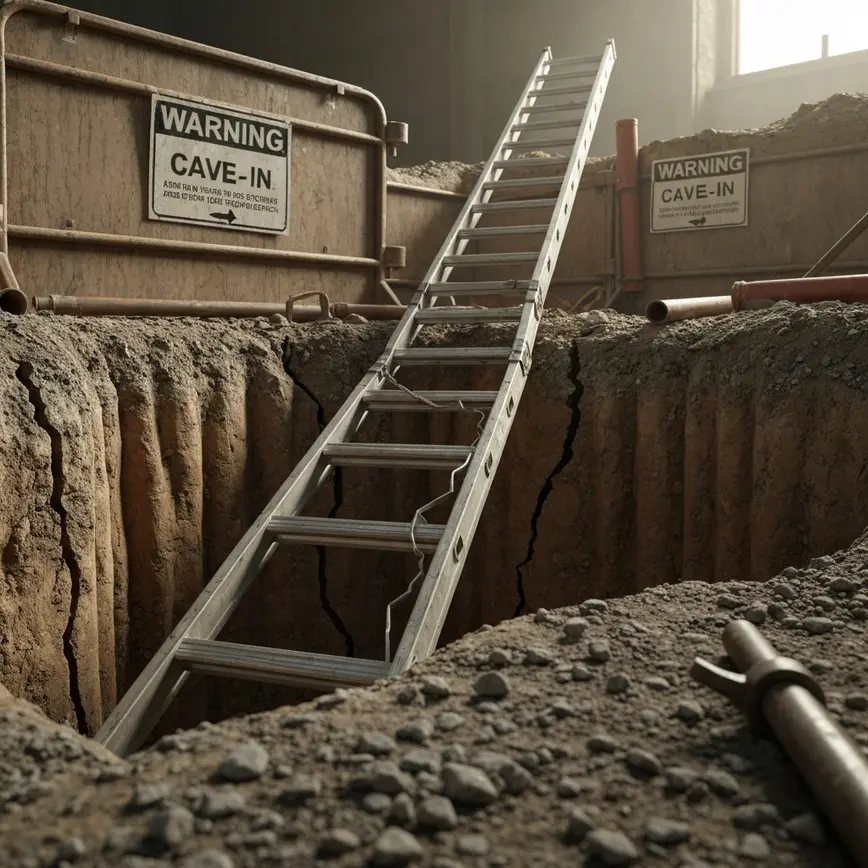
The U.S. Department of Labor’s OSHA launched a thorough investigation, resulting in eight serious safety violations cited against the company. These included unprotected and unsupported sections of the trench, failure to train workers on recognizing trenching hazards, lack of protective helmets for employees, and the use of a damaged ladder for access. OSHA proposed penalties totaling $115,855, and the company was given 15 business days to respond. This incident serves as a stark reminder of the multi-layered failures that amplify trenching safety hazards on job sites.
Core safety lesson
The technical failures in this incident revolved around multiple lapses in trenching protocols, but the primary catastrophe stemmed from unprotected trench walls that collapsed without warning. Additional issues compounded the risks: inadequate worker training on soil analysis and emergency procedures, absence of required personal protective equipment like hard hats, and reliance on defective access equipment such as a damaged ladder.
The Hazard: Unprotected or unsupported trench walls leading to cave-in, compounded by lack of hazard recognition training, missing PPE, and damaged ladders.
The Control: Implement cave-in protection systems such as sloping, shoring, or shielding per OSHA 29 CFR 1926.652, tailored to soil type, depth (protection required for trenches over 5 feet), and site conditions; provide competent person training on hazards per 29 CFR 1926.21 and Subpart P; enforce PPE like hard hats under 29 CFR 1926.100; and inspect/replace ladders regularly per 29 CFR 1926.1053.
These controls are non-negotiable because trench collapses occur suddenly and without audible warning, with soil weighing up to 100 pounds per cubic foot—enough to crush or suffocate in seconds. Training ensures every worker can spot unstable soil or water accumulation early, while PPE and reliable ladders prevent secondary injuries during entry/exit. Skipping any layer invites preventable fatalities, as evidenced by the eight violations and $115,855 in penalties; full compliance not only saves lives but avoids legal and financial repercussions in 2026 and beyond.
Supervisor’s discussion guide
Use these questions to engage the crew in a 3-4 minute discussion, encouraging honest input on site-specific trenching safety hazards:
Q1: “Looking at our own trenches today, where is the biggest risk of collapse or other trenching safety hazards?”
Q2: “Have we all completed training on recognizing trenching hazards like soil types and water issues? What gaps do we see?”
Q3: “Show me your PPE—do we have hard hats for everyone, and are ladders inspected before use?”
Q4: “What daily inspections can we add to catch damaged equipment or unsupported walls before they become deadly?”
Action plan & inspection
Immediately after this toolbox talk, conduct these 5 mandatory checks and document results:
- Inspect all active trenches deeper than 5 feet for cave-in protection (sloping, shoring, or shielding) matching soil type and conditions.
- Verify worker training records for trenching hazards, soil analysis, and emergency response; schedule retraining if any are missing or outdated.
- Conduct a full PPE audit: ensure hard hats are available, undamaged, and worn by all in potential hazard zones.
- Examine all ladders and access equipment for damage, defects, or improper setup; tag out and replace any compromised items.
- Perform a competent person daily inspection of the entire worksite, documenting trench stability, weather impacts, and protective systems.
Key takeaways
Trenching safety hazards like unsupported walls, inadequate training, missing PPE, and damaged ladders are entirely preventable with strict adherence to OSHA standards. The Breland Homes incident claims one life and triggers $115,855 in penalties because corners were cut—never let that happen here. Every supervisor must act as the competent person, enforcing daily inspections and controls to protect our crews in 2026.
Remember: Trenches over 5 feet demand protection, training is mandatory and documented, PPE is non-optional, and equipment must be inspected pre-use. Commit to these today, discuss openly, and walk away zero-tolerance for trenching safety hazards. Lives depend on it—stay vigilant.
Source & Disclaimer: This toolbox talk is for educational purposes based on public report. Read Original Report