Meeting details
Topic: Cisco Critical Vulnerabilities in Webex Services, ISE, and ISE-PIC
Goal: This toolbox talk on cisco critical vulnerabilities will review the April 16, 2026 Cisco patches for Webex, Identity Services Engine (ISE), and ISE Passive Identity Connector (ISE-PIC) and prevent similar network compromise risks on our sites in 2026.
The incident: what happened?
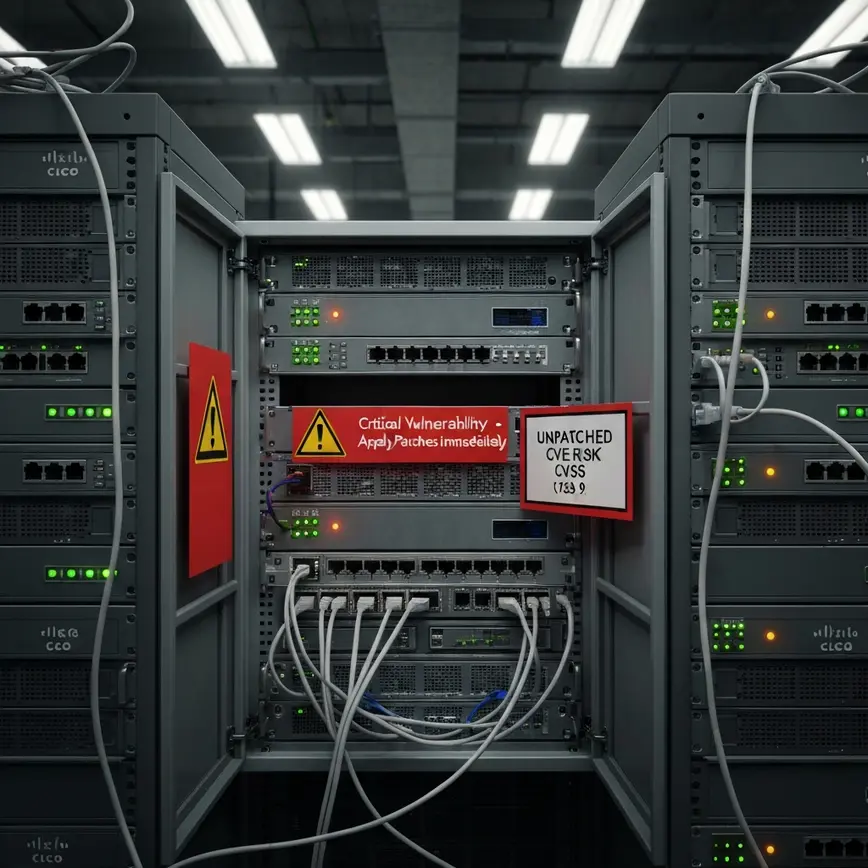
Cisco recently addressed multiple cisco critical vulnerabilities across key products including Cisco Webex Services, Cisco Identity Services Engine (ISE), and Cisco ISE Passive Identity Connector (ISE-PIC), as detailed in advisories published on April 16, 2026. One major issue involved improper certificate validation in Webex’s SSO integration with Control Hub, allowing an unauthenticated remote attacker to impersonate any user by supplying a crafted token for unauthorized access. Customers were required to upload a new IdP SAML certificate to mitigate this. Additionally, authenticated attackers with admin credentials could exploit vulnerabilities for remote code execution (RCE), path traversal, or arbitrary OS command execution on ISE and ISE-PIC, with some flaws like CVE-2026-20147 and CVE-2026-20180/20186 scoring a critical CVSS 9.9, potentially leading to root privilege escalation and denial-of-service (DoS) in single-node deployments.
Affected versions included ISE 3.1 through 3.5, with specific patches released such as ISE 3.1 Patch 11, 3.2 Patch 10, and ISE 3.5 Patch 3; ISE-PIC 3.4 reached end-of-sale. Other flaws like CVE-2026-20148 had a CVSS 4.9. No workarounds were available, and impacts ranged from unauthorized access and sensitive file reads to full system compromise and network access denial for unauthenticated endpoints. These cisco critical vulnerabilities underscored the urgency of immediate patching to avoid real-world exploitation on operational networks.
Core safety lesson
Cisco’s patches highlight failures in core security mechanisms: improper certificate validation in SSO, insufficient input validation enabling RCE and command execution, and path traversal exposing sensitive files. These technical breakdowns in enterprise networking products like Webex and ISE could cascade into site-wide disruptions if exploited.
The Hazard: Improper certificate validation in SSO enabling unauthenticated user impersonation; insufficient input validation allowing authenticated RCE and arbitrary command execution (CVSS 9.9); path traversal attacks exposing sensitive files on ISE/ISE-PIC.
The Control: Implement strict certificate pinning and regular IdP SAML certificate rotation with automated validation checks; apply principle of least privilege for admin credentials, enforce input sanitization/whitelisting in HTTP request handlers, and deploy patches immediately per vendor advisories; use canonical path resolution, file access controls restricted to authenticated sessions, runtime monitoring for anomalous file reads, and timely updates to fixed releases like ISE 3.5 Patch 3.
These controls are non-negotiable because cisco critical vulnerabilities like these have CVSS scores up to 9.9, meaning high likelihood of exploitation leading to total system compromise, data breaches, or operational downtime on industrial sites reliant on networked controls. Delaying patches or skipping validation exposes networks to remote attackers, amplifying risks in environments where ISE manages endpoint authentication. Regular rotations and monitoring ensure defenses evolve with threats, preventing a single flaw from halting critical operations.
Enforcing least privilege and input sanitization directly counters authenticated exploits, which often stem from insider or compromised credentials. In high-stakes site supervision, where network integrity protects safety systems, these practices form the backbone of resilience against evolving cisco critical vulnerabilities.
Supervisor’s discussion guide
Engage your crew with these questions to drive home the risks:
Q1: “Looking at our own equipment today, where is the biggest risk of improper certificate validation or unpatched cisco critical vulnerabilities?”
Q2: “How would an RCE exploit on our ISE devices impact site operations, and what signs should we watch for?”
Q3: “What steps have we taken to rotate SAML certificates and apply least privilege to admin accounts?”
Q4: “If we spot anomalous file access or path traversal attempts in logs, what’s our immediate response protocol?”
Action plan & inspection
- Verify all Cisco ISE and ISE-PIC devices are updated to patched versions (e.g., ISE 3.1 Patch 11, 3.2 Patch 10, 3.5 Patch 3) and document compliance.
- Upload new IdP SAML certificates for Webex SSO integrations and test validation before deployment.
- Audit admin credentials for least privilege enforcement and rotate passwords where necessary.
- Scan HTTP request handlers and input fields for sanitization/whitelisting gaps, enabling runtime monitoring for anomalies.
- Implement canonical path resolution and file access controls on all ISE/ISE-PIC instances, confirming no path traversal exposure.
Key takeaways
The cisco critical vulnerabilities patched on April 16, 2026, in Webex, ISE, and ISE-PIC serve as a stark reminder that unpatched systems invite unauthenticated impersonation, RCE (CVSS 9.9), path traversal, and full compromise. Supervisors must prioritize immediate vendor patches, certificate rotations, and least privilege to safeguard site networks from these high-impact threats.
Proactive controls like input sanitization, monitoring, and strict access rules are essential non-negotiables. By embedding these into daily inspections, we prevent cisco critical vulnerabilities from escalating into operational failures, ensuring network security supports overall site safety in 2026 and beyond.
Source & Disclaimer: This toolbox talk is for educational purposes based on public report. Read Original Report