Meeting details
Date: March 13, 2026
Topic: Overhead Power Line Safety
Goal: This toolbox talk on overhead power line safety will review the fatal electrocution incident involving Primoris Services Corp. during utility pole replacement in Pinellas, FL, in August 2025 and prevent similar accidents in 2026.
The incident: what happened?
In August 2025, at a Seminole site in Pinellas, FL, a work crew from Primoris Services Corp., operating as Primoris T&D Services LLC for Duke Energy, was replacing a utility pole. During the operation, the pole contacted an energized overhead transmission line, highlighting a critical failure in overhead power line safety protocols. This contact resulted in one lineman being fatally electrocuted and two other workers severely injured and hospitalized. The U.S. Department of Labor’s OSHA investigated, issuing three serious violations under Release 26-158-ATL from the Atlanta Region.
OSHA cited the company for failing to maintain minimum approach distances from energized parts or deenergize the line, not assigning a designated observer to monitor distances and issue warnings, and inadequate job briefings that omitted special precautions for working near energized transmission lines. Proposed penalties totaled $49,650, which the company contested. This incident underscores how seemingly routine tasks like pole replacement can turn deadly without strict adherence to overhead power line safety measures.
Core safety lesson
The technical failures in this incident stemmed from three key OSHA violations directly tied to overhead power line safety: failure to maintain minimum approach distances (or deenergize), lack of a designated observer, and insufficient job briefings.
The Hazard: Contact with energized overhead transmission lines during pole handling, exacerbated by no observer monitoring distances and incomplete pre-job planning.
The Control: Deenergize lines before work or strictly enforce minimum approach distances per OSHA 29 CFR 1910.269 using insulated tools and barriers if live work is unavoidable; assign a qualified observer for continuous monitoring and warnings with clear protocols; conduct thorough job briefings covering site-specific hazards, precautions, emergency procedures, and roles near energized lines.
These controls are non-negotiable because energized transmission lines carry lethal voltages that can arc through air or conduct via equipment contact, as seen in this fatality. Minimum approach distances prevent inadvertent contact during dynamic tasks like pole setting, where equipment movement is unpredictable. Without a dedicated observer, workers lose real-time awareness of proximity risks, especially in cluttered sites. Job briefings ensure collective understanding and commitment, bridging knowledge gaps that lead to complacency. Implementing them rigorously has proven to eliminate such incidents, saving lives and avoiding citations.
Overhead power line safety demands zero tolerance for shortcuts—every violation compounds risk exponentially, turning a routine job into a tragedy, as evidenced by the Primoris case.
Supervisor’s discussion guide
Use these questions to engage the crew in a 10-minute discussion:
Q1: “Looking at our own equipment today, where is the biggest risk of contact with energized overhead power lines?”
Q2: “What steps would we take to deenergize a line or maintain minimum approach distances before handling poles near transmission lines?”
Q3: “Who should be our designated observer for overhead power line safety, and what clear signals would they use to warn us?”
Q4: “Recall our last job briefing—what special precautions did we discuss for working near energized lines, and what was missing if any?”
Action plan & inspection
Immediately after this meeting, perform these 5 checks and document completion:
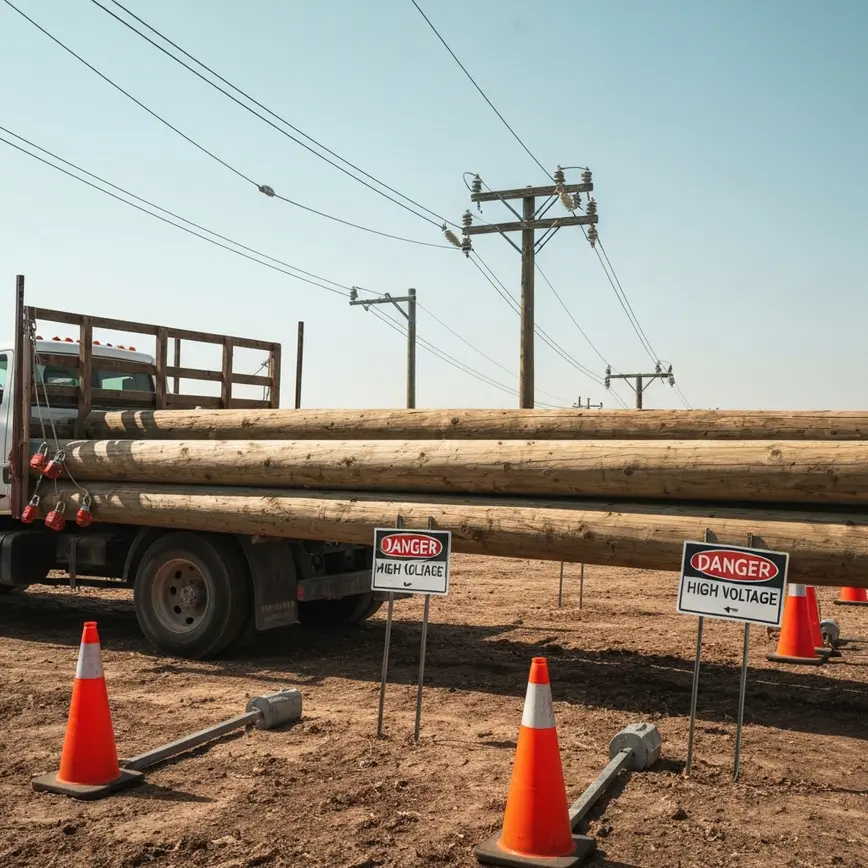
- Inspect all job sites for overhead power lines within 10 feet of work areas; measure and mark minimum approach distances with cones or barriers.
- Verify deenergization procedures and lockout/tagout devices are available and tested for any lines that cannot be distanced.
- Assign and train a designated observer for every task involving pole handling or equipment near energized lines; confirm communication protocols.
- Review and update job briefing templates to mandate sections on overhead power line safety, including site hazards and emergency response.
- Audit insulated tools, rubber goods, and PPE for certification; tag out any expired or damaged items.
Key takeaways
Overhead power line safety is paramount: always deenergize when possible, enforce minimum approach distances religiously, deploy a qualified observer without exception, and make comprehensive job briefings the unbreakable starting point for every shift. The Primoris incident in August 2025—claiming one life and injuring two—proves that neglecting these controls leads to irreversible consequences, OSHA citations, and contested penalties like the $49,650 fine.
Commit today: no work near energized lines starts without these measures. Supervisors, lead by enforcing them; crew, speak up if protocols lapse. This toolbox talk reinforces that proactive overhead power line safety prevents fatalities and keeps us all working safely into 2026 and beyond.
Source & Disclaimer: This toolbox talk is for educational purposes based on public report. Read Original Report