
Meeting details
Date: February 13, 2026
Topic: Recycling Facility Hazards: Lessons from Waukesha Fatal Incident
Goal: This toolbox talk on recycling facility hazards will review the fatal workplace incident at Waukesha Iron & Metal Recycling Facility and prevent similar accidents in 2026.
The incident: what happened?
Recycling facility hazards claimed the life of a 65-year-old truck driver, Joel “Homer” Jundt, who had nearly 40 years of experience at Waukesha Iron & Metal Inc. scrapyard located at 1351 E. Main St., Waukesha, Wisconsin. The incident occurred on a Monday, with the article published on February 13, 2026, implying the event took place around February 9. Emergency personnel arrived at the scene and pronounced the veteran worker dead on site. This tragedy at a third-generation family-owned company, established since 1956, underscores the persistent dangers in such environments despite long-term employee familiarity.
The Waukesha Police Department has launched an investigation into the circumstances surrounding the death, while the Waukesha County Medical Examiner’s Office is conducting an autopsy to determine the exact cause and manner of death. Additionally, OSHA has opened a formal investigation at the facility. The company has pledged full cooperation with authorities and extended condolences to the worker’s family, highlighting the need for heightened vigilance against common recycling facility hazards like machinery operation and material handling risks.
Core safety lesson
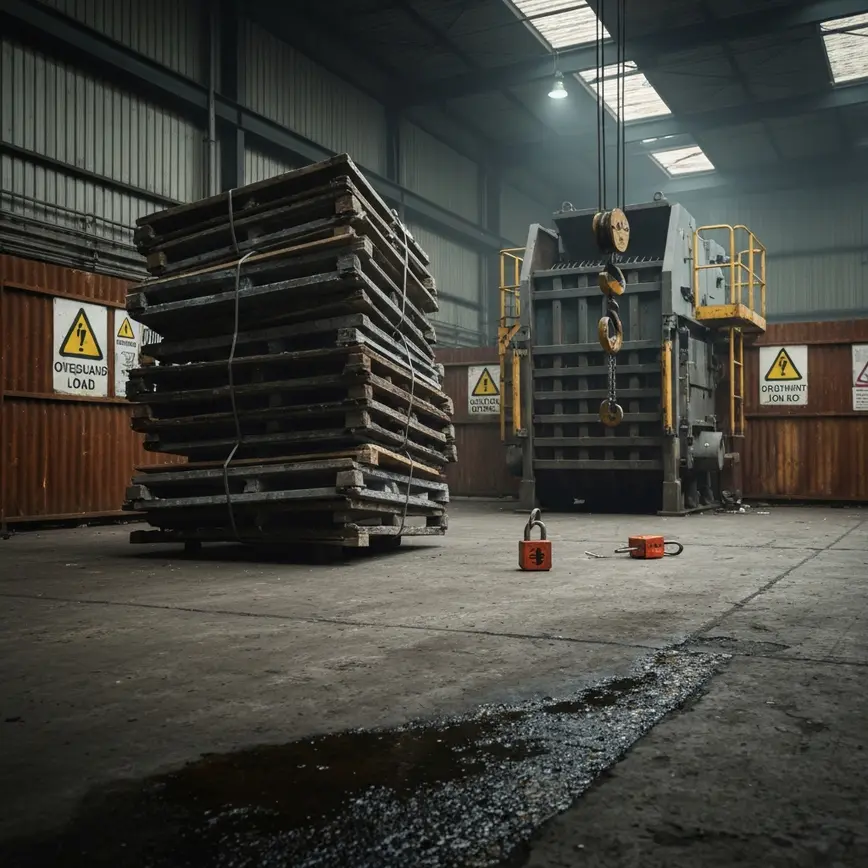
In recycling facilities, incidents like this often stem from uncontrolled machinery or equipment operation, where unintended activation leads to fatal entrapments or crushes. The input analysis points to key recycling facility hazards including machinery/equipment operation, material handling with heavy scrap metal, and confined space or overhead load risks from stacked materials.
The Hazard: Primary recycling facility hazards involve machinery/equipment operation (e.g., trucks, cranes, balers), material handling (shifting or falling scrap), and overhead loads or confined spaces in scrapyards.
The Control: Mandatory lockout/tagout (LOTO) procedures, daily pre-use inspections, operator certification training, PPE enforcement (hard hats, steel-toed boots), guarding around pinch points, spotters or remote operation, job hazard analyses (JHAs), continuous atmospheric monitoring, rescue plans, and physical barriers or proximity alarms.
These controls are non-negotiable because even experienced workers, like the 65-year-old with 40 years on the job, can fall victim to complacency or overlooked failures. LOTO prevents unexpected startups, while JHAs identify site-specific recycling facility hazards before tasks begin. Skipping them invites catastrophe, as seen in this OSHA-investigated case—proper implementation could have maintained safe distances and averted the fatality.
Supervisor’s discussion guide
Engage your crew with these questions to drive home the recycling facility hazards discussed:
- Q1: “Looking at our own equipment today, where is the biggest risk of machinery or material handling hazards?”
- Q2: “Have we conducted JHAs for high-risk tasks like loading scrap metal, and what gaps do we see?”
- Q3: “How can we ensure LOTO is applied every time before maintenance on balers or cranes?”
- Q4: “In our recycling facility hazards context, what PPE is non-negotiable, and why do we sometimes cut corners?”
Action plan & inspection
Immediately after this meeting, conduct these 5 checks:
- Inspect all machinery (trucks, cranes, balers) for daily pre-use conditions and verify LOTO devices are functional.
- Review and update JHAs for material handling and overhead load tasks in the scrapyard.
- Confirm PPE availability and compliance: hard hats, steel-toed boots, and gloves for all crew members.
- Install or check guarding around pinch points and proximity alarms for overhead loads.
- Test atmospheric monitors and rescue plans for any confined space entry risks.
Key takeaways
Recycling facility hazards demand unwavering adherence to controls like LOTO, PPE, and JHAs, regardless of experience—40 years on the job did not protect Joel Jundt from this fatal incident. Supervisors must lead by enforcing inspections and discussions to eliminate risks from machinery, material handling, and overhead loads before they escalate.
Act now: today’s toolbox talk commits us to zero tolerance for shortcuts. Full cooperation with investigations like OSHA’s reinforces that prevention through rigorous controls is the only path to sending everyone home safe in 2026 and beyond.
Source & Disclaimer: This toolbox talk is for educational purposes based on public report. Read Original Report
